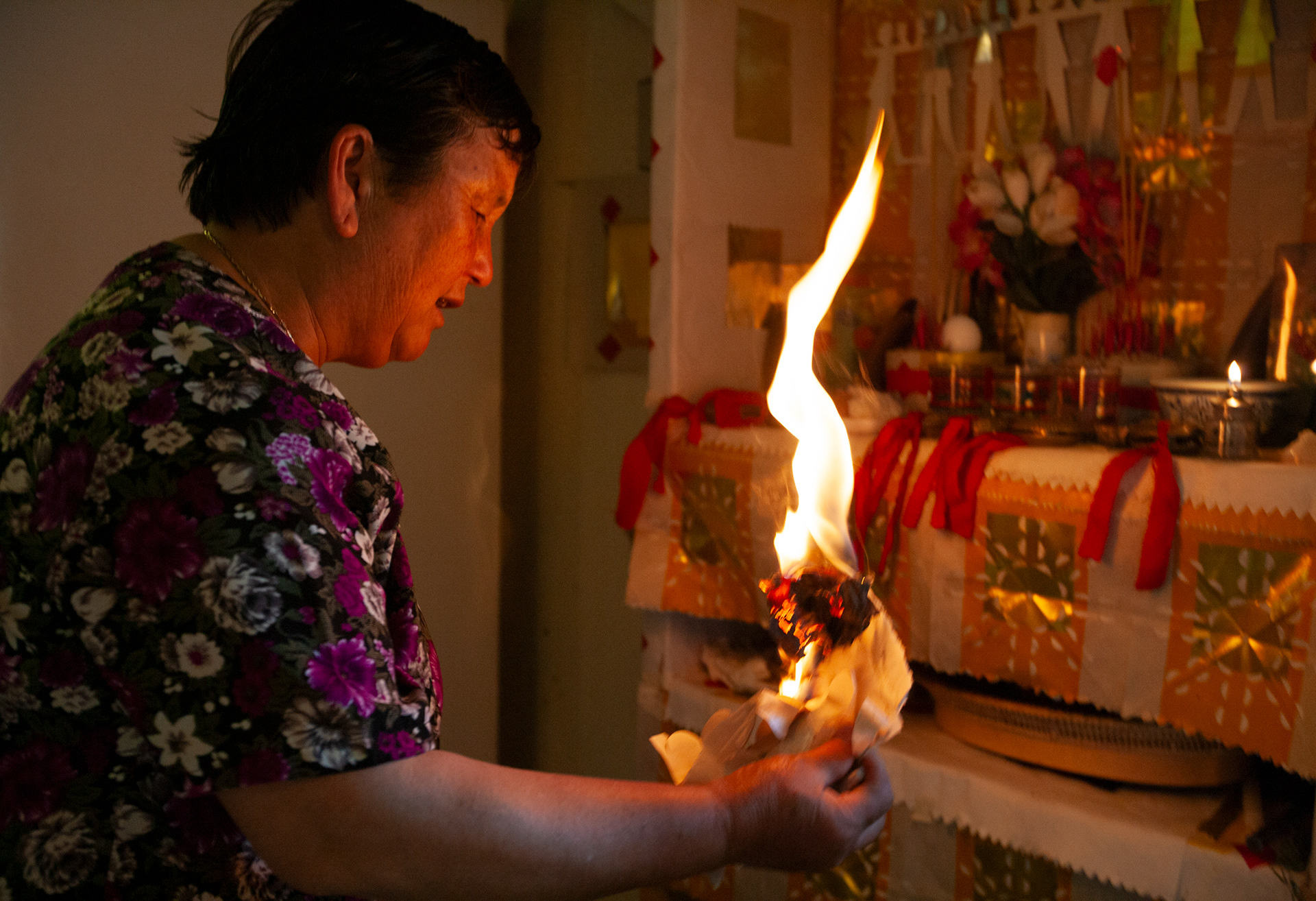
Yer Lor Lee, A Hmong Shaman Tells Her Story
The photographs in this narrative were made between 1962 and 2026.
This gallery introduces Yer Lor Lee, a highly respected Hmong shaman who lives in Fresno, California.
Yer Lor was born in Xieng Khouang Province, Laos in 1946. In 1963, she married Wa Lor Lee, who served in the Royal Lao Army. When Laos fell to the communists in 1975, Lee and her family became refugees, hiding in the jungle for five years while slowly making their way toward the Mekong River. They escaped Laos in 1980 and reached Ban Vinai, a refugee camp in Thailand. Yer Lee and her family emigrated to America in 1981
In addition to her own shamanic practice, Yer Lor Lee has mentored and helped other Hmong Americans to become practicing shamans, earning the title ‘shaman master.’ In 2026, she will celebrate her eightieth birthday.
For Yer Lee, shamanism is a compassionate calling; she considers herself duty-bound to use her skills to protect her family and help her community. Her life story offers an entry point to begin understanding the Hmong animist belief system and cosmology.
Click this link to see a Soul Calling ceremony performed by Yer Lee.
The following oral history is an edited excerpt from the book Soul Calling: A Photographic Journey Through the Hmong Diaspora (©2012 Joel Pickford):
Seated in her living room, surrounded by dozens of framed photos of her family, ancestors, and historic Hmong leaders, Yer Lor Lee revisits the first thirty-three years of her life, leading up to her arrival in America. Now, sixty-one, she is an animated storyteller, gesturing with her arms and occasionally leaping from her chair to act out a particularly dramatic scene. Dressed in black capris and a colorful print top, she wears her hair stylishly short and goes barefoot nearly every day of the year. Her eyes shine with contagious enthusiasm and she laughs frequently, despite the harrowing nature of much of her story. Sometimes, however, she breaks into tears as the terrors she survived come vividly to life in her memory. She often punctuates her narrative with the rising falsetto tones that both Hmong and Lao speakers use to emphasize the extraordinary height, weight, precariousness, or danger of a subject they are describing. When she talks about the war, she produces amazing sound effects. Her vocal imitations of bombs are the best I have ever heard; she is a virtual audio catalog of falling ordinance, skillfully rendering both the trajectory and impact of each type of bomb.
Yer Lor before her marriage, Phonsavan, Laos, ca. 1961-1962
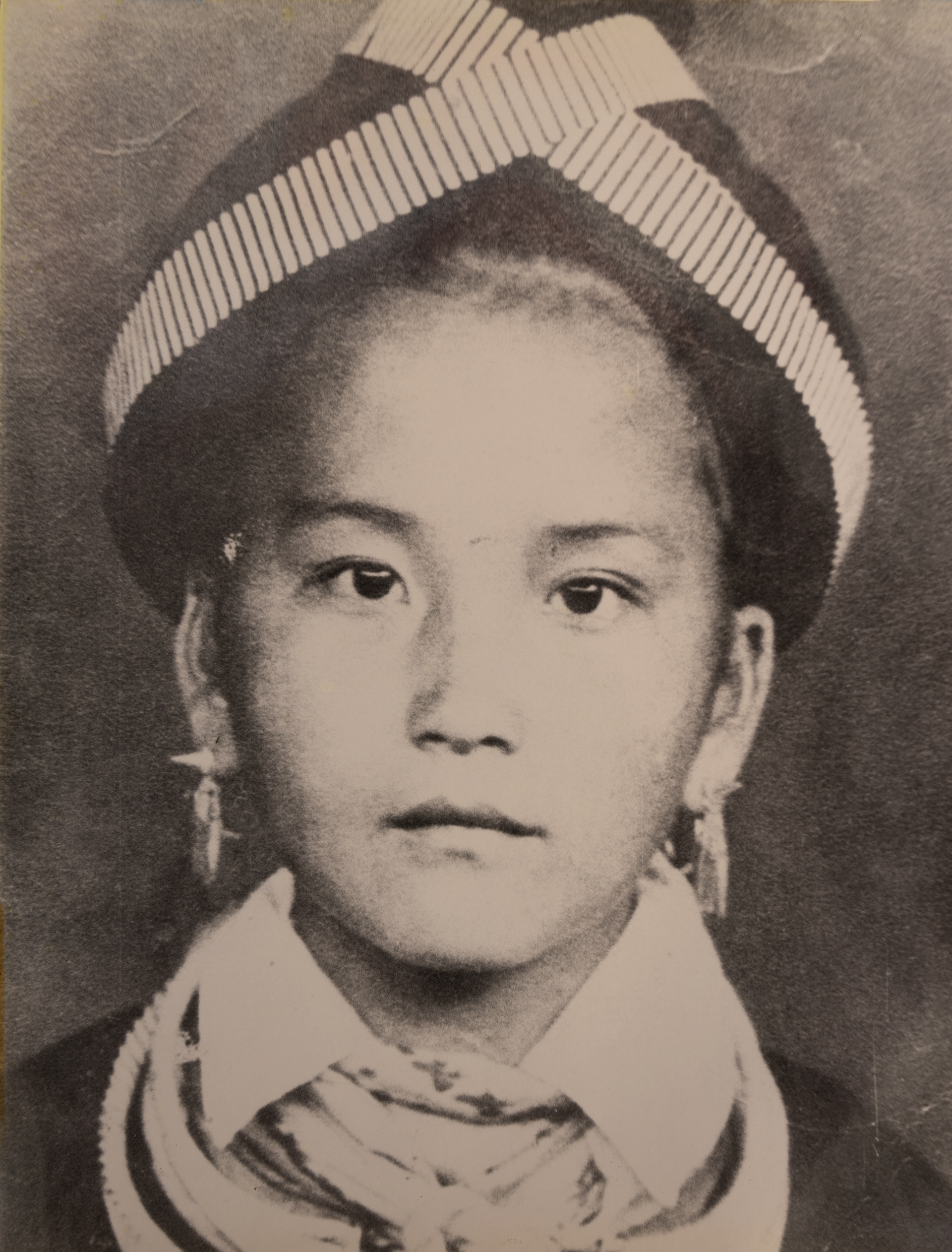
The first thing I can remember is going hunting with my older brother, Za Teng. I was about three or four years old. He gave me a little basket to wear on my back; every time he shot a bird or a squirrel, he would put it in my basket. Za Teng was my favorite brother and I loved him very much. He was like a father to me because my own father had died when I was about a year old. When the war came to Xieng Khouang, Za Teng was one of the first young men from our village to go fight and die.
My father had two wives, nine sons, and eight daughters; I am the youngest. All I can remember about my childhood is work. With our father gone, everyone had to work all of the time. When I was very young—too young to cut and bundle rice for the harvest—they would put a baby on my back and tie me to a tree stump with several other kids so we could not slip and fall down the steep hillsides where the rice grew. I would have to stay there all day and usually ended up falling asleep with the baby.
Without a husband, my mother had to do most of the farming and housework, with only her children to help. Besides that, she was the only shaman for our village of more than a hundred families. Once you become a shaman you have an obligation to help people when they come to you; you cannot refuse them. People came to our door at all hours of the night needing medicinal herbs, massages, or ceremonies. Mother was an expert on medicinal herbs, which not all shamans are, so she also served as the village doctor. She rarely slept more than two or three hours a night.
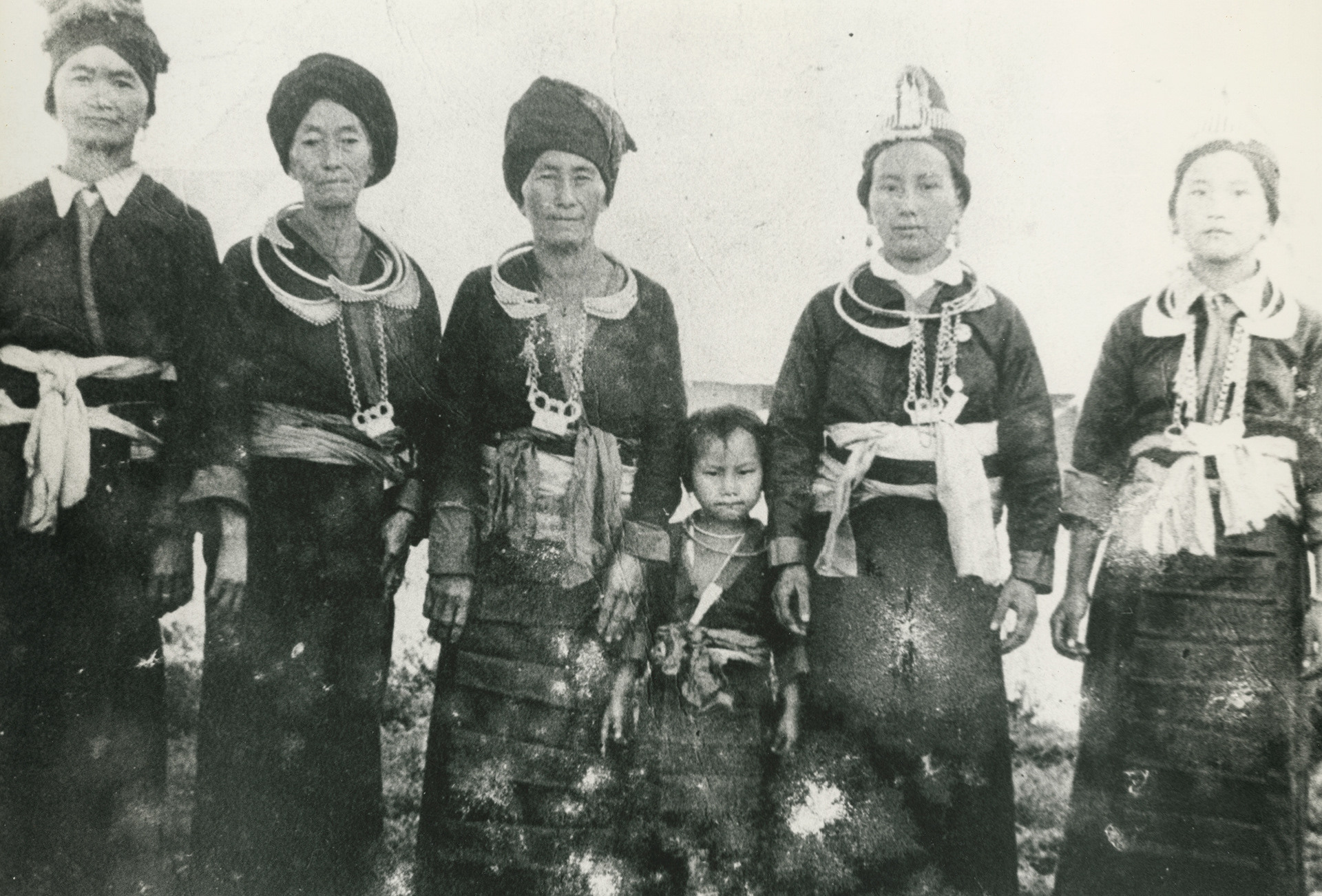
Yer Lor Lee story-02
Left to right: 1) Yer’s aunt, Mai Her; 2) her father’s first wife, Chee Xiong; 3) her father's second wife and her mother, Pa Lee; 4) Yer’s older sister with her young daughter; 6) (far right) Yer Lor, Sam Thong, Laos 1963
I was about eleven or twelve the first time I saw Vang Pao and the Americans. They came to build a base on the hilltop above our village. I remember how beautiful the parachutes looked floating in the sky as the airplanes dropped munitions. Soon after, the bombing started. I learned how to tell if a bomb was going to land close by or far away just by the sound it made. (She demonstrates the difference.) Even now, whenever I hear a loud noise of any kind, I get a sick feeling in my stomach and think about the war. All nine of my brothers had to go and fight, but only three came back. Today, I am very close to all of my siblings; we are more like best friends than brothers and sisters. Most Hmong families are close, but my siblings and I are even closer because of what we went through. We could never have survived without each other.
The war changed everything about our lives. We could not farm anymore and had to rely on American planes and helicopters to drop rice and other supplies. We used to grow a little opium on a plot of land high up in the mountains to sell to the Chinese traders who came every year. It took a whole day to walk up there and we had to sleep over. One night my mother put a dish of water out and in the morning it was frozen. I had never seen ice before! The Chinese traders paid us in silver, which we used to make the beautiful jewelry we wore around our necks. But once the war started, they stopped coming and the soldiers took over our land, so we no longer had any way to earn cash. From then on, we had to move from place to place around the Plain of Jars, following the American rice drops. Every day the bodies of our village men arrived at the airport in Phonsavan. You could hear the weeping for miles.
I was fifteen when I married Wa. He was eighteen. Our marriage was arranged; my clan, the Lors, owed the Lees a daughter because my father, who was a Lor, had married my mother, who was a Lee. So I was chosen by the elders. I was very unhappy because I didn’t like Wa when I first met him. Since he was too small to fight and had been sent home to guard his village, his elders decided that it was time for him to marry. That way he would have a wife to help him look after the village, which was a very small one with only six families. Just before the wedding, we had photos taken at a little studio in Sam Thong.
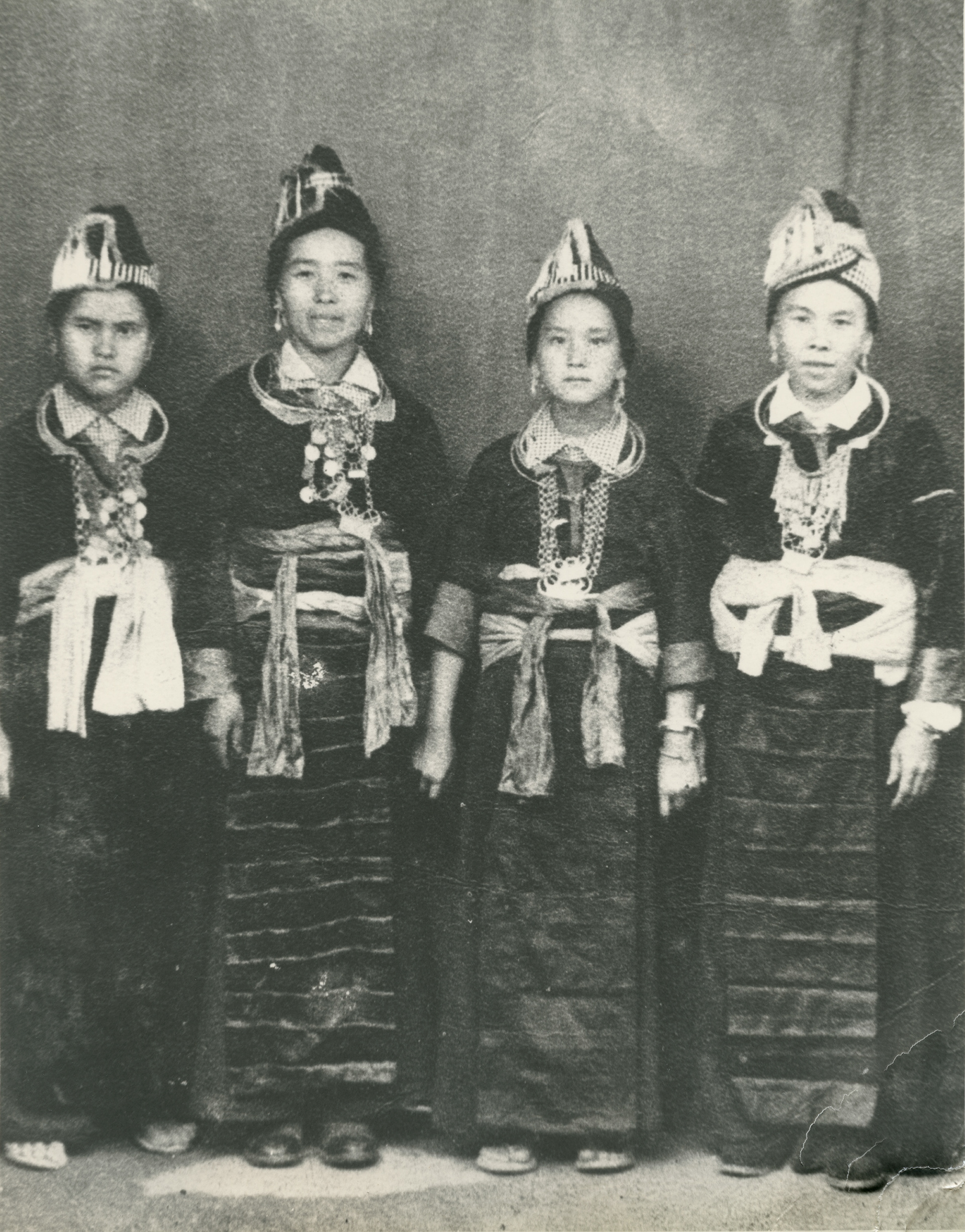
Yer Lor Lee story-03
Yer Lor is third from left in the photo taken for her wedding. Left to right: 1) Yer’s niece, Xia Lor; 2) wife of Yer’s oldest brother, Mee Xiong; 3) Yer Lor; 4) wife of Yer’s second oldest brother, Sam Thong, Laos 1963
After we were married, I went to live in Wa’s village for two years. I was miserable at first and thought about running away, but I knew that my family would only send me back. Wa’s family was very poor— poorer than mine—and life in that village was very hard. I decided that I would work hard to pull the family up and, in a short time, I did. Soon our first daughter, Lo, was born. Shortly afterward, Wa left for Long Cheng to be trained as a military policeman. Two months later we all moved to a village near Sam Thong Airport, where Wa was stationed. For three years Sam Thong was relatively peaceful and we were able to settle down and begin raising our own family. My sons, Xeng and Xue (David) were born there.
Even though our marriage was arranged and even though I was against it at first, I learned to accept Wa as my husband and to love him. He is a good husband and has never taken a second wife, like many Hmong men did back then and some still do today.
The peace in Sam Thong did not last. When the fighting came too close to our village for comfort, everyone packed up to move, as we had done so many times before. As we headed along the trail toward what we hoped would be our next home, a small band of Pathet Lao soldiers ambushed us and started shooting. I ran as fast as I could but fell behind. Suddenly, my right hand was on fire; a second later the same fire exploded in my left leg and I fell. Pain filled my entire body as I lay in the dust, looking up at the sky and gasping for breath. It seemed like a long time passed before some men picked me up and carried me to a clearing, and then to the small medical clinic at Sam Thong Airport. I was operated on by a Filipino surgeon who had been hired by the Americans to take bullets out of their pilots. I limped around for almost two years before I could walk normally again. Even now, when the weather changes I still feel the pain.
As long as I live, I will never forget the day General Vang Pao left the country. People ran like the four rivers. Our village was total chaos. You’d see a Hmong family running along a path, carrying everything they had on their backs, and a short while later you would see another family running along the same path in the opposite direction. No one knew where to go or what to do next. Rumors swirled about the location of the Vietnamese soldiers, but no one really knew how far away they were. We only knew they were coming to kill us.
We decided to leave the village and hide in the jungle. I was still carrying Hli (Kristie) on my back; she was only a few weeks old. There were many loose bands of Hmong soldiers roaming the mountains with their families, hoping that General Vang Pao would come back and continue fighting. We heard about a massacre south of Vang Vieng at Hin Heup Bridge. Thousands of Hmong with no place else to go had gathered there and were trying to cross the bridge so they could continue south along the main road to Vientiane. Suddenly the Pathet Lao soldiers opened fire with mortars and rifles, killing some of the refugees and scattering the rest into the countryside. Wa’s brother, Neng Thao, was there and made it back to tell us the story.
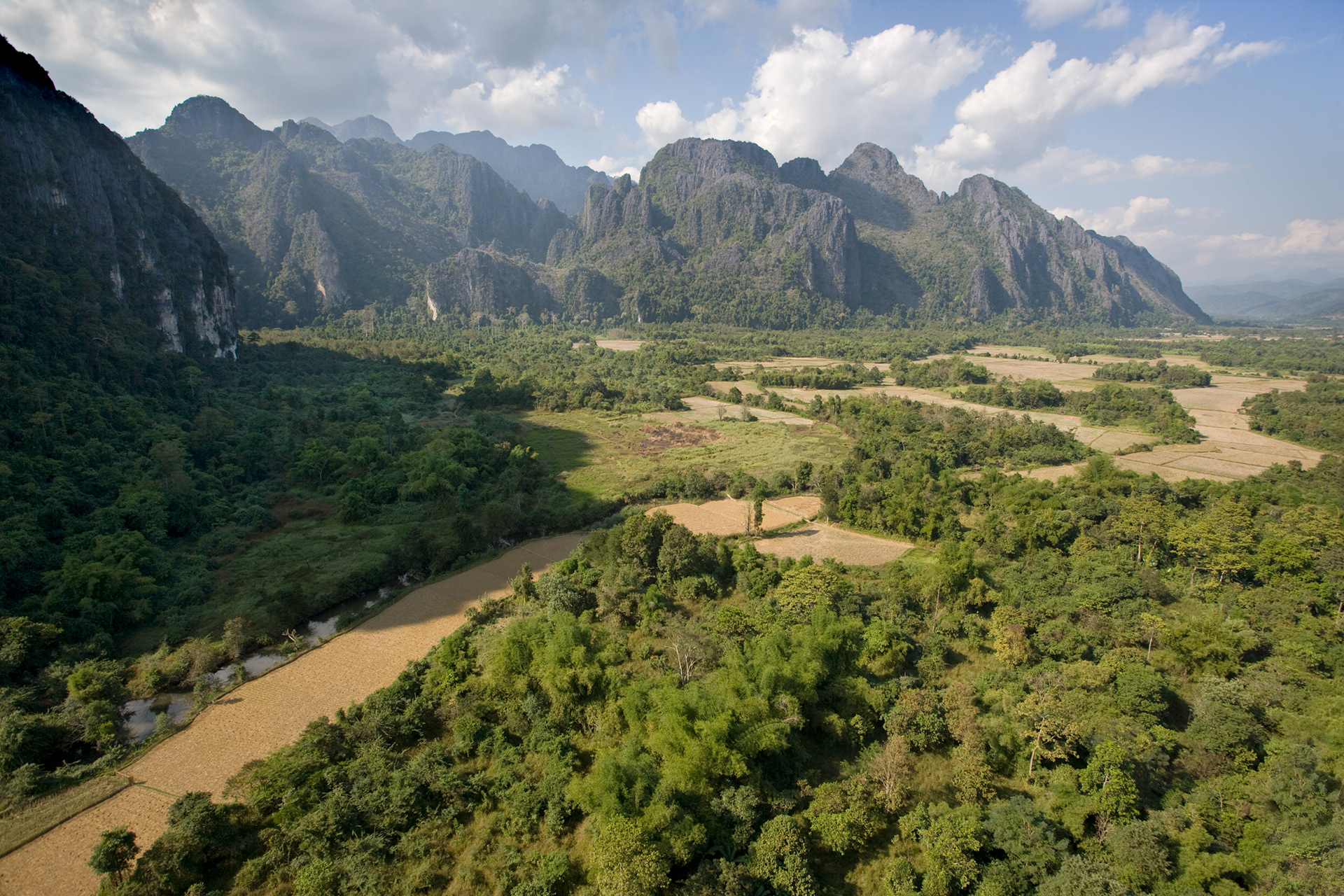
For the next few months we moved from place to place, mostly hiding in the jungle. After the Hin Heup massacre, we knew that we had to stay off of the main roads. Our group consisted of twenty-four families from the Lee and Xiong clans, who were all related by marriage. We decided to work our way west through the mountains, toward the big valley north of Vang Vieng. The Pathet Lao had already cleared most of the Hmong population out of that area, so we were able to settle in an abandoned village with good land high in the mountains above the river. The village was situated far from the town of Vang Vieng, in a place so difficult to reach that the soldiers would be unlikely to find us. We lived peacefully there for about a year and a half.
Yer Lor Lee story-04
The valley north of Vang Vieng, where Yer’s family hid in the jungle during the late 1970s and later occupied an abandoned Hmong village. Photo: December 11, 2006
My fifth daughter, Yang, was born in the hottest month of the dry season. I had always been sick for a few days after each of my children was born—my arms and legs would become stiff and I would go into a kind of trance—but Yang’s birth was different. I became far sicker than usual and stayed sick for almost a year. I was weak and delirious from almost constant fever. I suffered memory loss. Sometimes I had hiccups for days on end and could not eat. For a long time I could not even get up. Everyone thought I would die. When the rainy season finally came, it was the wettest one I can remember. It rained hard every day. Sometimes I would black out for hours at a time, then wake up to the sound of endless rain.
Finally, my family found a shaman who came to the house and performed a ua neeb ceremony for me. I lay on the ground because I was too weak to sit on the bench in front of the altar. When I heard the sound of the shaman’s gong, I began to shake violently. The shaking became stronger and stronger, worse than any fever. Flashes of lightning lit up the room. I could hear loud claps of thunder and rain pounding the leaky thatch roof above me. Sometimes a droplet of rainwater would fall on me, cooling my burning face. I tried to focus my mind on the steady beat of the gong. As soon I started to shake, the shaman knew that a spirit had entered my body and that I was going to become a shaman myself. The shamanic spirit passes from generation to generation, looking for the right person. When it finds that person it will not let go until he or she becomes a shaman. I believe my mother’s spirit passed to me that day.
The shaman told Wa and my cousin to help me up off the ground and onto the bench. As they did, the shaking became so strong that the two men could barely hold me. All of a sudden I started chanting; I didn’t understand any of it, but it just kept coming out of me. I chanted for a long time and gradually stopped shaking. After the ceremony I recovered quickly. I started eating and soon became strong again.
The shaman who cured me became my mentor. He taught me about the spirit realm and showed me how to use the gong, saber, spirit rattle, split buffalo horns, dagger, finger bells, spirit money, eggs, rice, and other food offerings to negotiate with the dab for the return of a sick person’s soul. It was an awkward situation, though, because the shaman was a man. In our culture, if a married woman has any dealings with a man outside of her family, she must always go through her husband, who will then take care of the matter for her. She is not normally allowed to spend time with an unrelated man the way I did with that shaman. Since there was no female shaman in the village who could teach me, my family understood and accepted the situation.
People in the village soon began coming to see me about their problems and ailments, just like they do today. I remember one man who came to me because he had not been able to pee for several days. I asked him if he had put a nail in his altar recently. He said, “Yes, how did you know?” I told him that was the cause of his problem and sent him home to remove the nail. As soon as he pulled it out, he wet his pants! The altar has a soul—your soul. It is part of you, so when you put a nail in the altar it is like putting a nail in yourself.
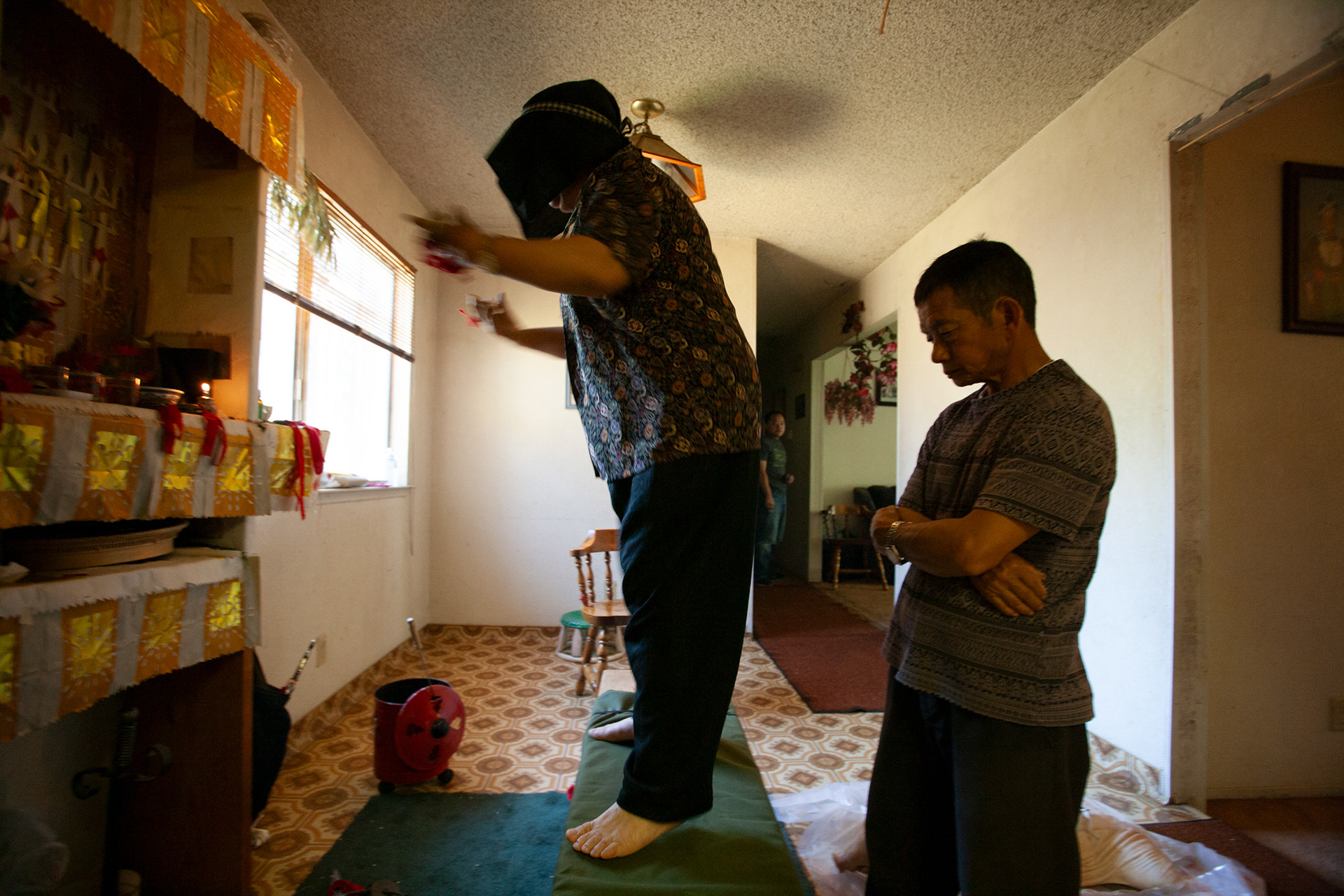
When I go into a ua neeb or spirit trance, I cover my face with a cloth, so that my spirit mentor can instruct me in the proper nkauj neej, or ritual chants. If you remove the cloth, you won’t be able to speak the language of the spirits, so you must keep it in place until the ua neeb is finished. There are two different types of shamans, those who wear a red cloth and those who wear a black one, as I do. Shamans who wear a red cloth keep the lightning guardian spirit, Xob, on their altar at all times and must therefore call upon him for every ceremony. Those who wear a black cloth only call upon Xob as a last resort, when negotiations with the dab have failed. The lightning guardian spirit is very powerful but can also be dangerous and unpredictable.
If there is a spirit in my presence when I enter the trance, I will see it right away. A spirit looks just like a human being. Sometimes there are more than one. When there are many spirits, the ceremony will be more difficult and take longer. If there are no spirits present, the ceremony will be finished quickly, but the patient’s condition will not improve. During the ceremony there is a lot of conversing back and forth between the shaman and the spirits. The shaman relays the information back to the real world and then converses with the spirits again. That is why you hear so much talk mixed in with the chanting. There are many matters to be discussed; sometimes the ancestors bring up things that happened a long time ago and must be settled before the soul can be returned to its owner.
Yer Lor Lee story-05
Yer Lor Lee performing a Ua Neeb or spirit trance ceremony, May 19, 2005
One full-moon night my children were out playing when two young men who had been assigned to guard the footpath to the village began to yell: “The Viet soldiers are coming!” These two were normally very quiet, so no one believed them at first until several gunshots rang out. We grabbed only the barest necessities and headed up the mountainside, where the thickest jungle lay. That night we lost some relatives who were not able to escape. For several days we moved through the jungle with the other survivors, wondering what to do next. The Vietnamese soldiers had us completely surrounded. The men had a meeting and discussed our options. If we surrendered as a group, the men and older boys would all be killed. If the women and smaller children surrendered, the men might be able to escape but would probably never see their families again.
After the men came back from the meeting everyone in our group began to cry uncontrollably. It seemed like there was really no way out. Some families decided to surrender, but my husband would never go along with such a plan. So we decided to leave the group and try to escape by ourselves. We met some Hmong people from Luang Prabang Province who hadn’t fought in the war but still had to flee the communists and get out of the country. They decided to surrender, hoping for better treatment because their men had never been soldiers. They invited us to surrender with them, so my husband told them to go ahead, that we would follow after we rested a bit. Once they surrendered, the soldiers left, thinking they had captured all of the Hmong in the area, and we were able to move on.
The month that followed was the worst of our lives. We hid in the jungle northwest of Vang Vieng and foraged for food. The jungle in that area is so dense and tangled that almost no one lives there. We had only enough rice to cook one very small pot each morning. Each person got a handful and that was all we had to eat for the whole day. You never really know how good rice tastes until you have so little. The soldiers were constantly patrolling the area, so we had to be very quiet. My baby, Yang, cried a lot because I was not making enough milk and she was hungry. Her crying put everyone else at risk, so my husband dug a hole about eight feet deep; I would sit at the bottom of that hole with my baby to muffle the sound of her crying, so that the soldiers could not hear it. Sometimes I would have to sit down there in the dark for hours on end, breathing in the cold, dank smell of earth while the baby just cried and cried.
Finally our rice ran out. Everyone was hungry and there was nothing to eat anywhere in sight. Wa and Xue went out foraging all morning and came back in the afternoon with only a single small tuber that they had managed to dig up. It wouldn’t even provide a mouthful for each person. Rain began to fall, softly at first, and then harder. I felt an anger well up in me just like I did when I first went to stay in my husband’s village and saw how poorly everyone lived there. Somehow that anger, mixed with hunger, gave me the strength to go out and forage for food on my own. I wouldn’t let anyone come with me. I moved quickly through the forest, barely caring if the soldiers heard me or not. I started digging near a large tree and found some fat, white tubers growing amongst its roots (arrowroot). I kept digging and soon had a basketful; they tasted like starchy yams if they were boiled long enough. We survived on them for the next few weeks.
The Vietnamese soldiers set up a base camp in our former village and began sending pro-communist Hmong every day to try to persuade us to surrender. Meanwhile they fired mortars and grenade launchers at us all night long. Some of them landed dangerously close. We lived in constant terror of being killed or captured at any moment. One night we heard the sounds of approaching footsteps and cracking branches. It was pitch dark and we had nowhere to run. As the sounds drew nearer I felt sick to my stomach. Everyone was sure we were going to die. Suddenly a man stepped into the clearing and we all let out a huge sigh of relief; it was only my brother-in-law, Lor Pao, who had come looking for us.
Lor Pao said it was safe to travel now and led us back to join the surviving members of our group, who had more food than we did. The men had a meeting and decided that we could not stay near Vang Vieng any longer. The time had come to begin moving south, toward the Mekong River and Thailand. But the journey might be dangerous, so we killed and boiled some chickens, then looked at their feet: the claws curled very nicely without crossing over one another, a sign that it was a good time to go. The journey would take about three months.
Along the way, we had to pass many villages. There were Lao, Hmong, Khmu, and other hill tribe people living in the area; many of these villagers had been neutral during the war, while others supported one side or the other. As we moved along through the hills and jungles, we had no way to know the difference, so we had to stay hidden by day and travel by night. Whenever we neared a village, we had to count on our luck. One day our luck ran out. Some men from our group went to buy a couple of pigs from a Hmong village and brought them back to be cooked. They didn’t know that the Hmong people who sold them the pigs were helping the communists. Soon the Vietnamese soldiers came and captured most of our group. They took us back to the village and left us in the custody of their Hmong collaborators.
Even though we were now prisoners of war, we considered ourselves fortunate that we were being held in a Hmong village. We knew that the soldiers would not kill, rape, or torture any of us in the presence of other Hmong, because they needed the villagers’ loyalty. The pro-communist Hmong treated us like low-class people and made us work like servants, but they also gave us shelter and enough to eat. However, we knew that sooner or later the soldiers would come back and take our men away to the seminar camps.
One day while my husband was out gathering bamboo, he met a man in the forest who asked if he was one of the “new people.” Wa told him our story. The man said that some Hmong men would soon come from Thailand to rescue us. “Just act normal, follow orders, and don’t try to run away from the village,” he said. Wa pretended to start building a house so that the villagers would think we were planning to stay a long time. Meanwhile, I was put to work pounding rice. Pounding rice is boring and time-consuming, but I know how to do it fast, so many families hired me. Each family would give me a little rice after I finished pounding their crop. I worked very hard and, in one month, managed to accumulate a large sack of rice.
One day, four men came to rescue us just as the man in the forest had promised. They were dressed like soldiers and carried guns. They went straight to the village chief and told him that their troops had the village surrounded. Since Hmong New Year was about to begin, they promised the chief that no one would be harmed as long as our group was allowed to leave peacefully. However, if the chief refused to let us go, the troops would burn every house in the village. Of course it was all a lie, but the chief believed it. That day we walked out of the village with our rescuers, who helped guide us on the journey toward the river. But their service was not free; as our share of the payment, my husband and I had to give them all of the silver we had left.
Some people in our group told my husband to leave his aged mother behind in the village, but he refused to listen. Many of them had already abandoned their elderly parents and grandparents along the way, but Wa had always helped his mother along the trail himself when no one else would. Now he refused to leave her behind once again, and he also refused to leave the sack of rice that I had worked so hard to earn. I will never forget the sight of him carrying that big sack of rice on his back with Kristie on top of it and his old mother leaning on one arm. I carried most of our dry goods on my back and held Yang in my arms. Song, Xue, Xeng, and Lo carried baskets on their backs. My husband was the slowest one in our group.
By now there were so many Hmong families trying to get out of the country that the trails were full. We saw the same people day after day and our kids became friends with their kids. Sometimes their playmates died along the way, a fact of life they had already gotten used to. When we got separated from each other, we used a relay system to send messages from person to person along the trail, as all refugee families did. Even though Xue and Xeng were small for their ages—nine and eleven years old—they walked faster than the rest of us. One time they got so far ahead we didn’t see them for a couple of days. I knew they would be all right; by now they were practically adults and could take care of themselves. My kids had no choice but to grow up fast.
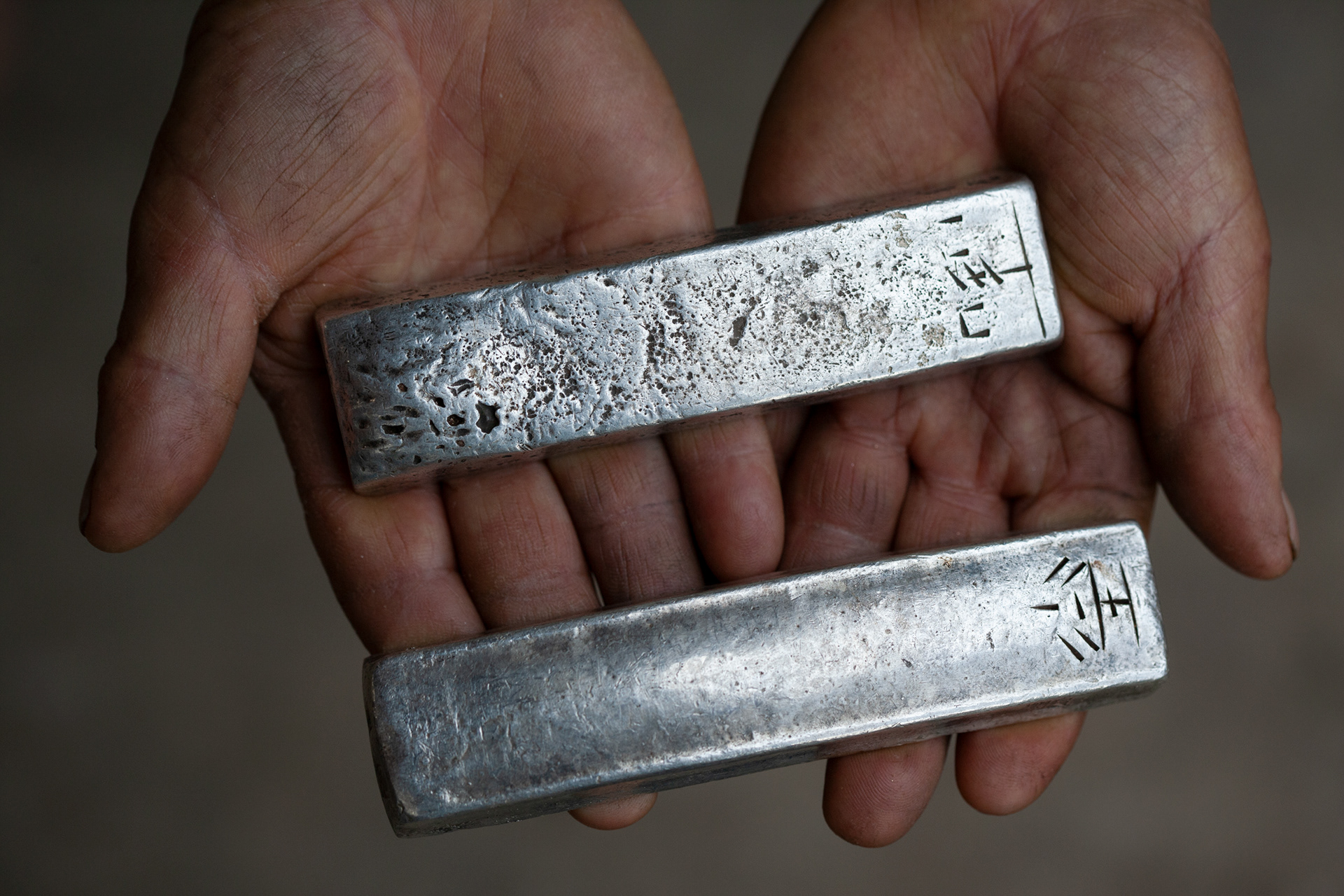
When we finally reached the Mekong, there were dozens of families waiting to cross over to Thailand, and dozens more arriving every day. The Thai boatmen made a very good business for themselves; they were charging one hundred fifty dollars in cash or one bar of silver for each boatload of people they carried across the river. Since we had no money or silver left, my husband went around asking all of the other families in our group if they could loan us a bar of silver. One after another, they turned us down, saying that they only had enough to pay for their own passage. Finally, my brother-in-law agreed to loan us some old French silver coins, which we would have to repay in Thailand. If we could not repay the loan, he would take our fourteen-year-old daughter, Lo, as a bride for his son. We had no choice but to accept.
We tried to hire a boatman to take us across the river, but they all told us that our coins were not enough. Then a widowed woman who was traveling by herself offered to loan us a bar of silver on the following terms: she would give us four bars of silver to carry across for her; we would use one bar to pay for the boat and give her back the other three bars when we got to the refugee camp. If the remaining silver was lost or stolen, we would have to repay her for all of it.
Yer Lor Lee story-05
Silver bars called "Chao" used by Chinese traders before the war to buy opium from Hmong villagers. After the war, the Hmong became refugees in their own country and had to use their silver to pay for safe passages. Photo: March 10, 2007.
That night all of us managed to squeeze aboard the long, narrow boat. It was very dark out and I felt scared because I had never seen such a big river before. That type of boat tips easily, so you must keep very still. The trip seemed short—only about ten minutes; when we got out and walked across the sand, we discovered that the boatman had dropped us off on an island in the middle of the river. Everyone panicked. We knew that as soon as the sun came up the Pathet Lao soldiers would shoot us and we would have nowhere to run. Everyone began to cry. When the boatman came back, he told us that we would have to pay more money if we wanted to go all the way to Thailand. One of the men who had rescued us from the pro-communist village was on the boat and began to argue loudly with the boatman in Thai. He was very angry because they had already done a lot of business together. He reminded the boatman that they had drunk chicken blood together and tied baci strings around each other’s wrists when they made the original deal. The boatman hesitated for a moment, then agreed to honor his promise. Even though Thai people follow the Buddha, they also believe in spirits.
As soon as we got off the boat on the other side of the river, the Thai soldiers were already waiting for us. They lined us up on the beach and pointed their guns at us. Next, they searched us, dumped our baskets out in the sand, and took everything valuable they could find. Many people started to cry as they lost the beautiful silver neck pieces their ancestors had given them. Now my husband and I could see who had lied and who had told the truth when we asked the other families to loan us money. Meanwhile, I had carefully hidden our three remaining silver bars at the bottom of my seven-year-old daughter’s basket; when Song saw the soldiers coming, she casually dropped the basket on the ground, just as I had told her to do. People who clung tightly to their baskets got searched and lost everything. As the soldiers walked past us, they ignored Song because she was only a child—except for one soldier, who paused and gave her little basket a nudge with the toe of his boot. When only a few worn utensils and some old, dry sticky rice fell out, he moved on.
The next morning the Thai police arrived with several trucks to take us to the camp. But first they lined us up and robbed us, just as the soldiers had. They got very angry when they learned that the soldiers had already come the night before and taken almost everything of value, so they didn’t waste much time looking for more. Nevertheless, one policeman pawed through my basket and took all of my shamanic tools: buffalo horns, gong, finger bells, rattle, and even my black cloth. The shaman in Vang Vieng Valley had warned me that if I ever lost any of these things, someone in my family would get sick.
The ride to Ban Vinai refugee camp was long, hot, and uncomfortable; we were packed like cattle into a large military transport truck and had to stand up the whole way. The entire camp was surrounded with a tall barbed-wire fence. Instead of taking us to the central area, where the markets were, the drivers dropped us off on the outskirts of the camp near the open latrines. The smell was awful! We had to camp there for a week before we were finally able to move in with our cousins, where our whole family lived in a room the size of a small American bedroom. We felt so embarrassed about the way we looked; our cousins wore clean, Western-style clothes while we still wore traditional Hmong village clothes that, by then, were completely in tatters.
In spite of these hardships, we were very happy to be in Ban Vinai. For the first time in many years, we felt safe. The Thai police treated us much better in the presence of the international aid workers than they had outside of the camp. We found relatives we had not seen in years. My brother-in-law in Minnesota wired us money to repay our loans and cover a few other expenses. Our life seemed to be improving, and then my youngest daughter, Yang, got sick with diarrhea and a high fever. Without my shamanic tools, I could not perform a ceremony for her, nor could I find the herbs I needed to treat her in the camp. Her condition grew worse for three weeks. Then one hot afternoon she went to sleep and never woke up. I was heartbroken; it seemed so cruel that I had carried her all that way and protected her from so many dangers only to lose her now. We had a small funeral at Neng Thao’s house and buried Yang in the cemetery at the edge of the camp, beneath the barbed-wire fence. Two years later, they bulldozed the cemetery to make room for more refugee houses
Yer Lor Lee story-07
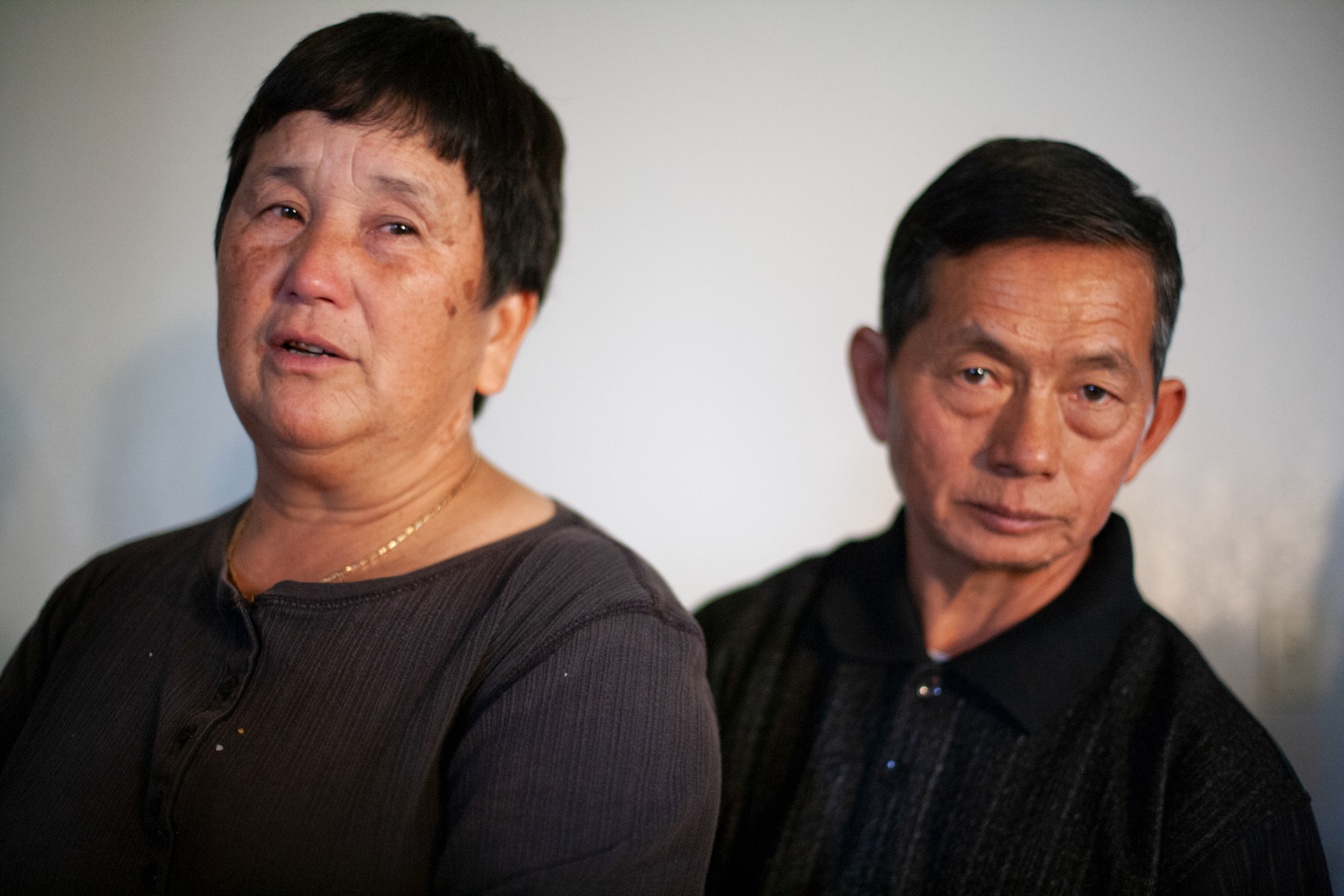
Yer and her husband, Wa remembering traumatic events of their flight from Laos to a refugee camp in Thailand. Photo: November 19, 2005
After Yang died, we began to see that life in Ban Vinai was not as good as we thought at first. Because of the overcrowding, hot weather and unsanitary conditions, many people were sick all the time. Moreover, it was not safe to leave the camp for any reason; people who did were regularly beaten up and robbed. The food that aid workers brought us was often stale or rotten because they collected it from local Thai markets after it had gone unsold for several days. I remember getting awful, smelly seafood every week and trying to cook it with lots of peppers to cover up the bad taste.
My husband and I finally decided to apply for refugee status so we could go to America. But it was not an easy decision. All we knew about the United States were the stories we heard every day around the camp. Some people said that Americans, who we called nyav, liked to cook Hmong people and eat them. Others told us that the sun was much closer to the earth in the United States and people were often burned to death if they went outside during the daytime.
After we completed the paperwork, it took us four months to get an interview. There was a long line that day and we had just ten minutes to convince the case worker that my husband had really served in the war. The only proof we had was our wedding photo showing Wa in his Royal Lao Army uniform; somehow we had managed to hang on to it through twelve years of war and five more years of hiding in the jungle. It was just a tiny black-and-white photo, faded and wrinkled, but now it was our ticket to freedom. When the day arrived for us to board the bus to the Bangkok airport, we were all given big, heavy coats. We could not imagine why.
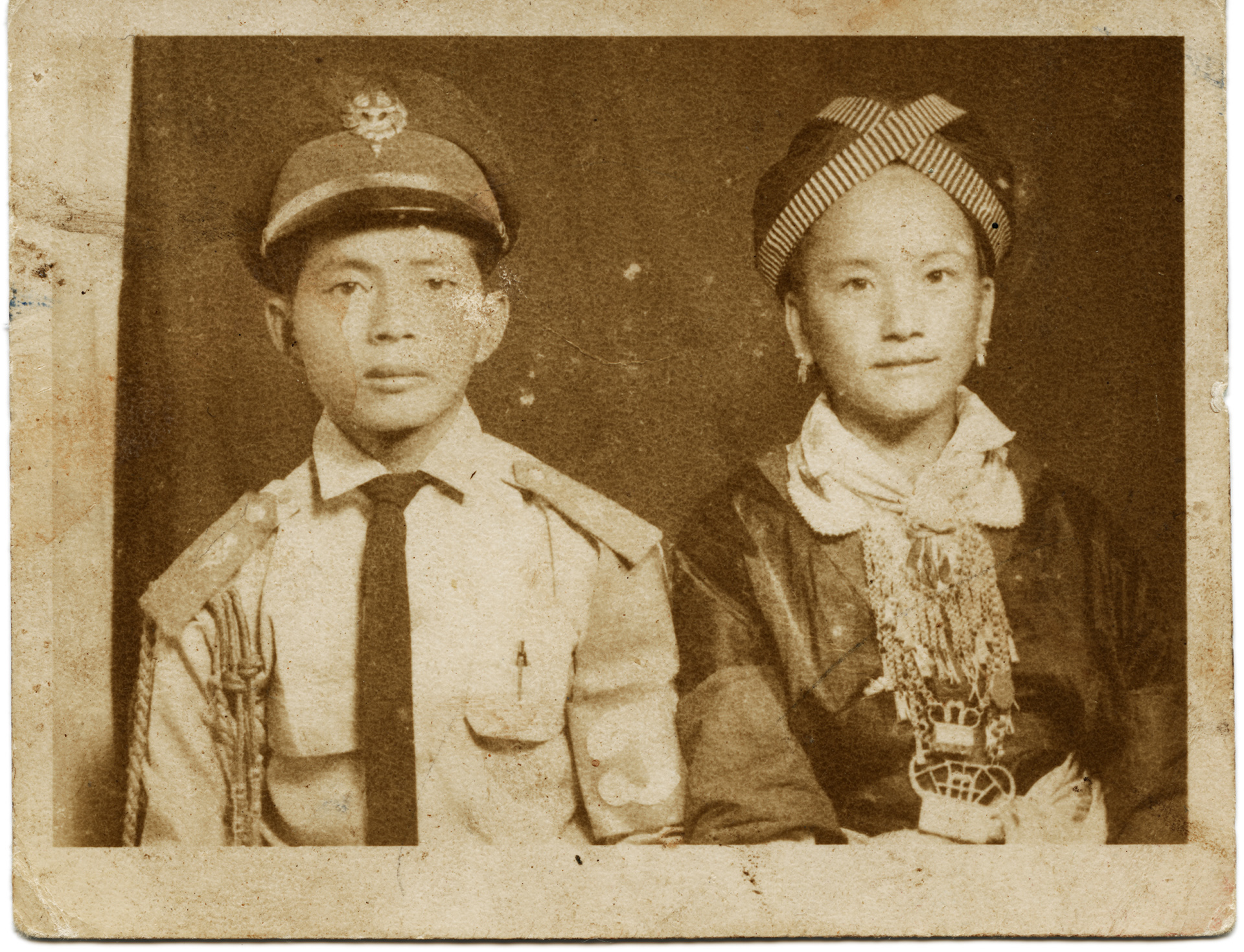
Yer Lor Lee story-08
Wedding portrait of Wa Lor Lee and Yer Lor Lee taken in Sam Thong, Laos in 1963.
This is the original 4”x 5” print that served as proof of Wa's military service and enabled the family to emigrate to the United States as refugees.
It seemed like we had been on the airplane for days when we finally landed in St. Paul. It was dark out and unbelievably cold. The ground was covered with white as far as we could see in every direction. My kids got into an argument about whether the white stuff was salt or sugar and ran outside the airport to have a closer look. They scooped up handfuls of the mysterious substance and tasted it, even though I had told them not to. The sponsors picked us up and drove us to our new home in a big apartment complex. When we woke up the next morning and looked out the window, the ground was still covered with white and there were no people anywhere.
Later that day, an older American man and his wife who lived in the apartment next door brought us warm food and an old TV set. They liked our kids and tried to help them learn English by pointing at different things and saying the English words. They were poor people like us, but they shared what they had and I will always remember their kindness. Not everyone was so kind, though. Many times during our early years in Minnesota, people would come up to us and say, “You don’t belong here; why don’t you go back to your country?”
It was unbelievably cold that winter, so we just stayed inside for the first three months. It was hard to believe that anyone would build a city in such a cold place. When we looked out the window we hardly ever saw anyone. Gradually, the snow melted and people started coming out. Summer arrived with its amazingly long days and we planted a garden. One evening we were out weeding and picking vegetables when we heard gunfire. I grabbed all of the kids and herded them inside as fast as I could. The gunfire continued for half an hour and then the bombing started. I made all of the kids stay down on the floor. I was so scared I felt sick to my stomach. The fighting went on for hours and finally died down after midnight. The next morning everything seemed normal outside, as if nothing had happened. Nobody had told us about the Fourth of July.
To this day, I still have nightmares about the war and hiding in the jungle. When my kids ask me to go camping with them, I can’t bring myself to go because it makes me think of that time. I will carry these memories with me until the day I die. Nothing will ever make them go away. Not the car or the house or the food or the sofa. We did not come to this country because it is a rich country. We did not even want to come; we had no choice but to come here or spend the rest of our lives in the refugee camp. We were not wanted anywhere. I am happy that my children and grandchildren will have a better life than I did. But I am also worried that so many young Hmong today do not respect their elders and are not learning Hmong language and culture. They think that wisdom is how well you speak English, but I believe that wisdom comes from experience. My greatest fear is that our culture will disappear and our families will fall apart.
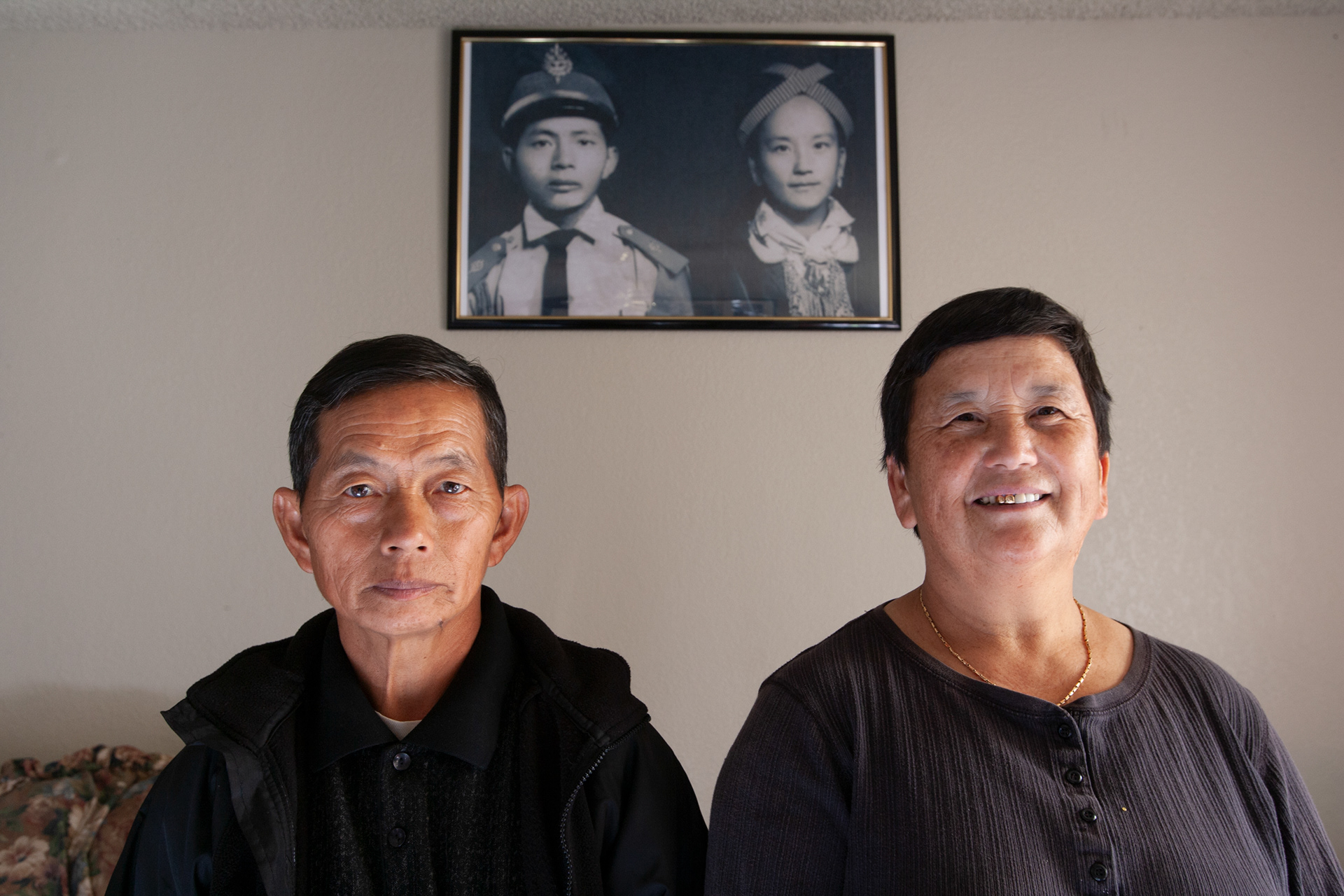
Yer Lor Lee story-09
Wa and Yer seated in their living room, November 18, 2005
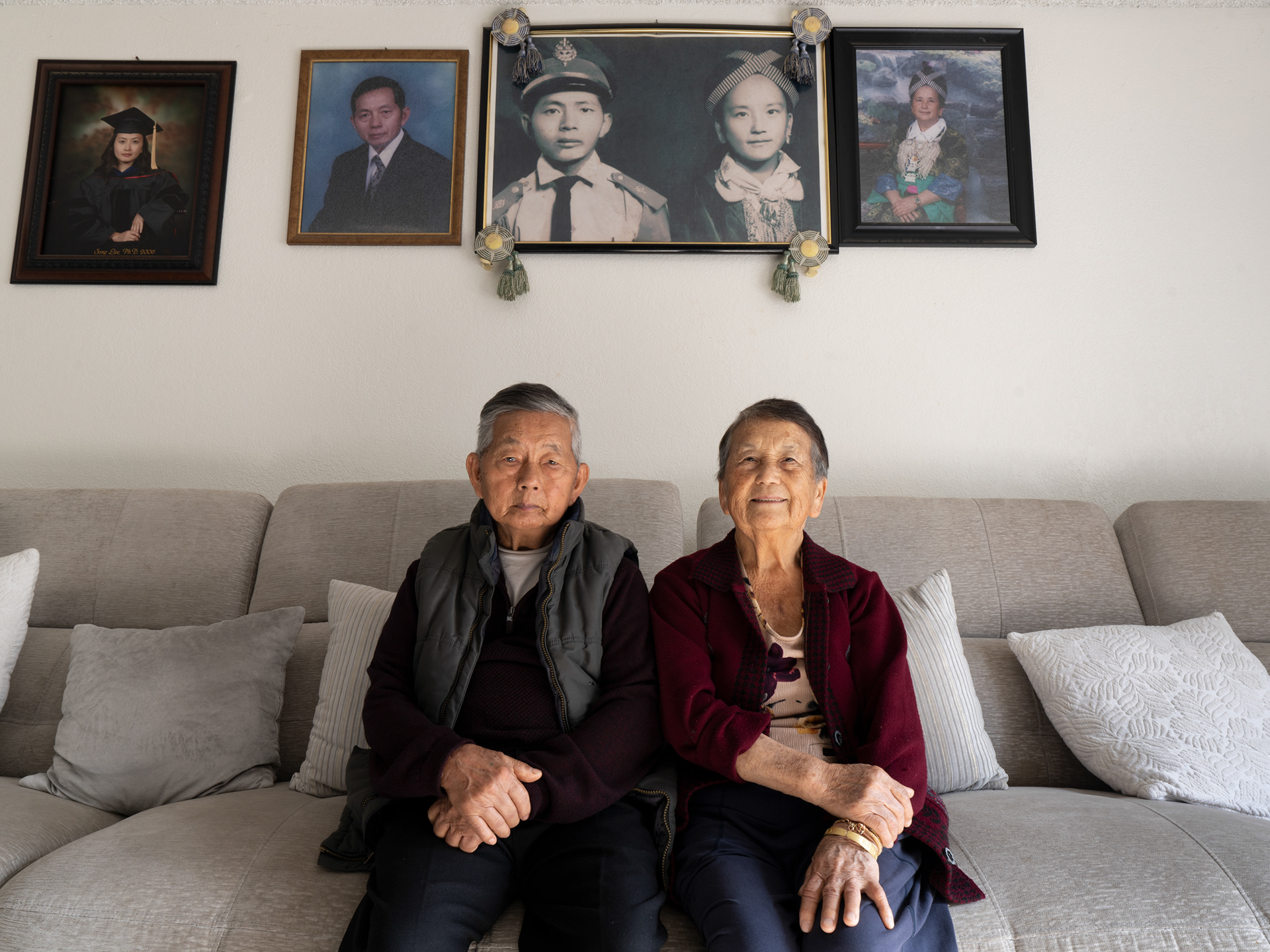
Yer Lor Lee story-10
Wa and Yer seated in their living room 20 years later, January 31, 2026
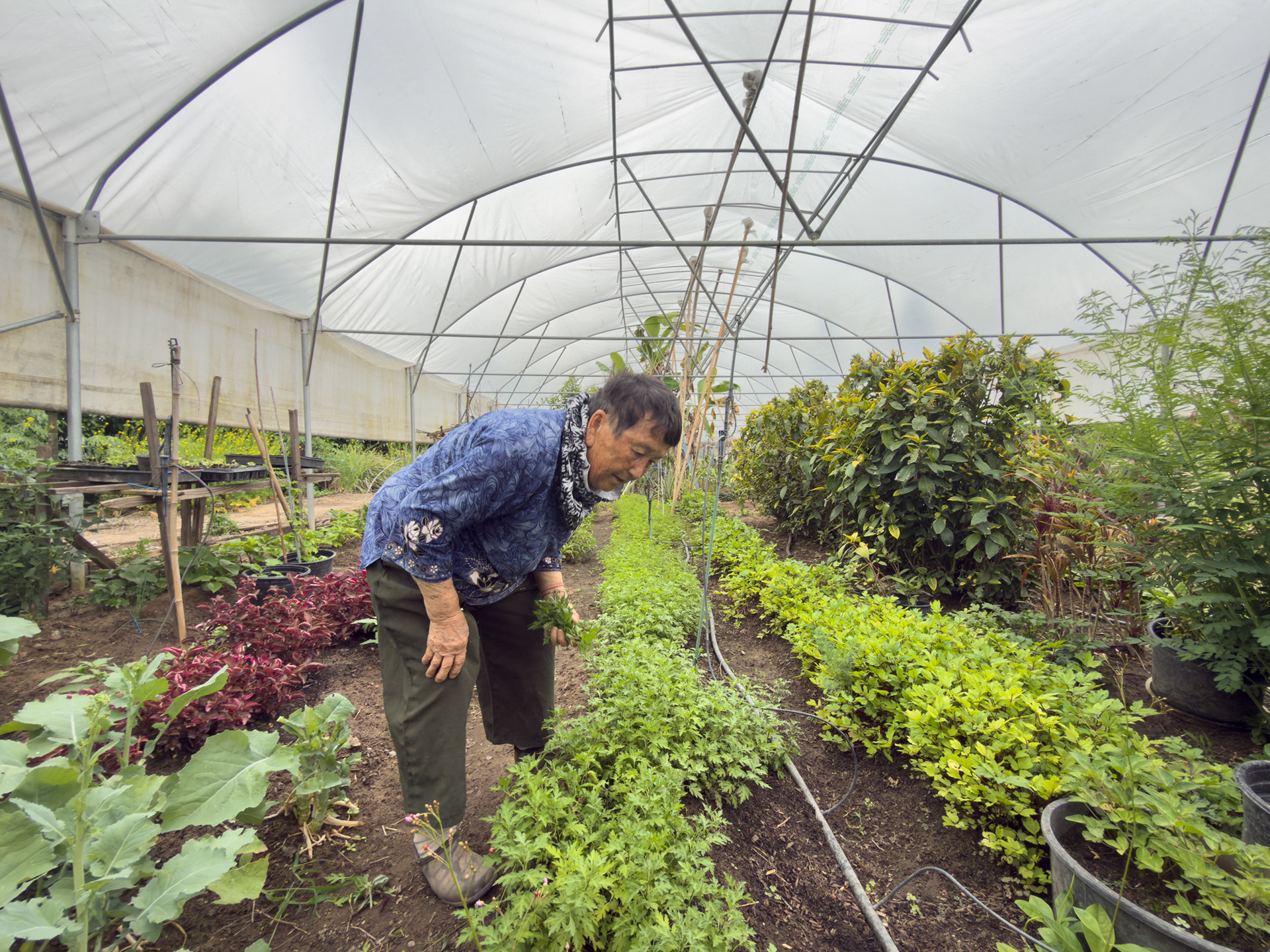
Yer Lor Lee story-11
At 80, Yer Lor Lee is a passionate gardener, raising a multitude of crops on her daughter, Song’s land near Sanger, California, March 3, 2026