November 12-13, 2007
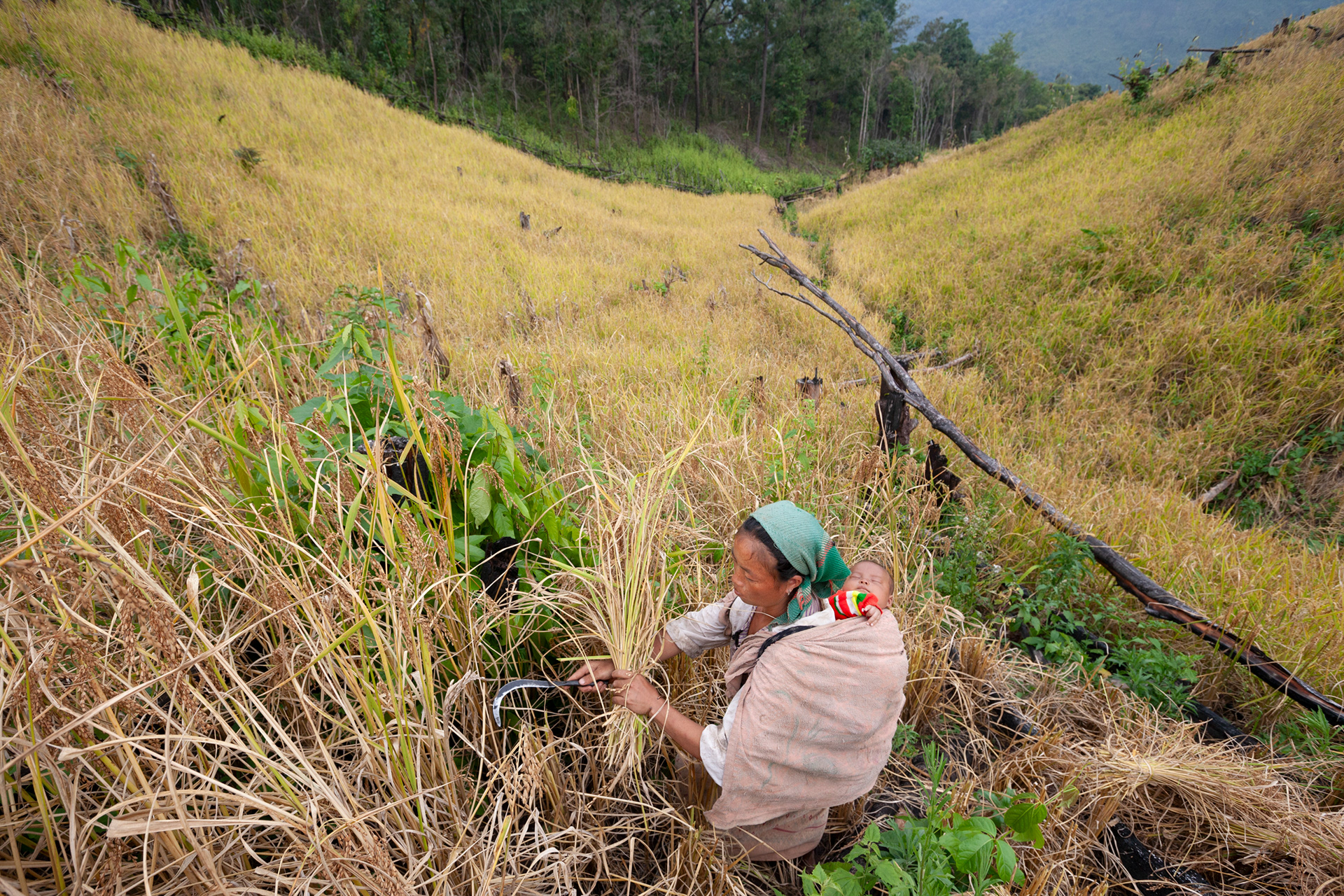
Ban Pha Keo is a Hmong village in the mountains of eastern Xiang Khouang Province, Laos
The village can only be reached on foot via a steep trail of six miles and 3,000 feet of elevation change. We spent the night there. The trailhead lies two hour’s drive northeast of Phonsavanh off Route Seven, the major road linking Laos and Vietnam. It begins about half a mile east of Ban Tha Chok, another village featured in this collection. My guide and trilingual interpreter was Long Vang. Two friends of his, off-duty guides, accompanied us and helped carry gear.
The following is an edited excerpt from the book Soul Calling: A Photographic Journey Through the Hmong Diaspora (©2012 Joel Pickford):
Harvest
Today our goal is to reach Ban Pha Keo, a Hmong village high in the mountains where I hope to photograph the rice harvest. Elsewhere in the province, the harvest is mostly finished, but the farmers of Ban Pha Keo are still at it, delayed by the cooler microclimate of their high altitude fields. Underlying my interest in the rice harvest is a deeper desire to seek out Hmong culture in its more traditional forms, as little touched by the twenty-first century as possible.
Ban Pha Keo certainly meets my criteria; it was founded in 1975 after the end of the Secret War. A group of Hmong families from Long Cheng made the grueling journey to their new home on foot. While most refugees fled southwest toward the Mekong River, this group went the opposite direction, heading for the highest inhabitable mountains they could find. Today I will learn the hard way why the Vietnamese soldiers never bothered to go after them.
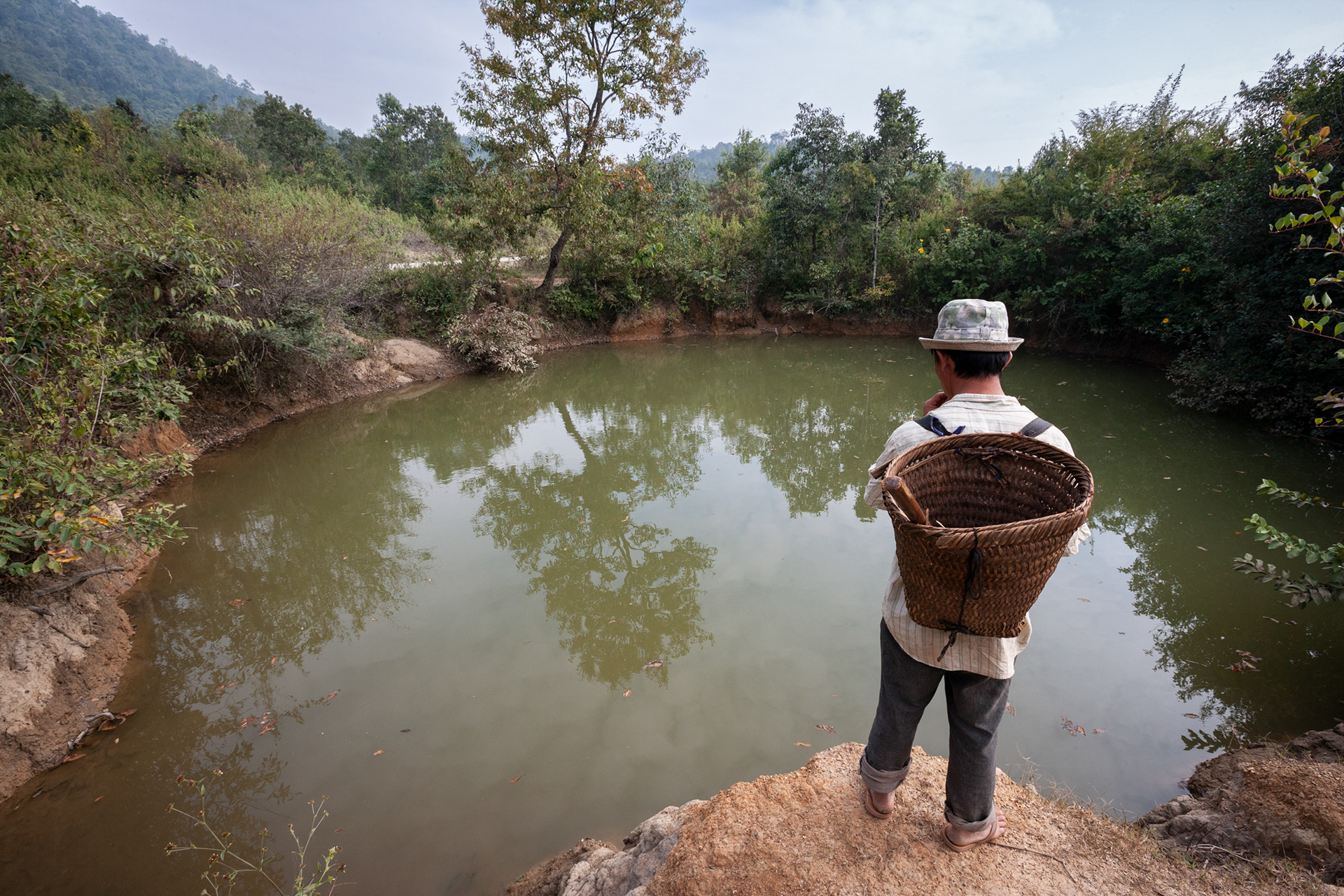
After two hours' drive from Phonsavan, we turn onto a bumpy dirt road and follow it past Ban Tha Chok, a large Hmong village. We stop briefly to pick up two friends who will accompany us on the hike to Ban Pha Keo; both are unemployed guides who have decided to come along out of curiosity about a place they have heard about all of their lives but never seen. A mile farther down the dirt road, the driver drops us off at the trailhead, which seems little more than a cattle path. We follow it for fifty yards to the biggest bomb crater I have ever seen; it is at least forty feet in diameter and very deep, judging by the dark green water that fills it. A Hmong villager cuts a very small figure as he fishes from its elevated rim.
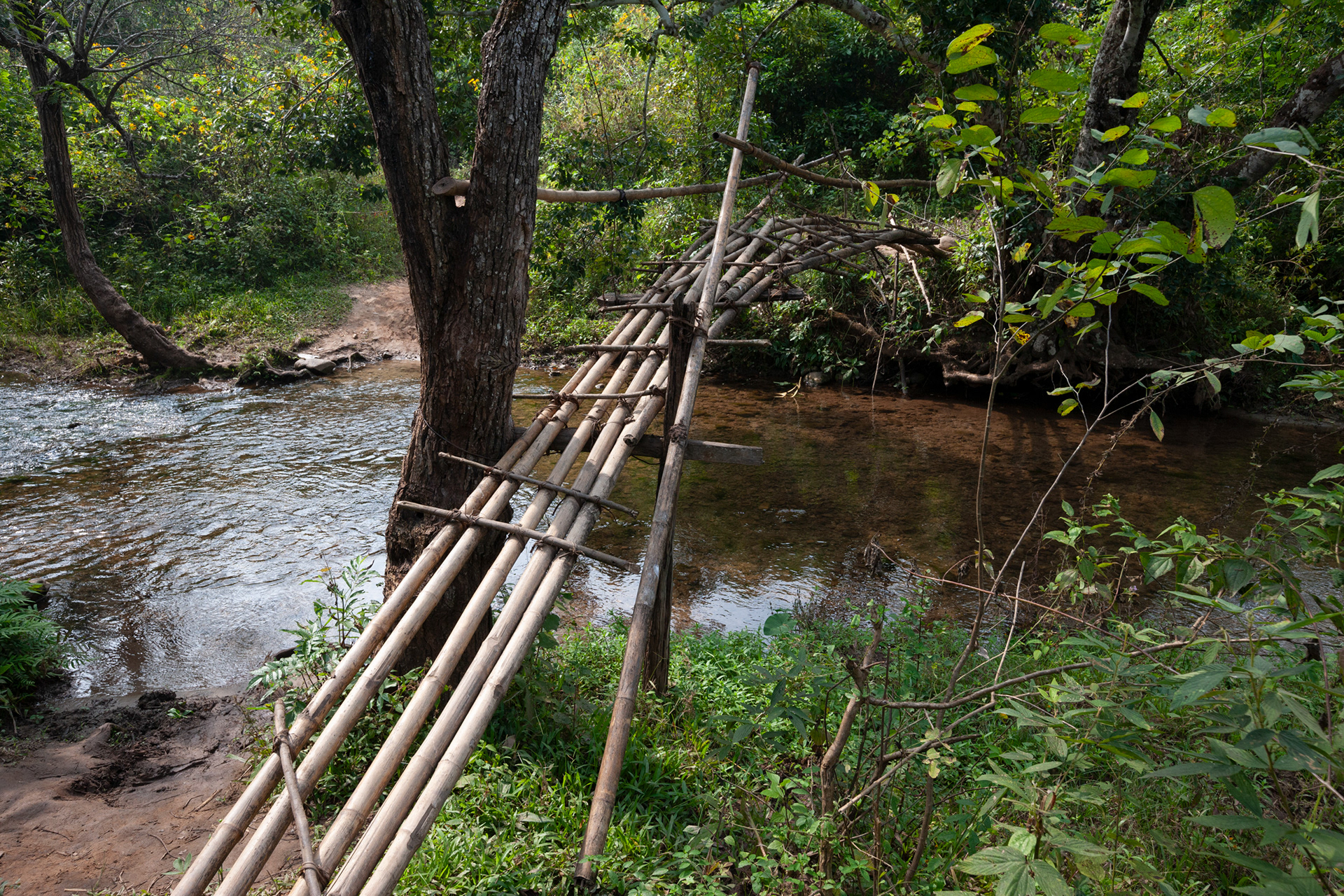
From there we begin a long descent, passing a small Khmu village. We continue downhill for several more miles and cross a stream. It’s rickety bamboo bridge is not an option for someone of my weight. Cradling my sweaty hiking boots under one arm, I linger midstream, letting my feet luxuriate in the deliciously cool water. Meanwhile, my companions wait impatiently for me, having already splashed across in their flip-flops. Long chooses the arched bamboo bridge, which holds.
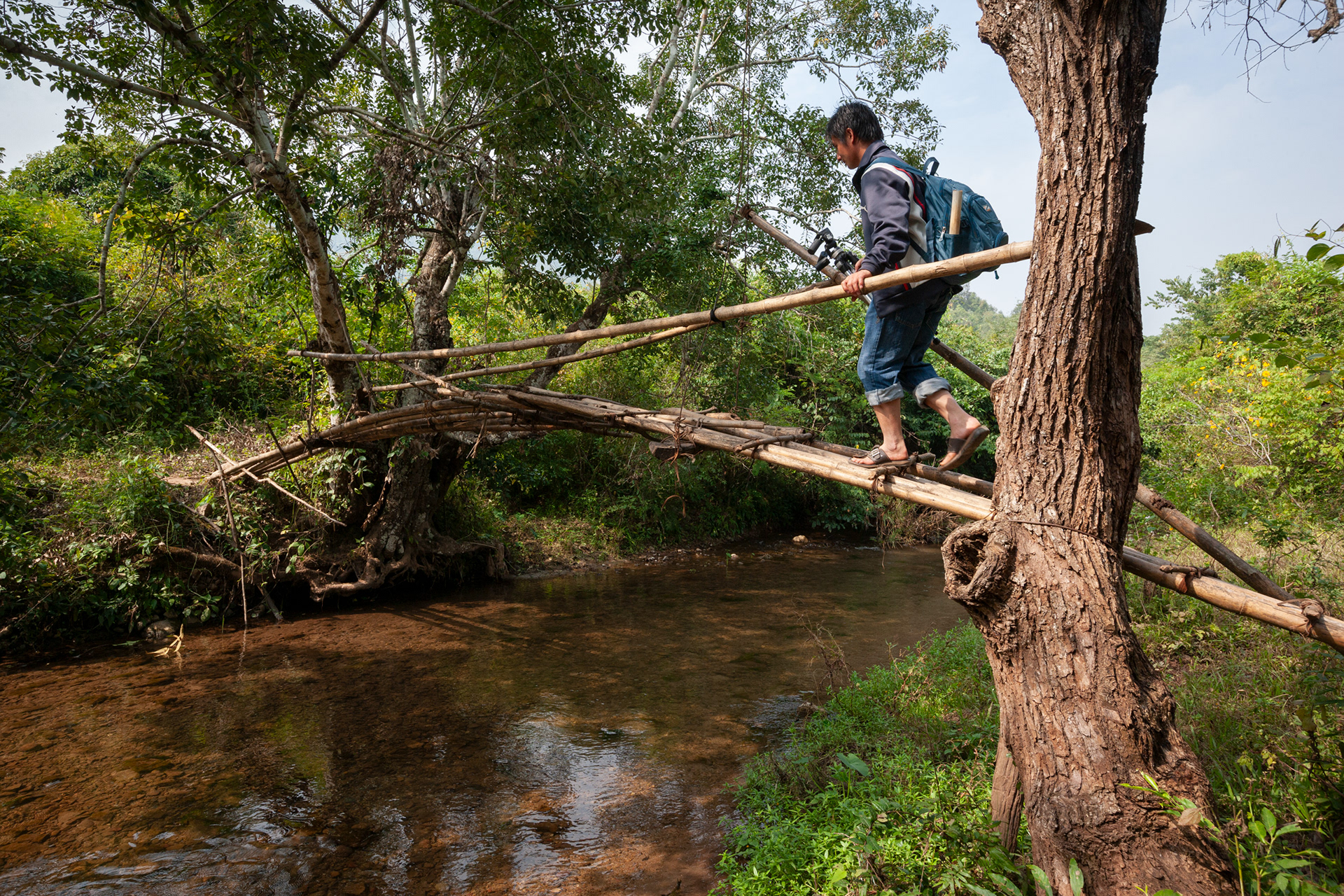
My guide, Long Vang crosses a dicey bamboo bridge that likely won't support my weight with camera gear.
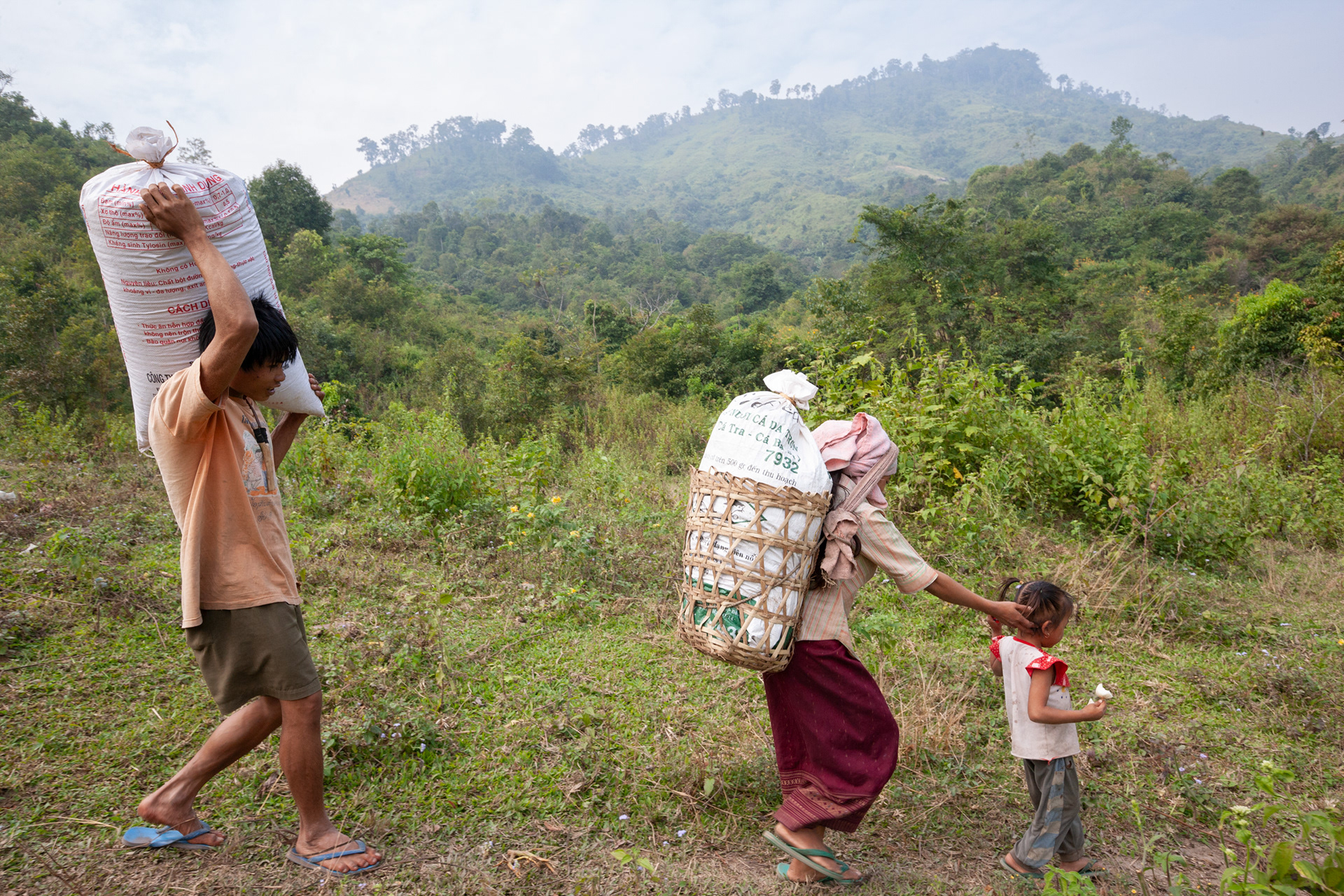
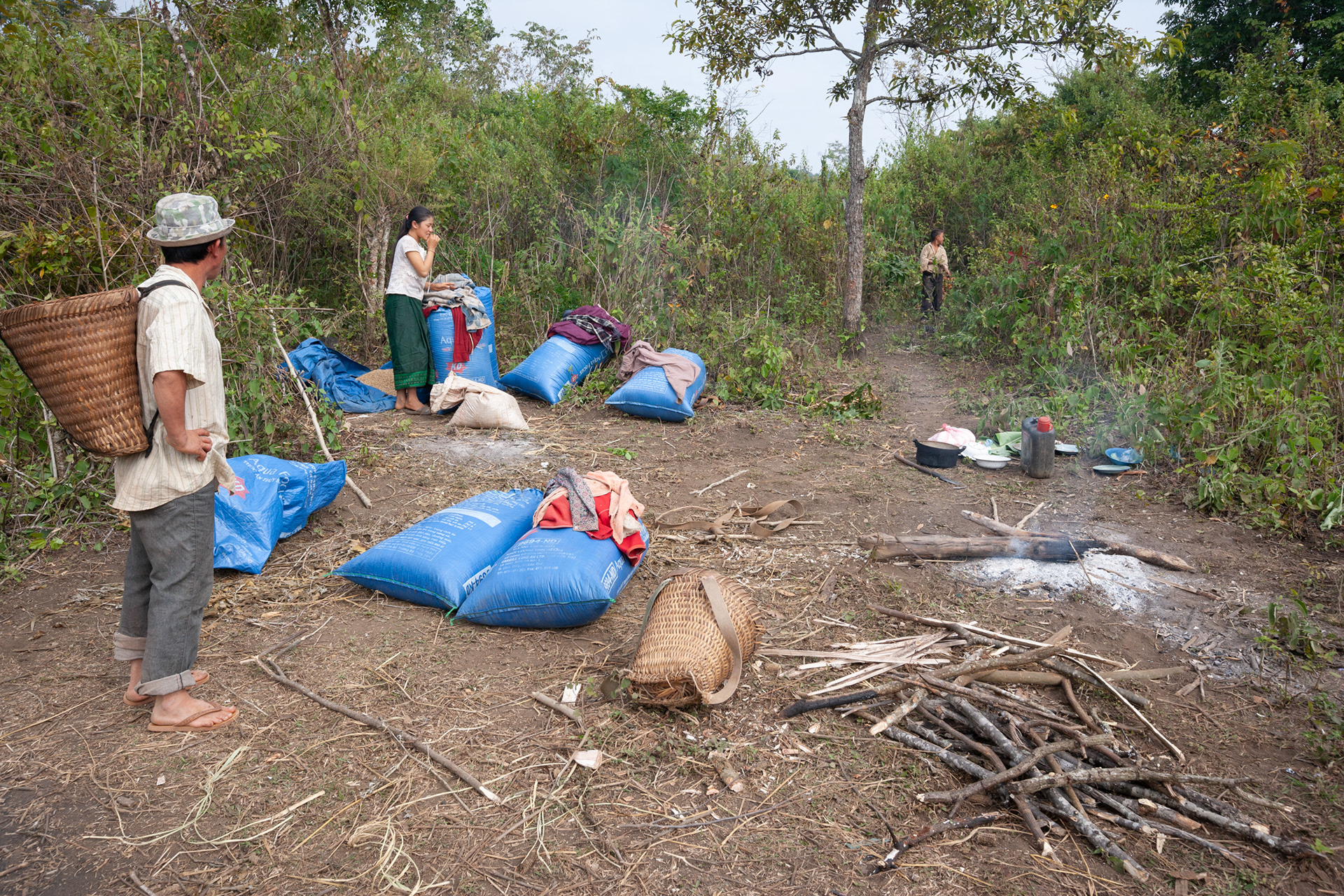
On the other side we begin our ascent of a nearly vertical wall of jungle. The mountainside faces south and never gets any sun at this time of year, leaving the red earth trail damp and slippery as it zigzags up the steep slope. Carrying forty-five pounds of photography gear on my back, I sweat profusely yet feel chilly in the moist jungle shade. It is impossible to find the right combination of clothing. For two and a half hours we trudge up the endless switchbacks, harassed by swarms of persistent gnats, who are impervious to mosquito repellent. From time to time, we pass Hmong villagers coming downhill from Ban Pha Keo, each balancing a fifty-pound sack of rice on one shoulder. They will sell their meager surplus for a few dollars at one of the villages along Route Seven. This punishing trail is their only connection to the outside world; all goods and supplies must be carried in and out on foot.
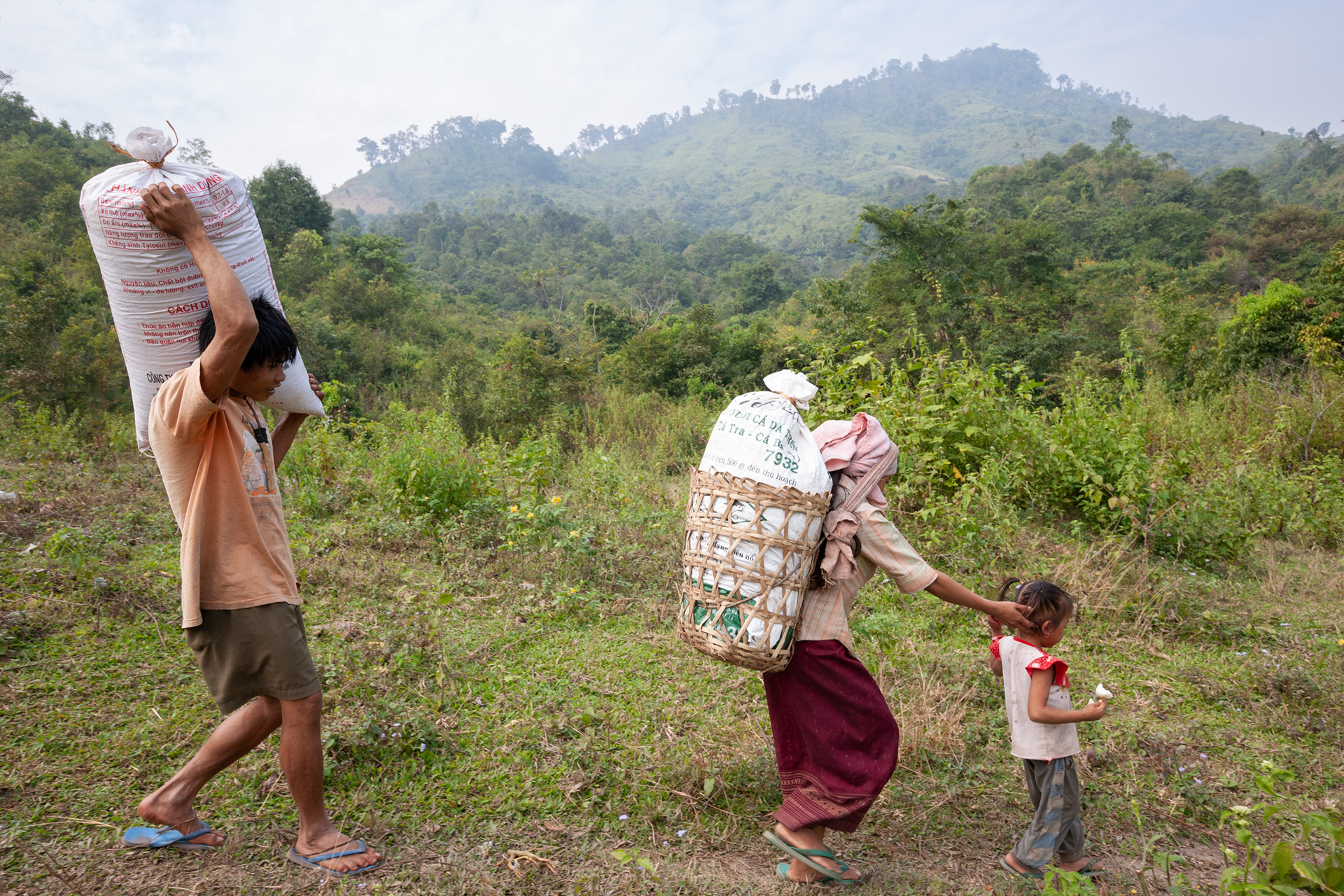
Villagers from Ban Pha Keo descend the trail to sell their surplus rice at a large village near Route Seven.
After climbing up a steep ridge, we finally reach the rocky summit of the mountain. A broad alpine vista opens up. In the dry season, distances between peaks and ridges are defined by modulating shades of blue haze created by the wood fires that most people in Laos still use for cooking. Foliage is sparser than in the rainy season and colors are muted. From now on, the trail courses over stony terrain in manageable ups and downs, allowing us to take in a wide panorama of the Annamite Range that divides Laos from Vietnam. Apart from the trail, there is no mark of human presence as far as the eye can see.
We stop to rest by a fallen tree and enjoy a snack of small, seedy oranges and sticky rice. I am thankful for my steel-toed hiking boots, which have bounced off more than a few jagged rocks along the trail today. Meanwhile, my companions hike in flip-flops As we sit procrastinating the remaining mile of trail that separates us from our goal, the conversation turns to the Secret War. I am impressed with my companions’ knowledge of a chapter in history that is not taught in Lao schools or available in Lao libraries.
“How do you guys learn all this stuff?” I ask.
“We have poems in Hmong language that tell our story,” Long explains. “We memorize them and pass them along from one generation to the next.” These twenty-somethings know considerably more about their history than do most of their American-born cousins.
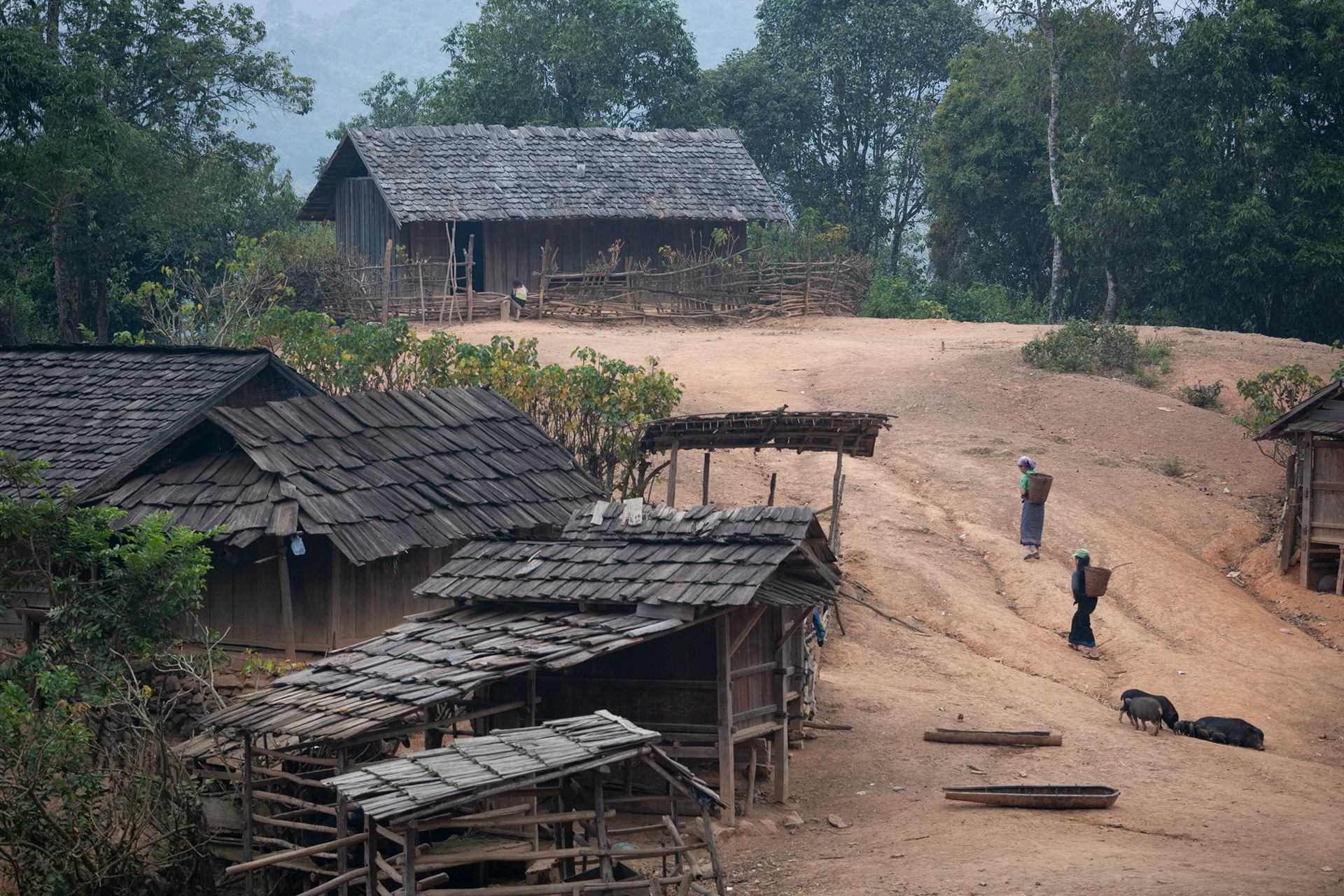
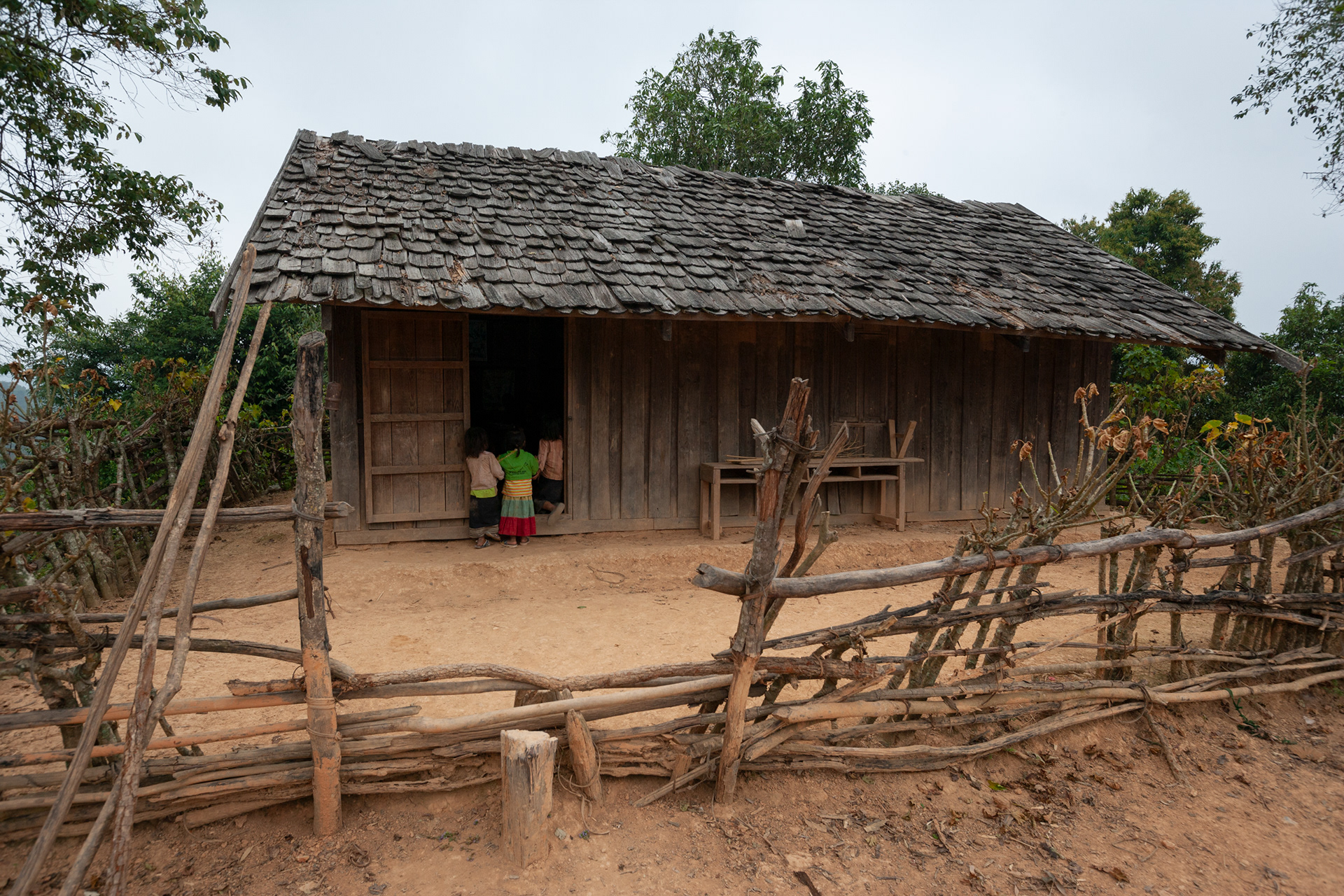
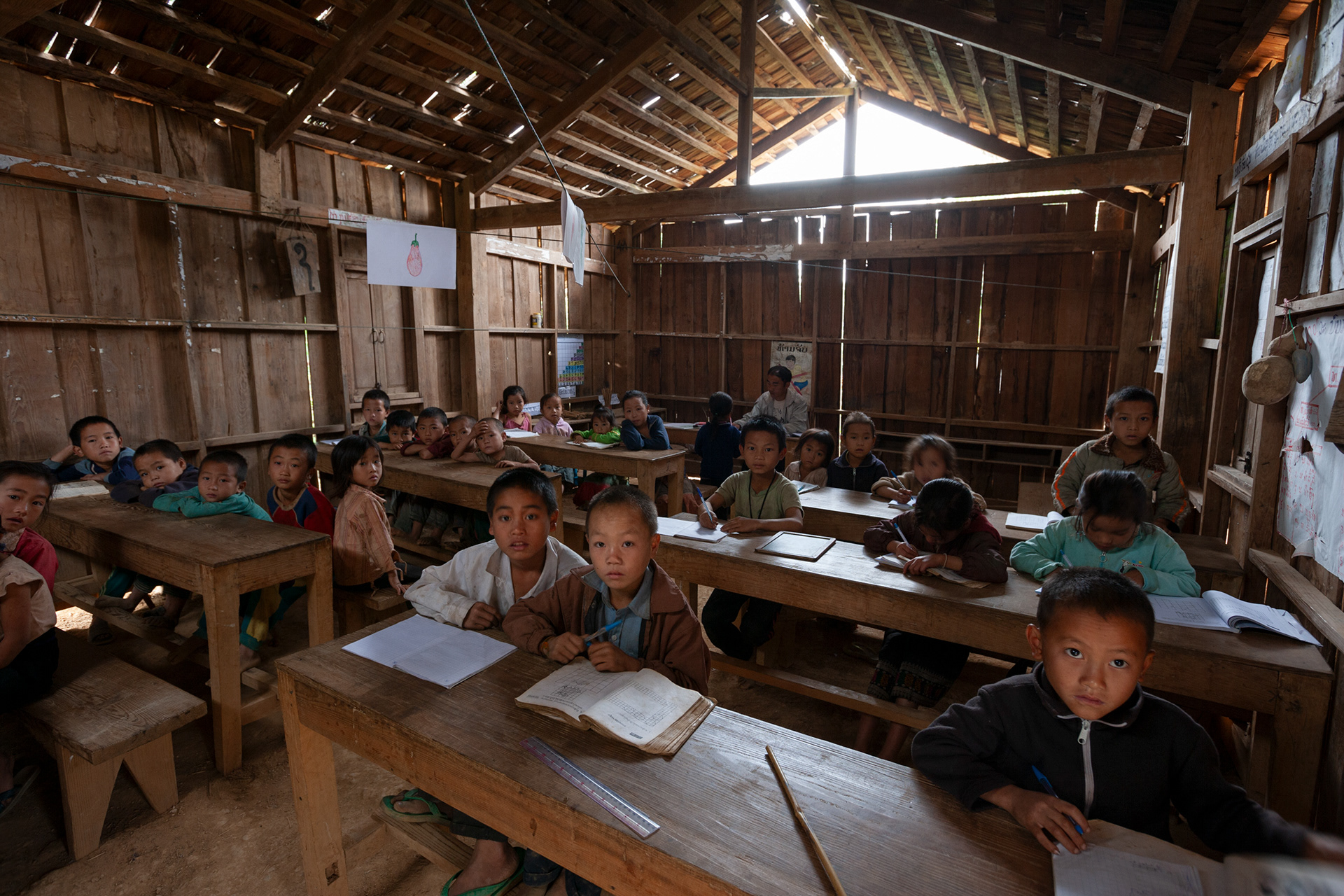
After climbing one last steep hill, we are treated to a spectacular view of the village from above. Nestled in a saddle between three rocky peaks, Ban Pha Keo is home to twenty-three Hmong families. The houses are built of weather-darkened wood with packed-earth floors and hand-hewn shake roofs. Pigs, chickens, and small children meander about in the central dirt area that seems to be ubiquitous in Hmong villages. To our right, a one-room primary school overlooks the village. I can’t resist peeking inside. The teacher sits at the back of the class as the students take turns reading aloud from a Lao text. They sit three or four abreast in tightly spaced rows, sharing long, slender wooden tables that serve as communal desks. It is hard to imagine studying all day in such a dimly lit classroom; the spaces between the wall siding boards and under the eaves provide the only light, as the village has no electricity.
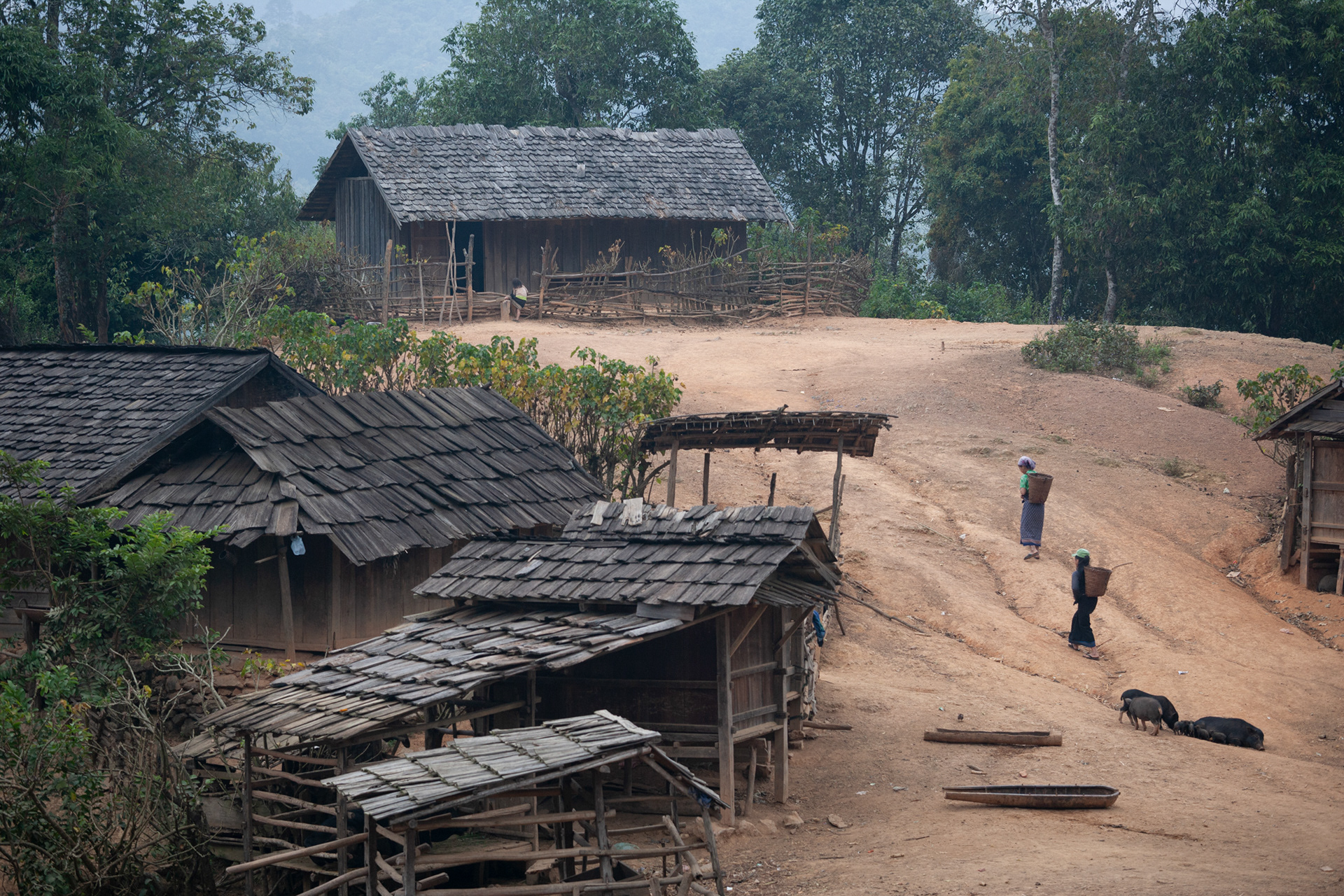
A schoolhouse sits on Ban Pha Keo's highest hill. Pigs feed from spent American bomb casings repurposed as troughs.
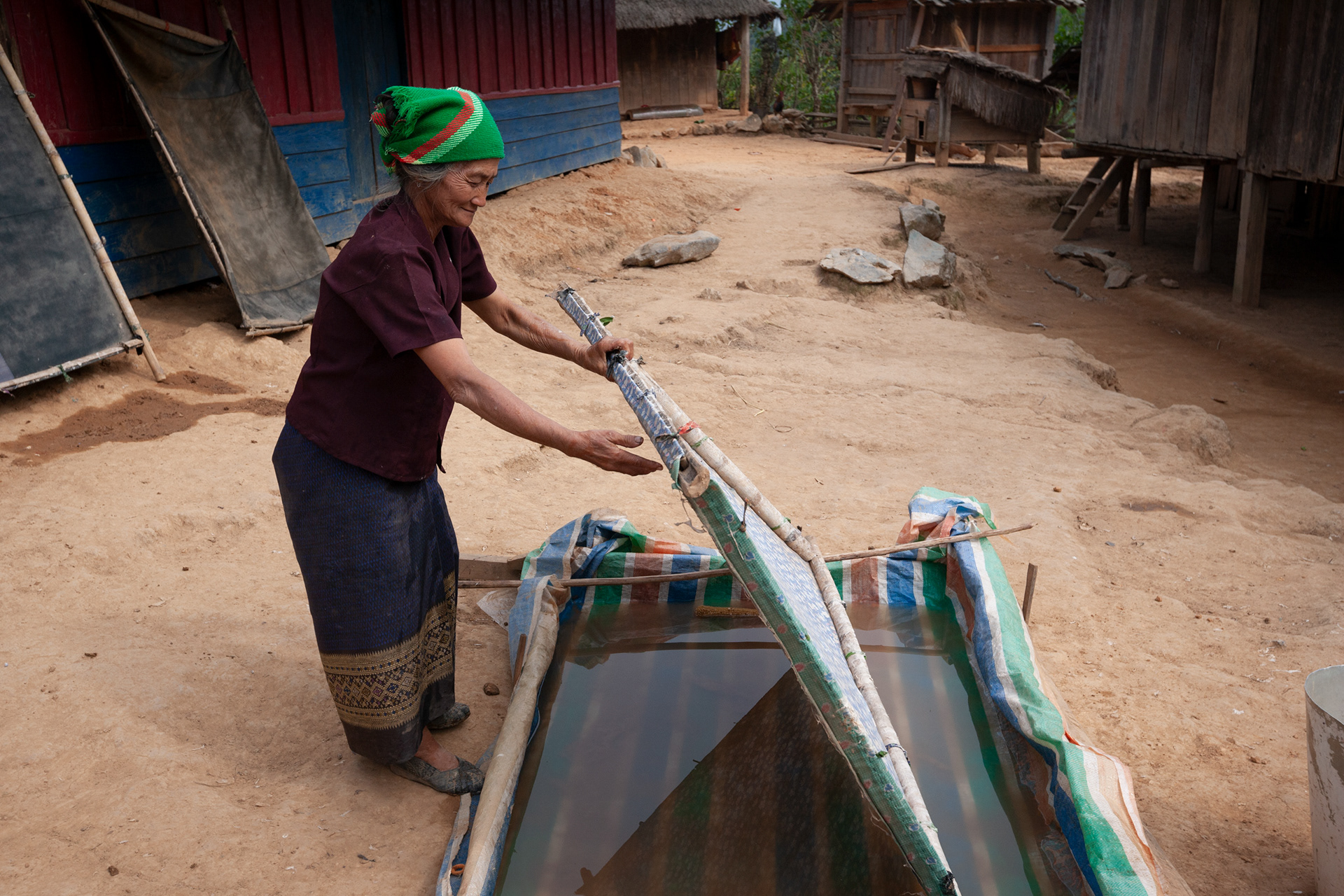
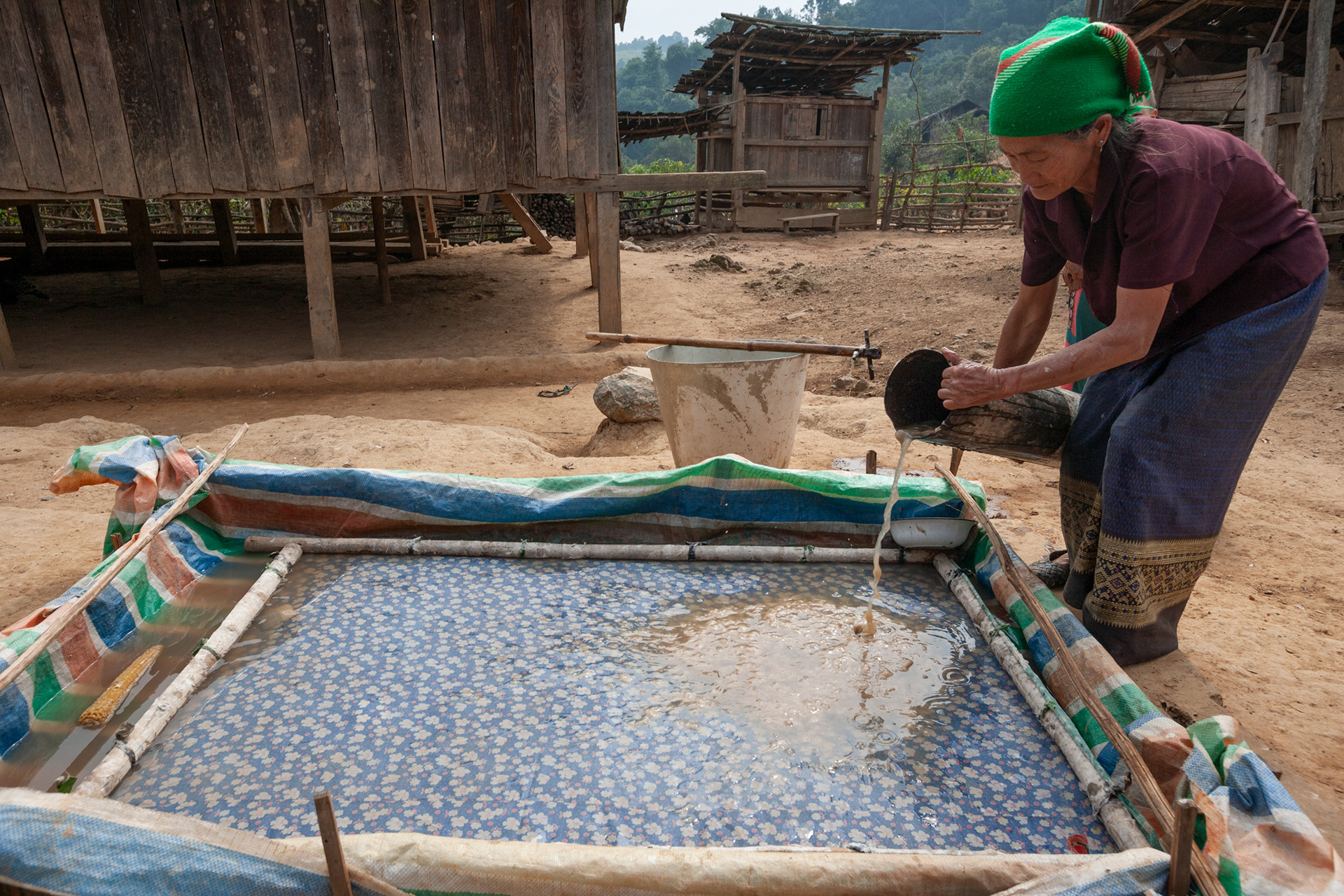
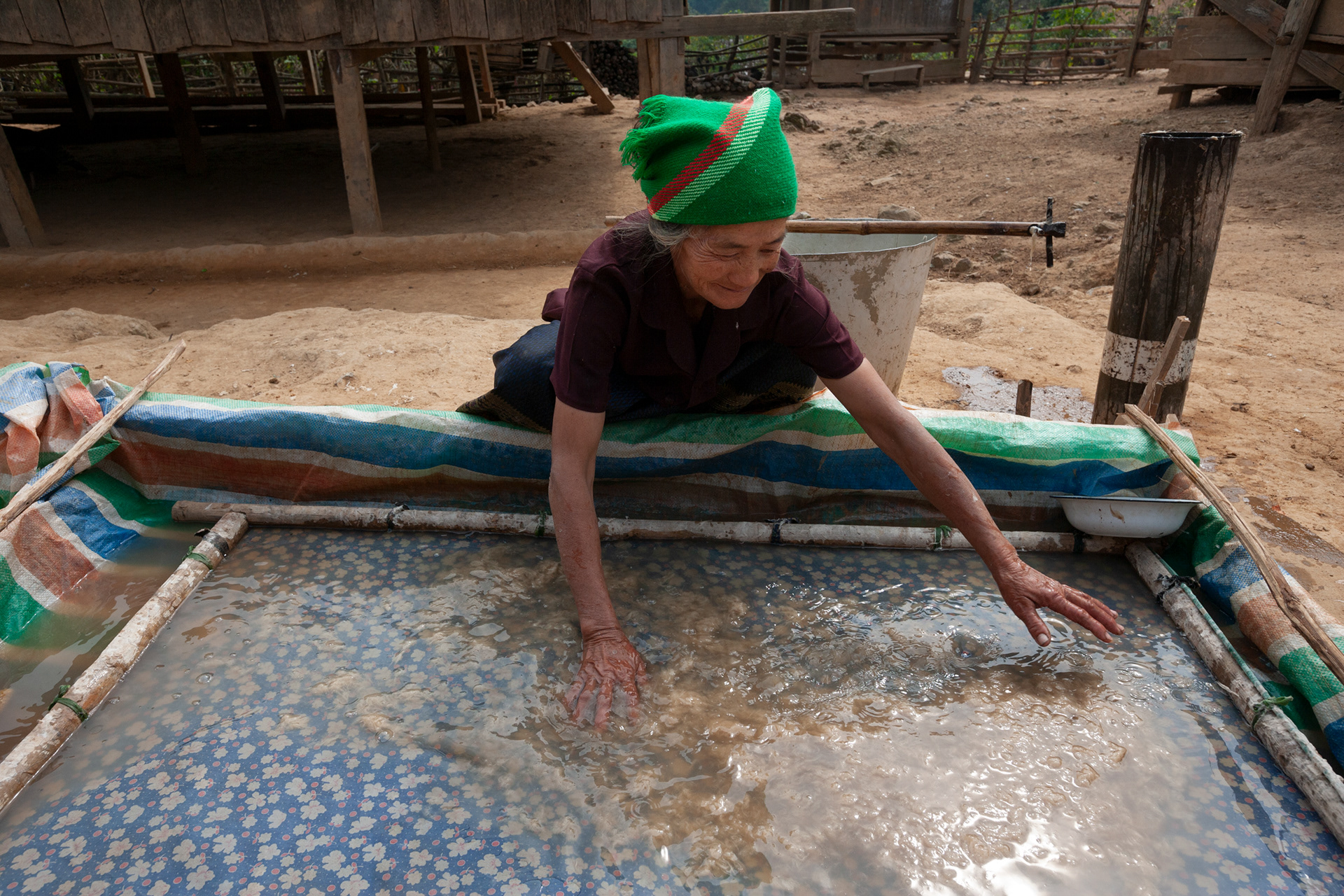
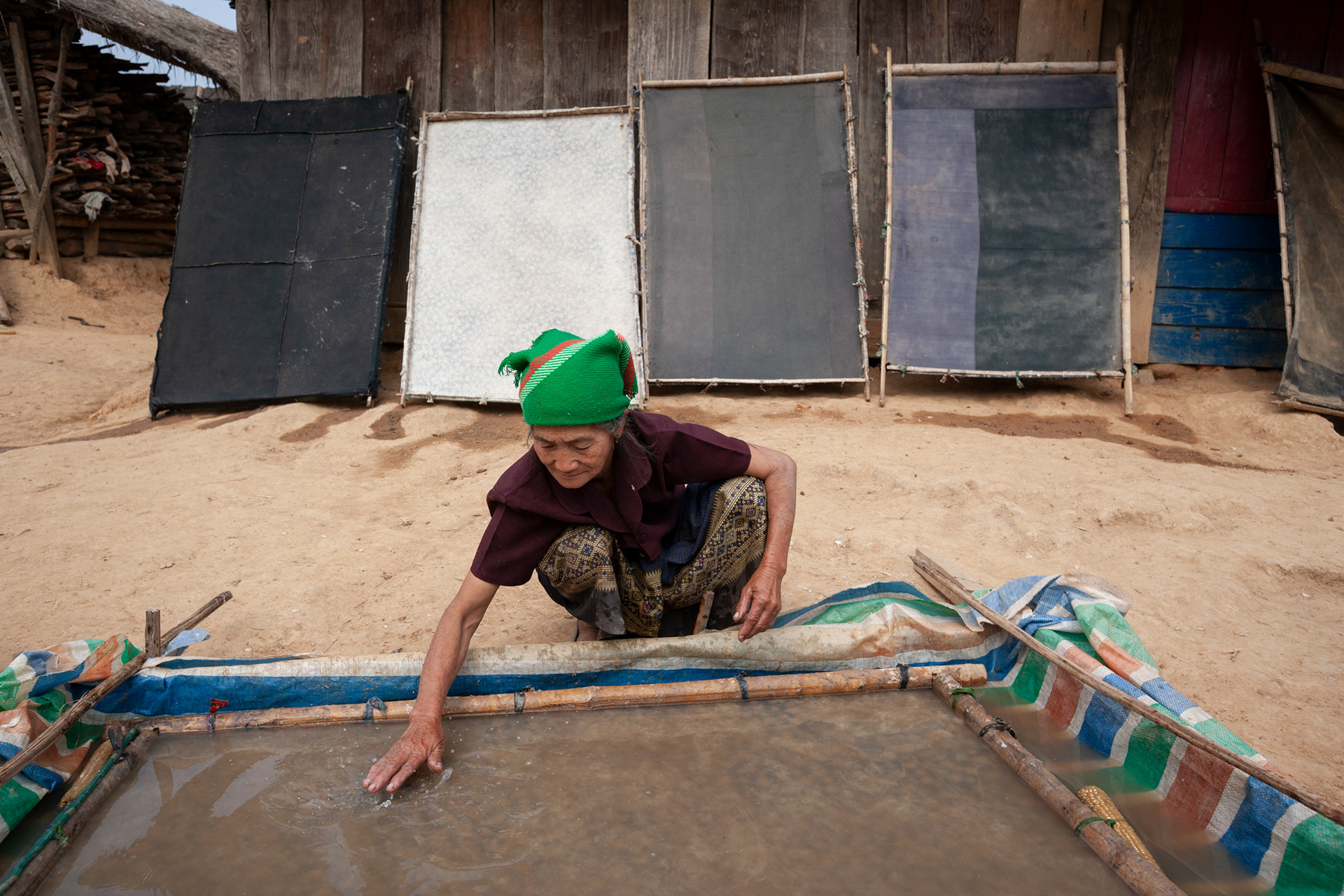
Long and I leave some of our gear in the village chief’s house and prepare for another hour of hiking to reach the slopes where the rice harvest is taking place. I take a moment to photograph an old woman who is making white pepper by hand. After soaking the pulp in a shallow pond, she dries it on wood-framed screens leaning against the side of her house. Later it will be ground with a mortar and pestle and used to season soups and boiled meats. Any surplus will be carried down the mountain and sold to vendors along Route Seven.
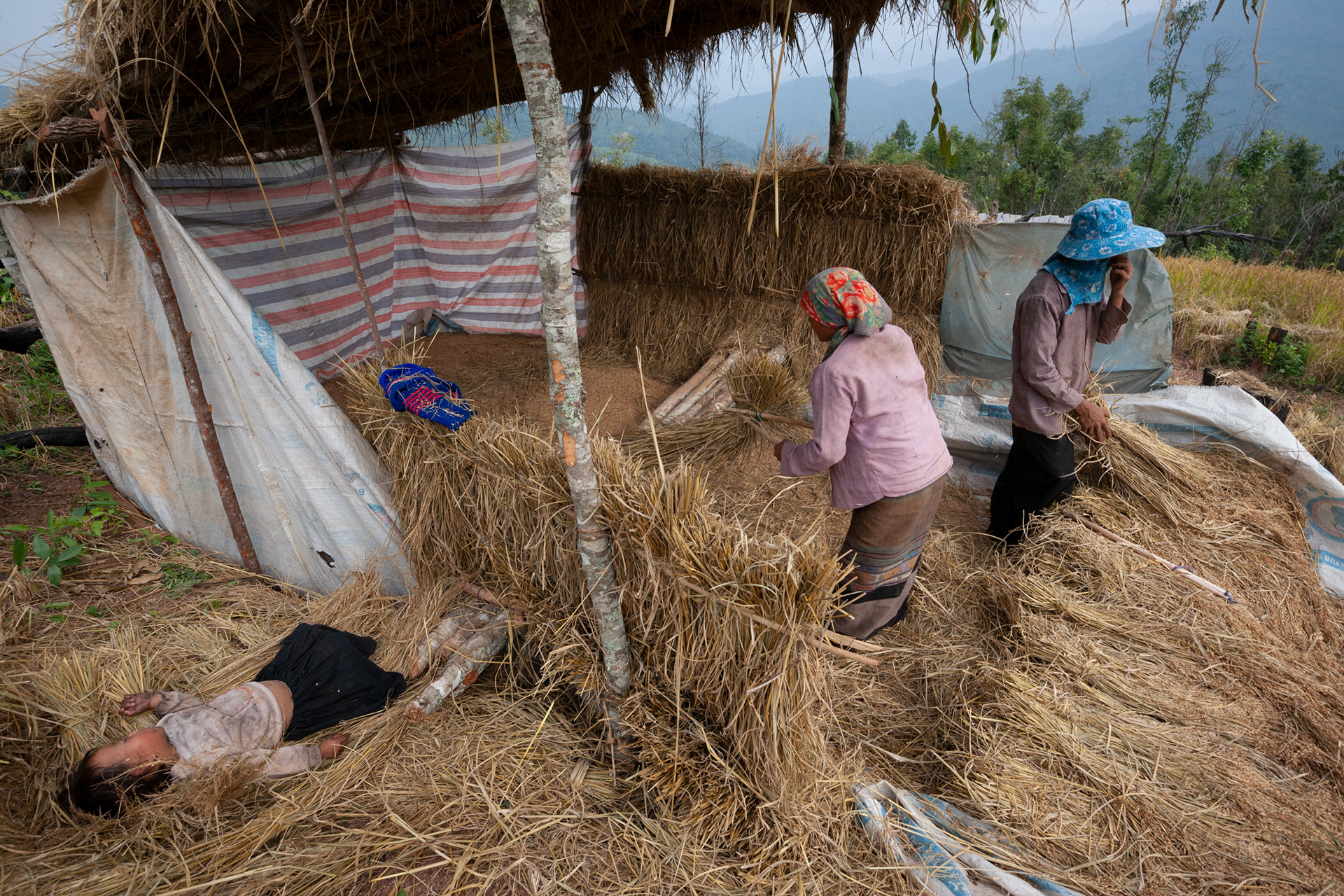
We head south on a well-worn trail, passing many villagers who are already returning from the fields, some leading cattle or water buffaloes. Half an hour later we stop to photograph a young couple threshing their recently harvested rice crop. The man and his wife take turns threshing the rice while the other watches their toddler. They work under a crude lean-to structure, beating each bundle of rice stalks vigorously against a log suspended on two stakes about a foot off the ground. With each blow a few more rice kernels fall on the trampled earth. From time to time they are raked into a tall golden pile under the lean-to.
Shortly after we arrive, the young woman hands the baby to her husband and begins her shift. She picks up a fresh bundle of rice, swings it high over her head and behind her back, then brings it down on the log with all her might. She repeats this eight or nine times, removing about ninety percent of the rice kernels. Then she holds the bundle in one hand and beats it with a stick to extract the remaining kernels. The work is backbreaking and tedious, continuing ten hours a day until the entire year’s crop has been threshed. I photograph the woman as she swings bundle after bundle of rice against a blue backdrop of Annamite Mountains. Her work will continue long after I leave. The baby has fallen asleep on a bed of spent rice stalks.
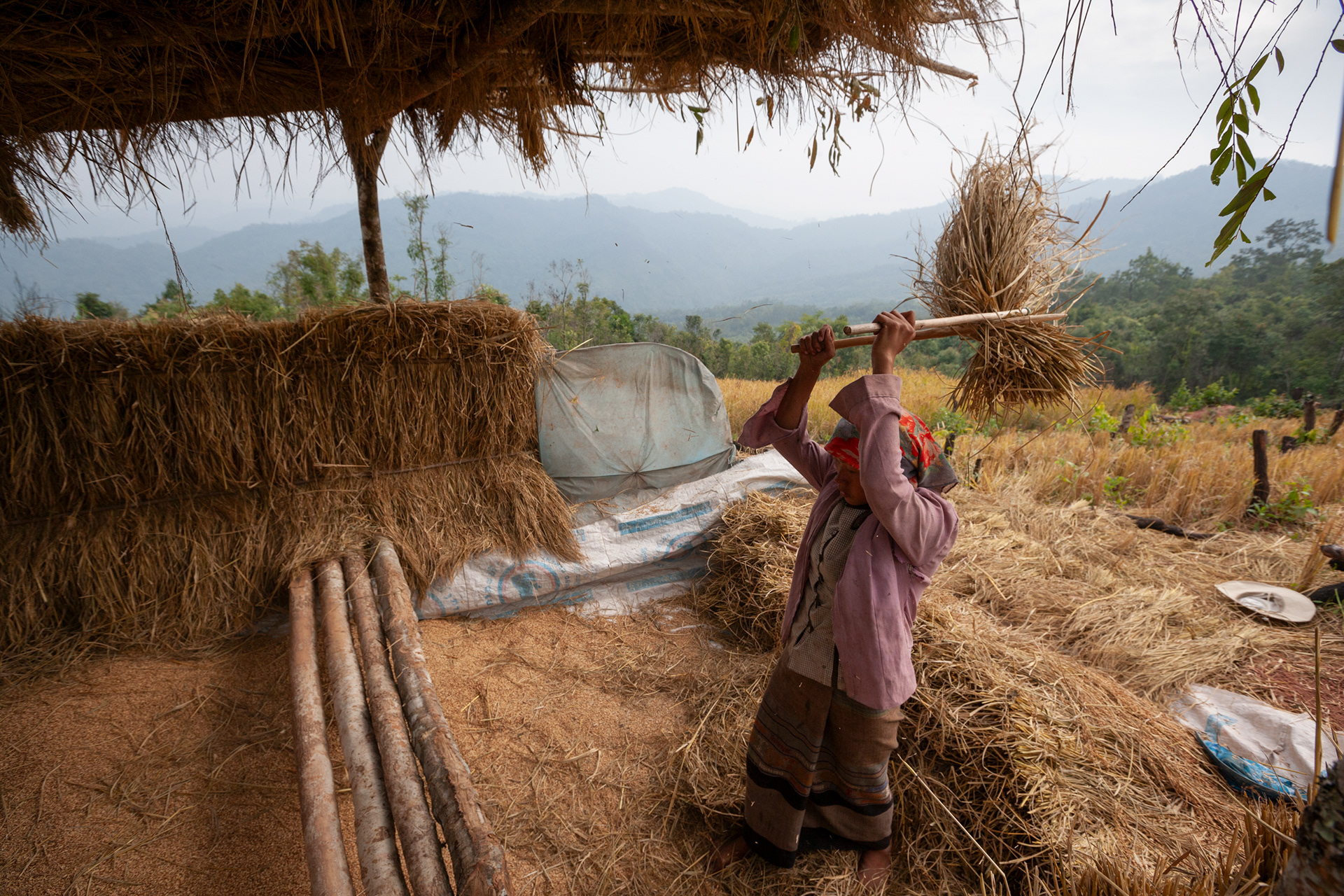
A Hmong woman threshes rice under a makeshift shed on the hillside.
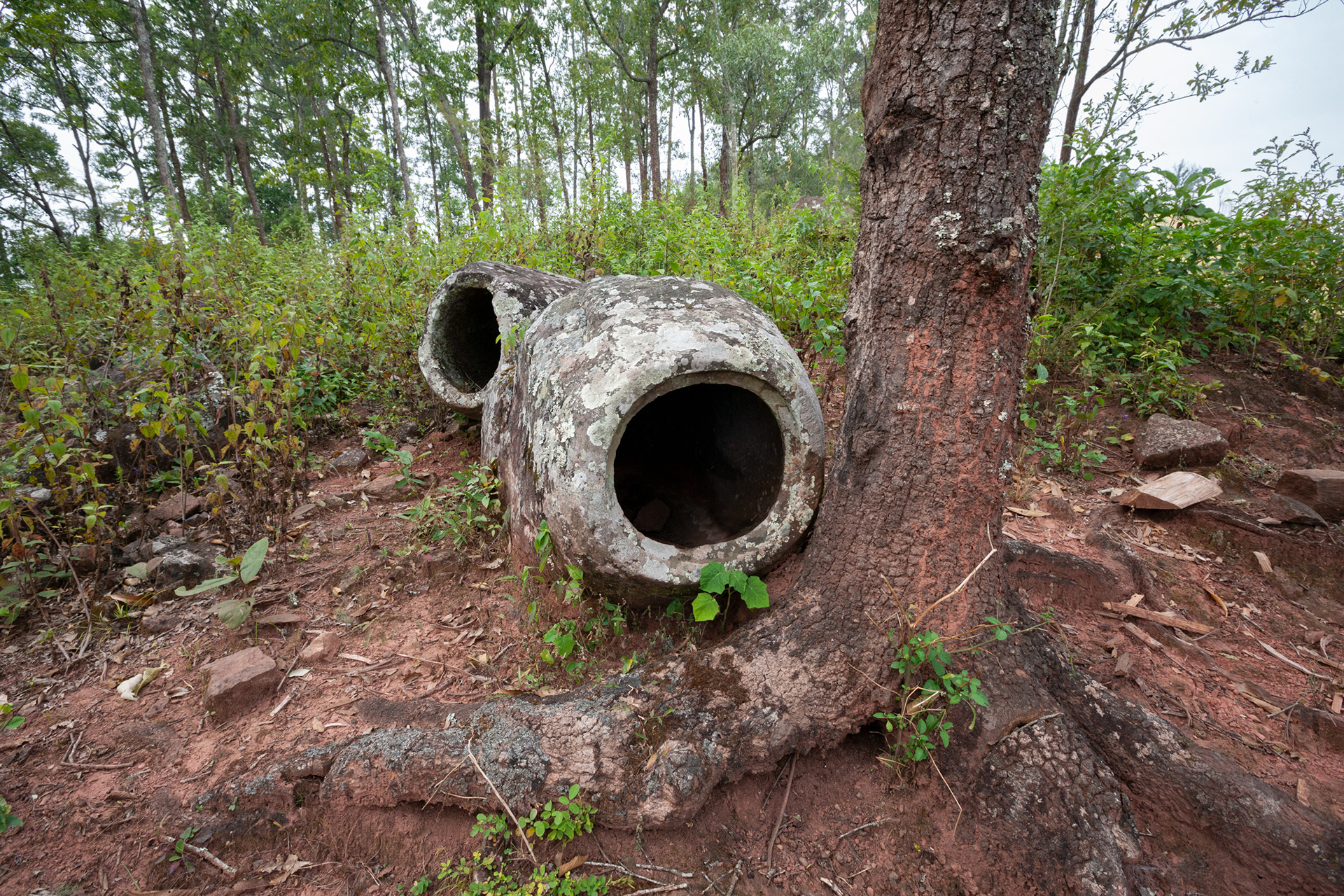
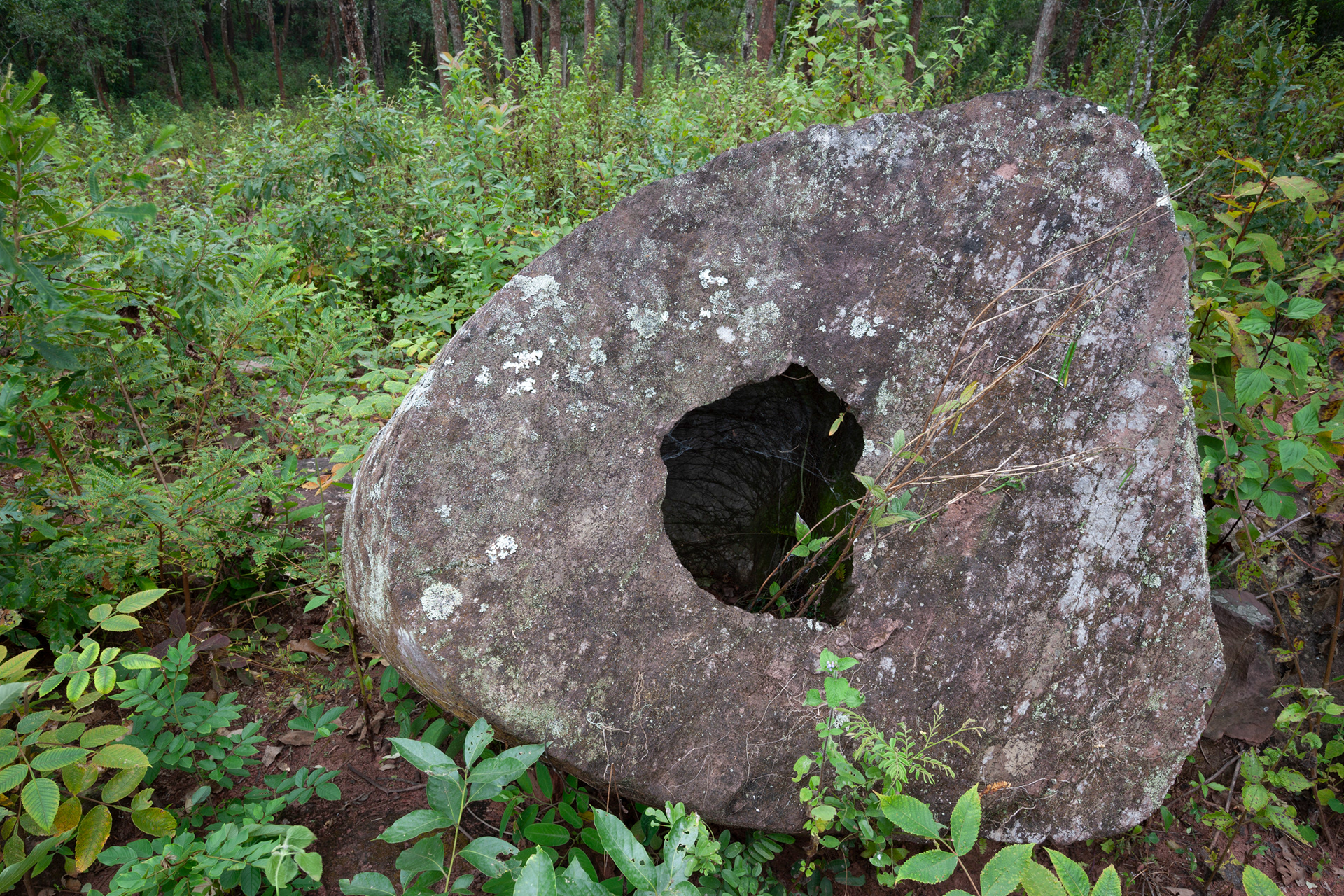
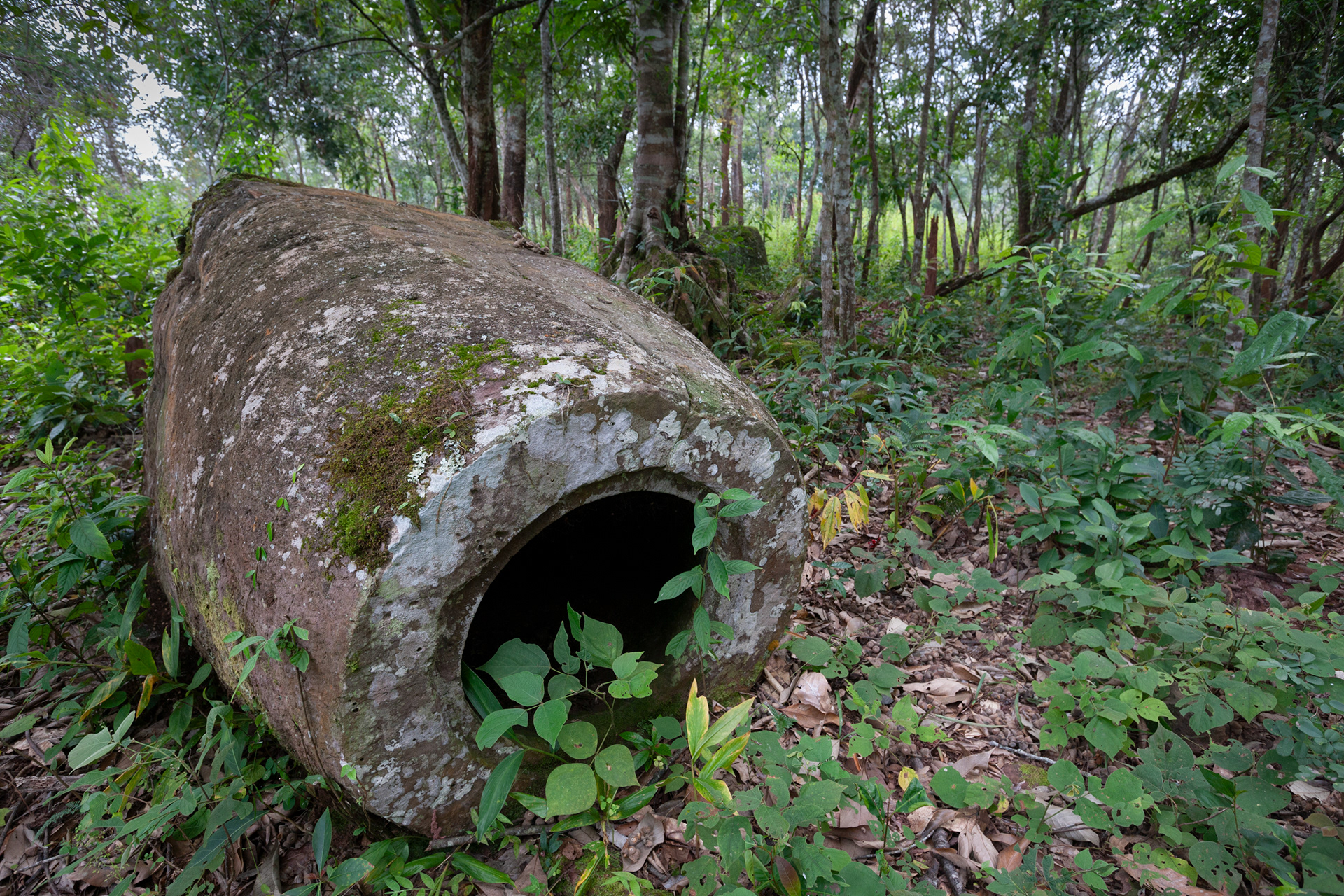
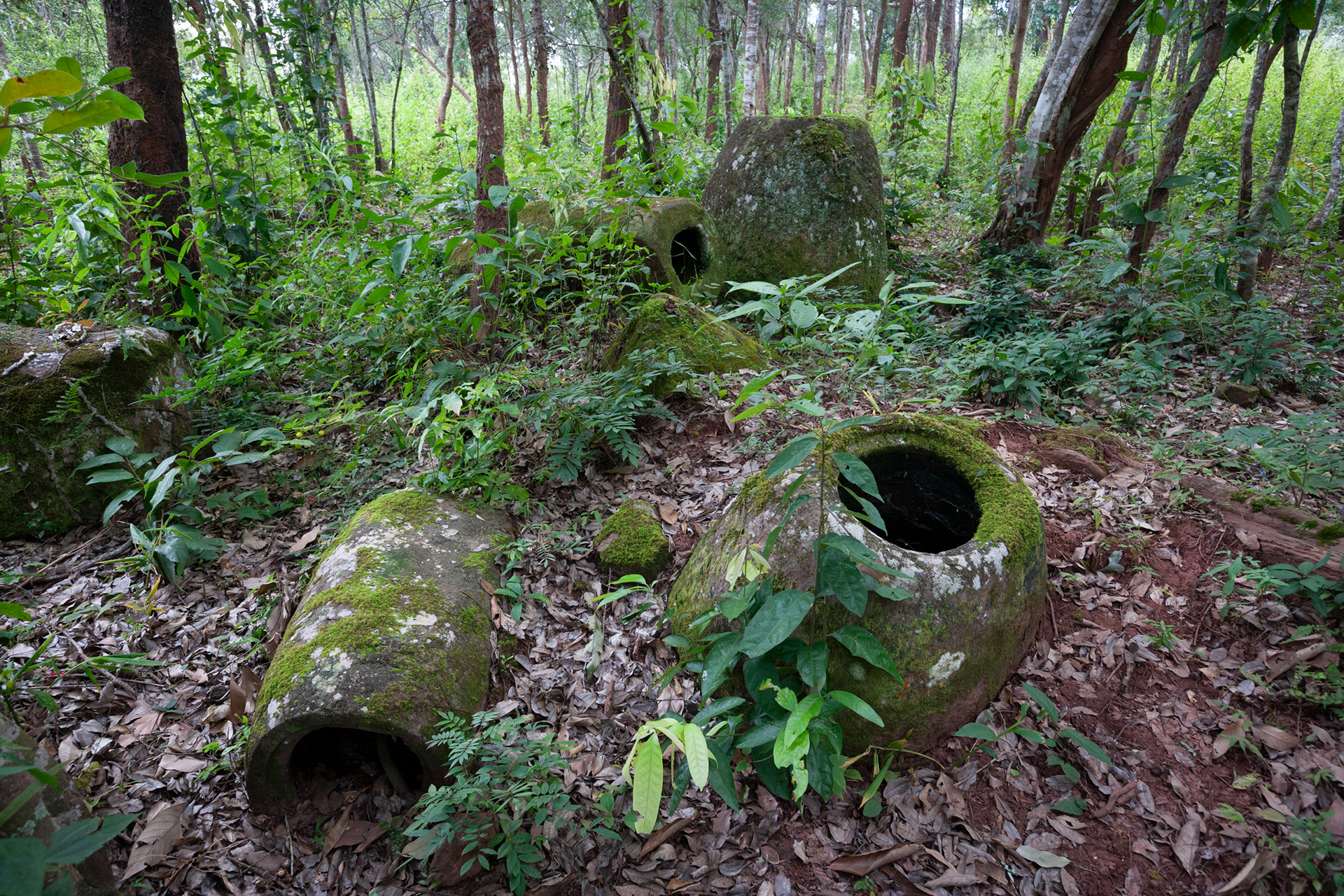
Continuing south along the trail, we enter a lush forest where an ancient stone jar site has recently been discovered by Western archeologists (though long known to local Hmong villagers). Only a few yards off the trail we begin to spot the two-thousand-year-old lichen-encrusted vessels half-hidden under foliage and nestled against tree trunks. The jars in this grouping average four feet high and three feet in diameter. Occasionally we find a broken lid half-buried on the forest floor. One bigger-than-average jar boasts a strangling tree with octopus-like roots growing over the top of it. Found in isolated locations throughout northern Laos, the original purpose of these jars is a mystery. Some scholars speculate that they might have been used to store grain or spirits, but many questions remain unanswered about the identity of their makers and the source of the labor required to quarry and transport the stone. Our brief detour to explore the jars provides a welcome respite from the long hours of hiking we have already put in. As we walk through the forest it feels as though we are discovering them for the first time.
2026 update: when I visited in 2007, it was deemed too dangerous to explore deeper into this group of jars because of the prevalence of unexploded bombs (UXO) dropped during the Secret War. A year later, the Mines Advisory Group (MAG) cleared the area, making it safe for an archeological survey in 2008. The newly named Site 52 was found to contain 420 Megalithic jars and quarries where the stone had been sourced. Analysis completed in 2018 revealed that the jars are among the oldest in Xiang Khouang Province, dating from 1240 BCE to 660 BCE.
More significantly, new research at Site 75, just 40 miles away, shows that the Jars in that area were used for human burial. Along with skeletal remains of at least 37 people, an iron knife, a copper bell, and glass beads used as trade currency were found. The beads have origins as far away as Egypt, Sumatra and Mesopotamia, pointing to the global nature of trade networks in the Megalithic Era, even in remote regions like this one. This major discovery supports the theory that the stone jars found throughout Northern Laos were made primarily for funerary purposes, not for food or water storage. These findings were published in 2026.
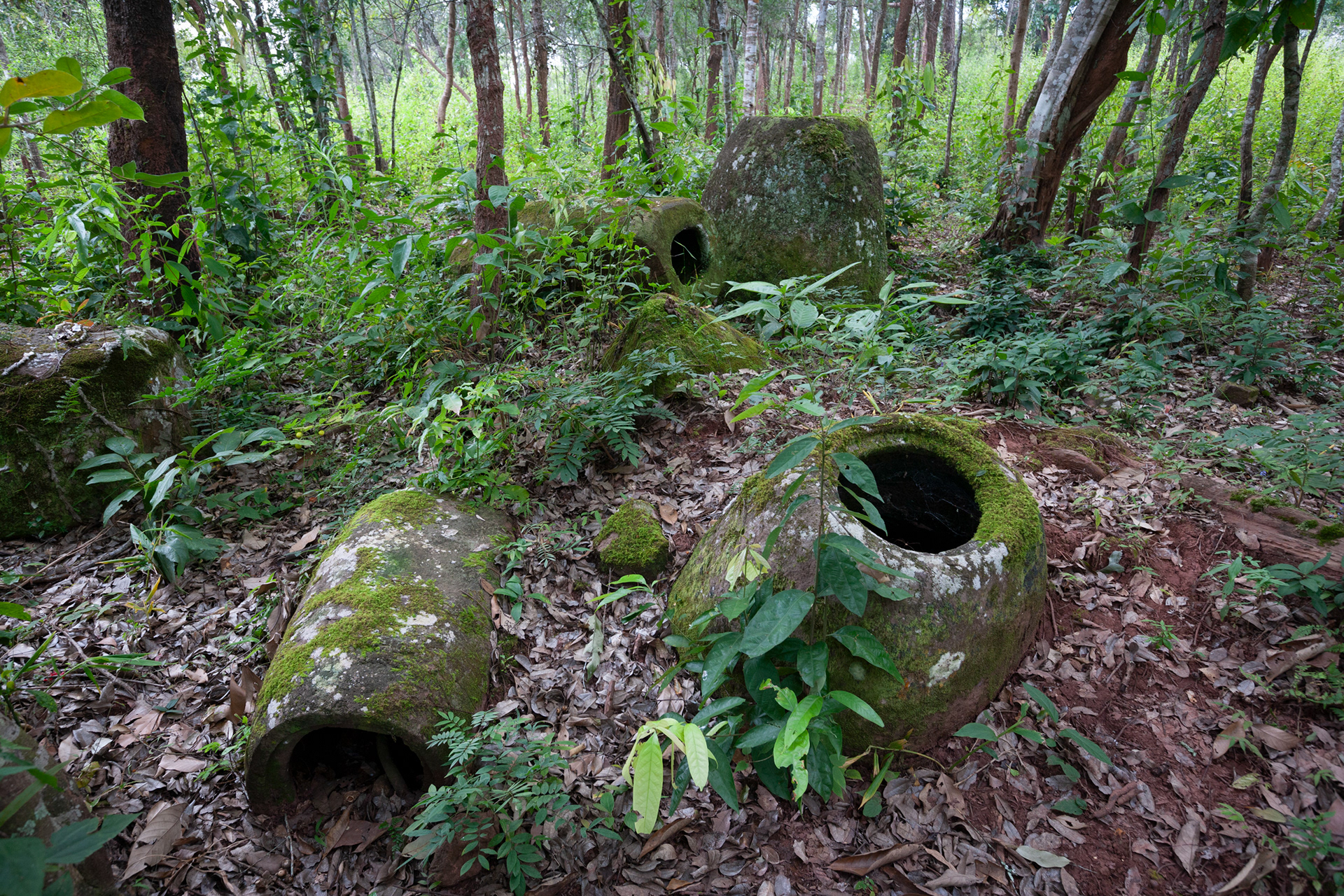
These funerary stone jars were quarried and carved between 1240 BCE and 660 BCE.
Now I return to my 2007 narrative:
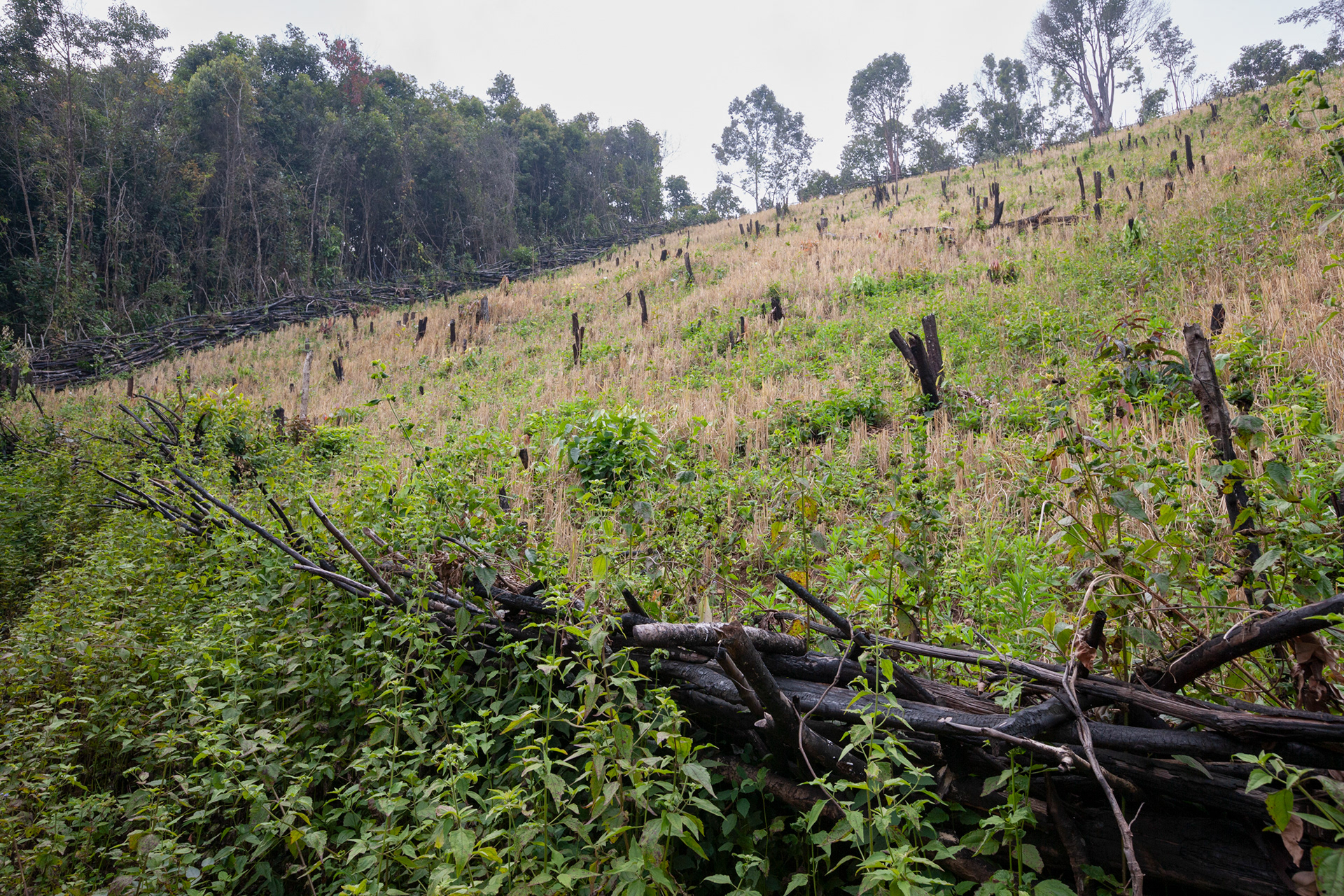
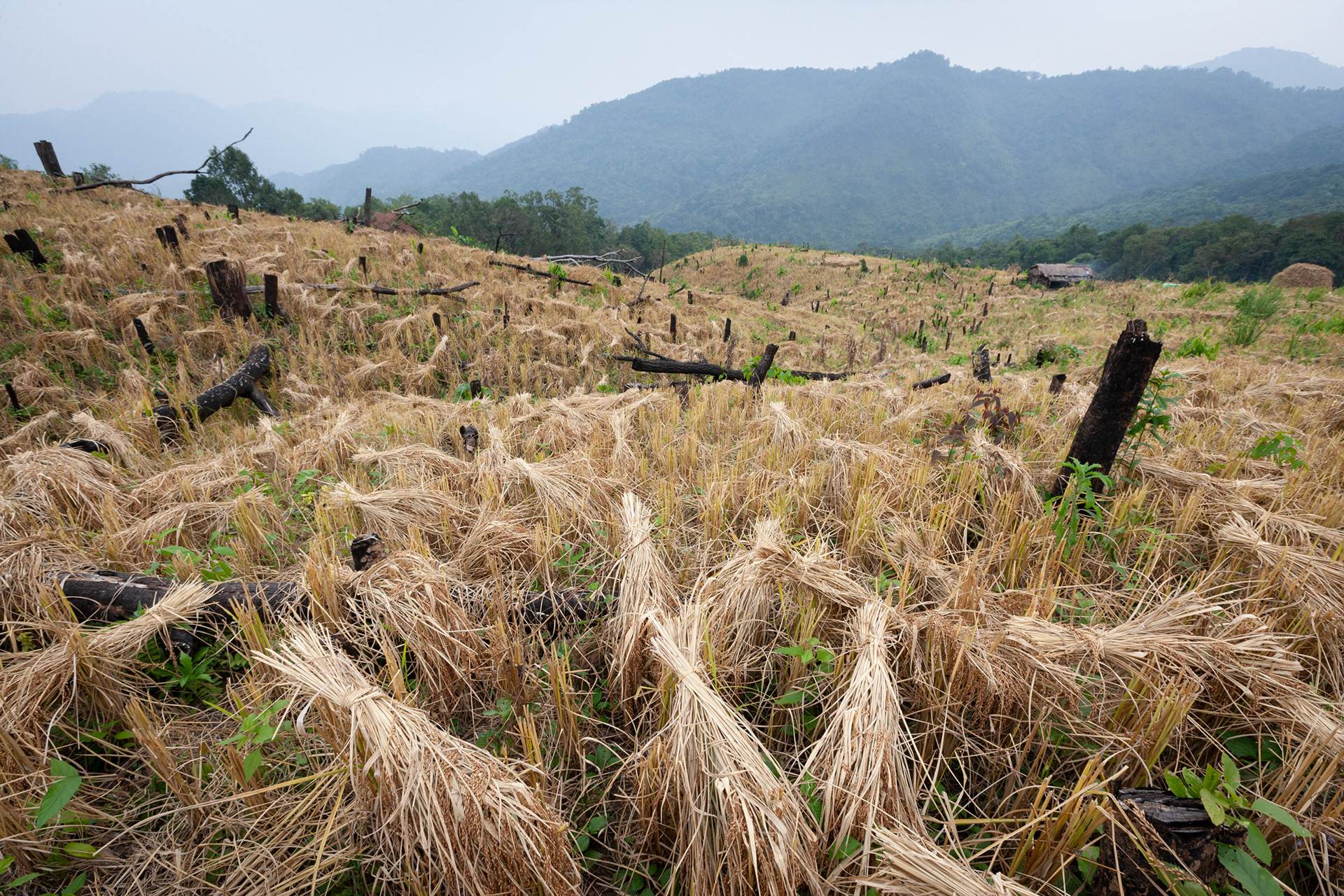
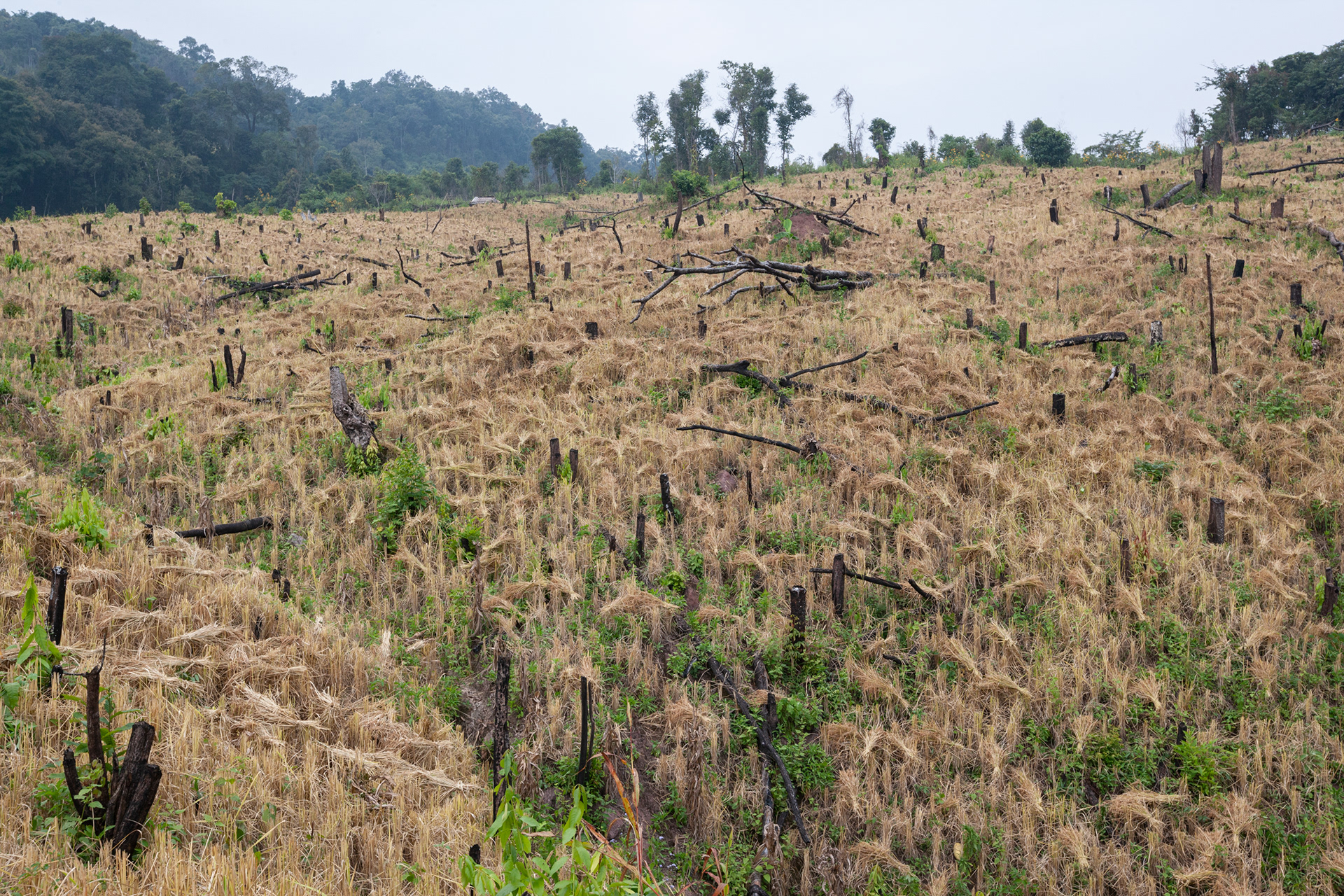
After leaving the forest, the trail cuts across increasingly steep hillsides scarred by the slash-and-burn agriculture of the Hmong. In every direction, massive, charred tree trunks litter the terrain, surrounded by parched golden rice stubble sprouting from fire-blackened earth. Every year after the harvest, the Hmong set new swaths of mountainous terrain ablaze to clear the land for planting next year’s crop. This ancient farming method quickly exhausts the soil and results in a net loss of hardwood trees every year. Moreover, it is far less productive than the wet paddy farming practiced by the Lowland Lao. However, as relative newcomers to Laos—the Hmong only began to migrate here from southern China about two hundred years ago—they must make do with the land no one else wants, just as they did for thousands of years as a minority culture in China.
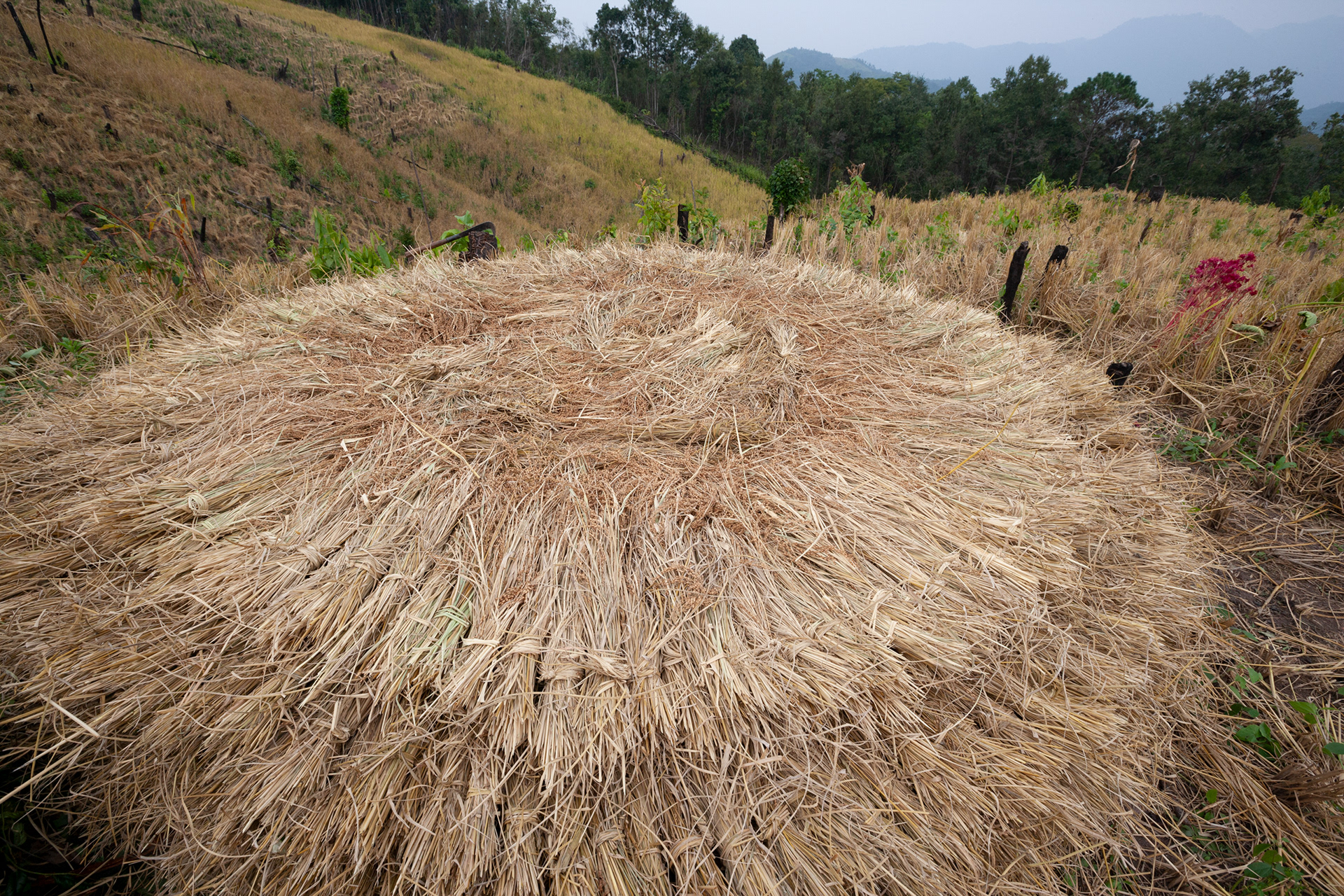
Descending a long ridge, we come to a small plateau used by a Hmong family as a base camp to harvest their rice crop from the adjacent slopes. They have erected a small shelter where meals are taken and where the children who are old enough to be left unattended but too young to work spend their days. A beautifully arranged wheel of rice bundles some fifteen feet in diameter and about three feet high is slowly taking shape. It will eventually rise to a golden dome resembling one of Monet’s haystacks. Once harvested, the rice must dry in this formation for a week or more before it can be threshed.
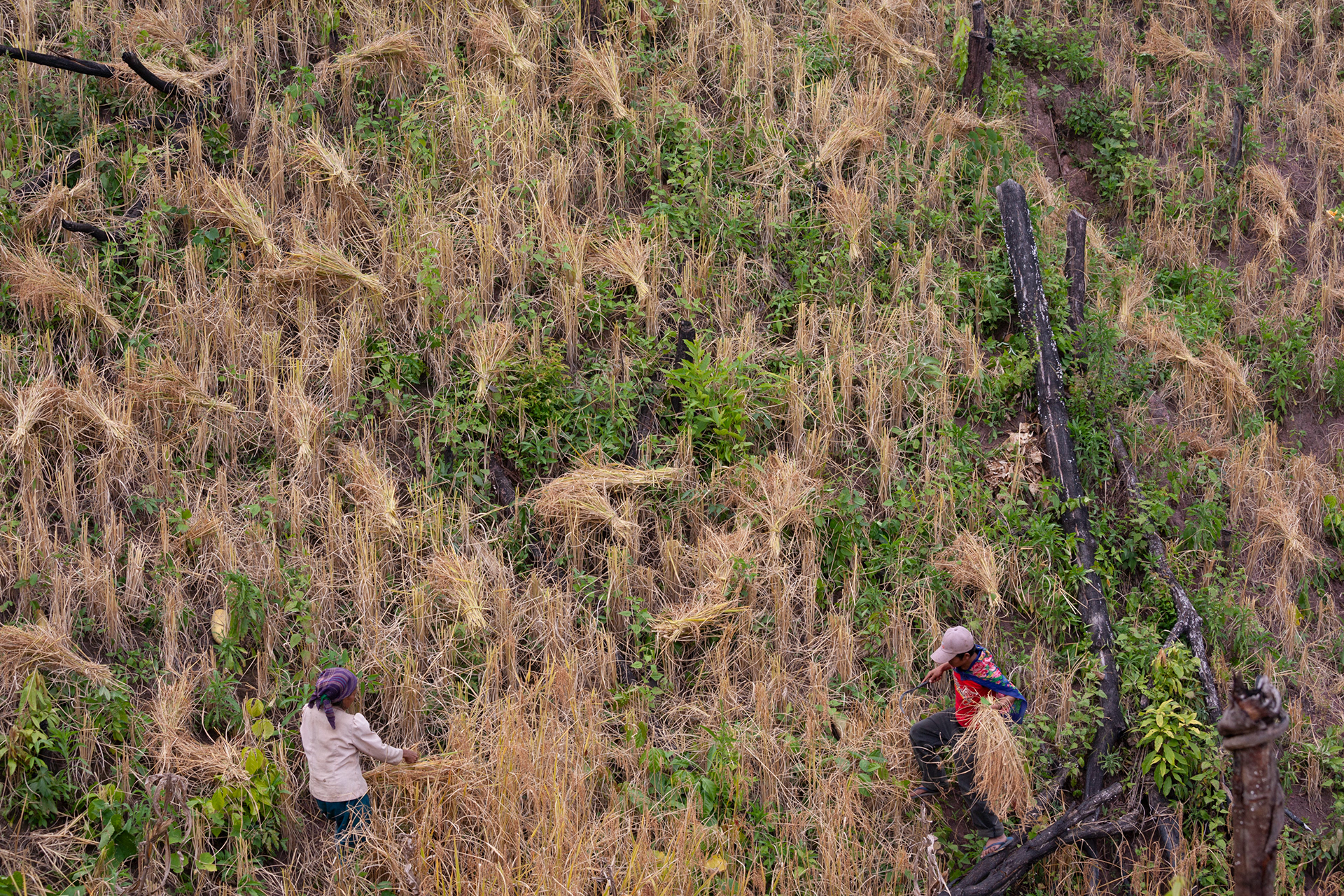
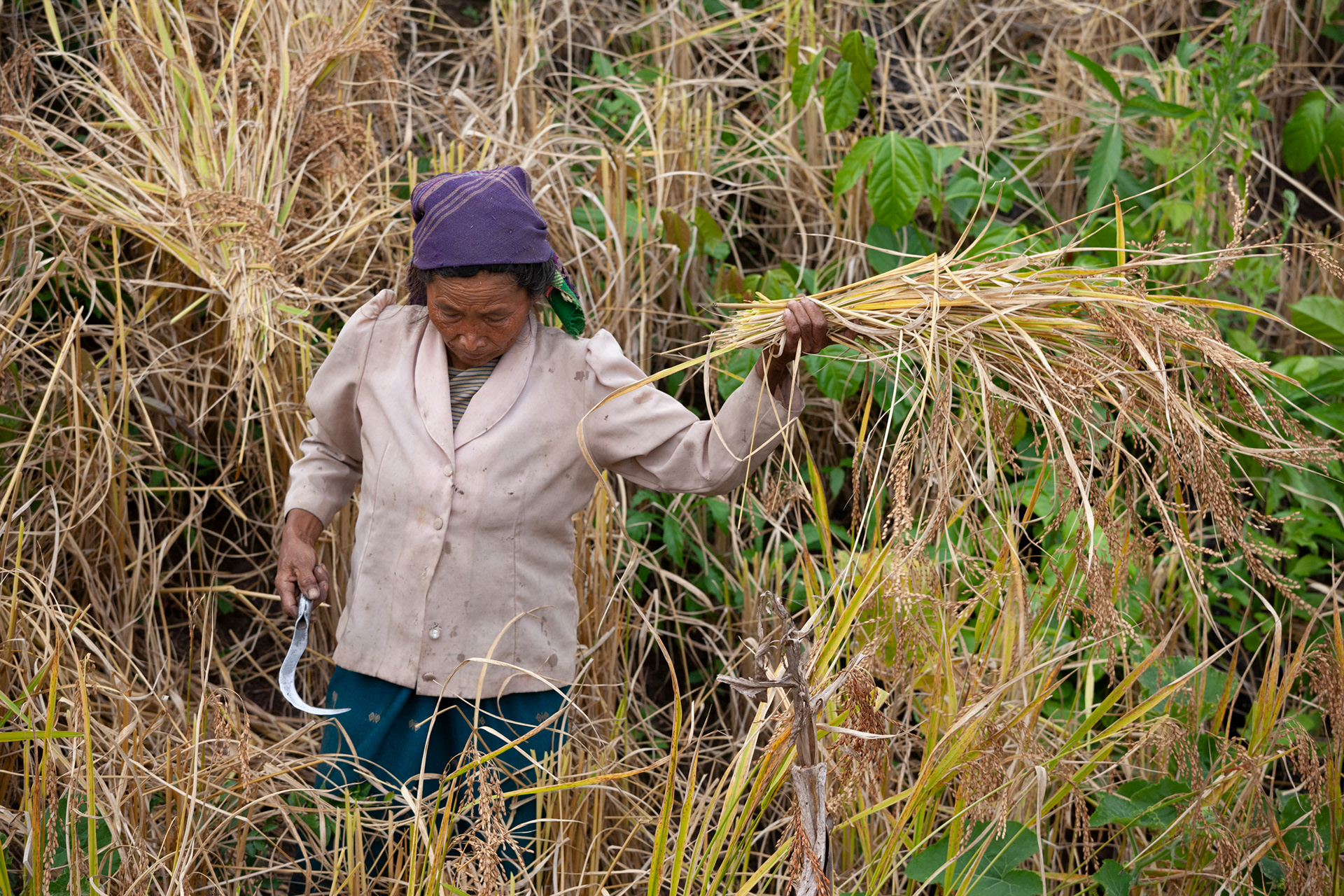
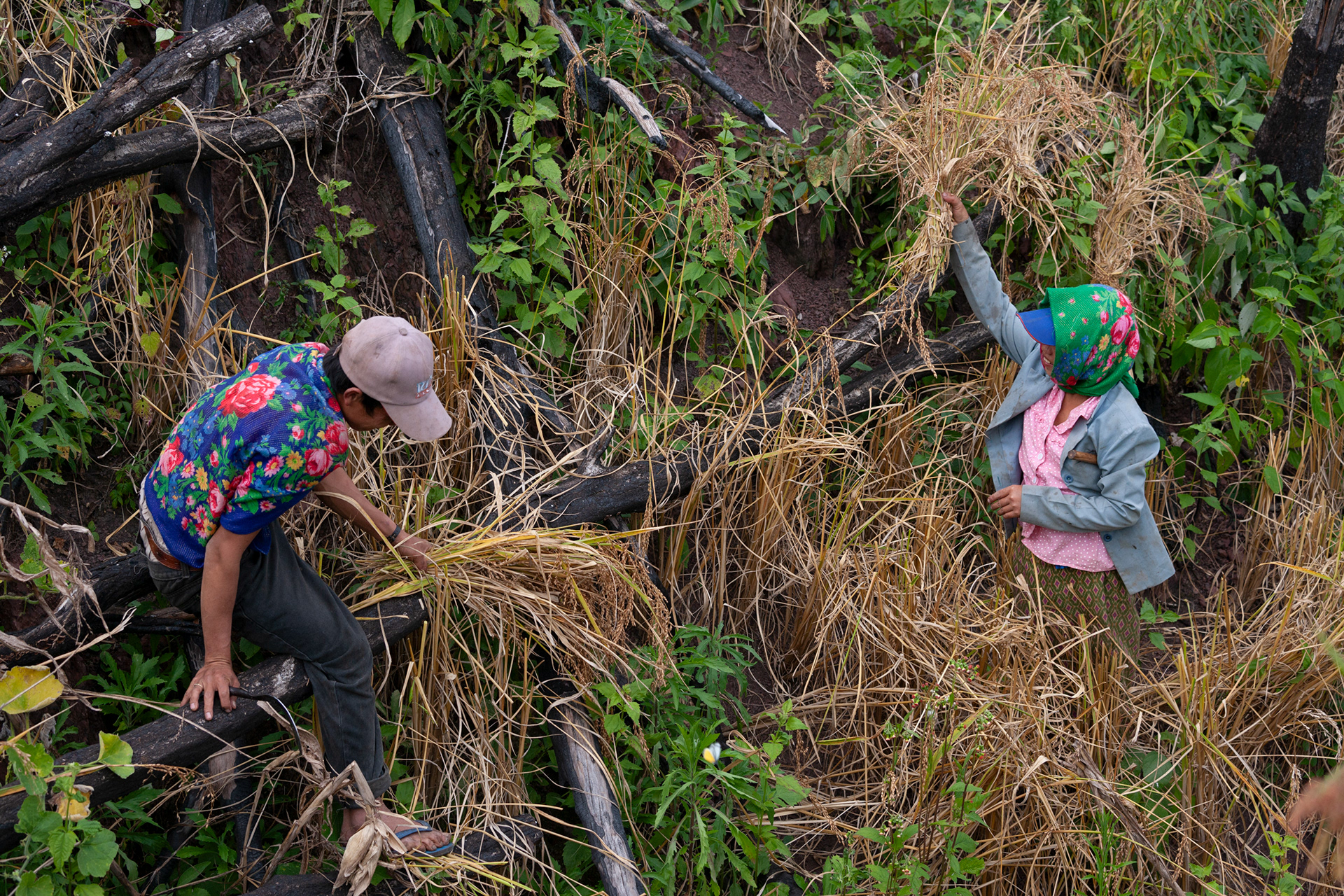
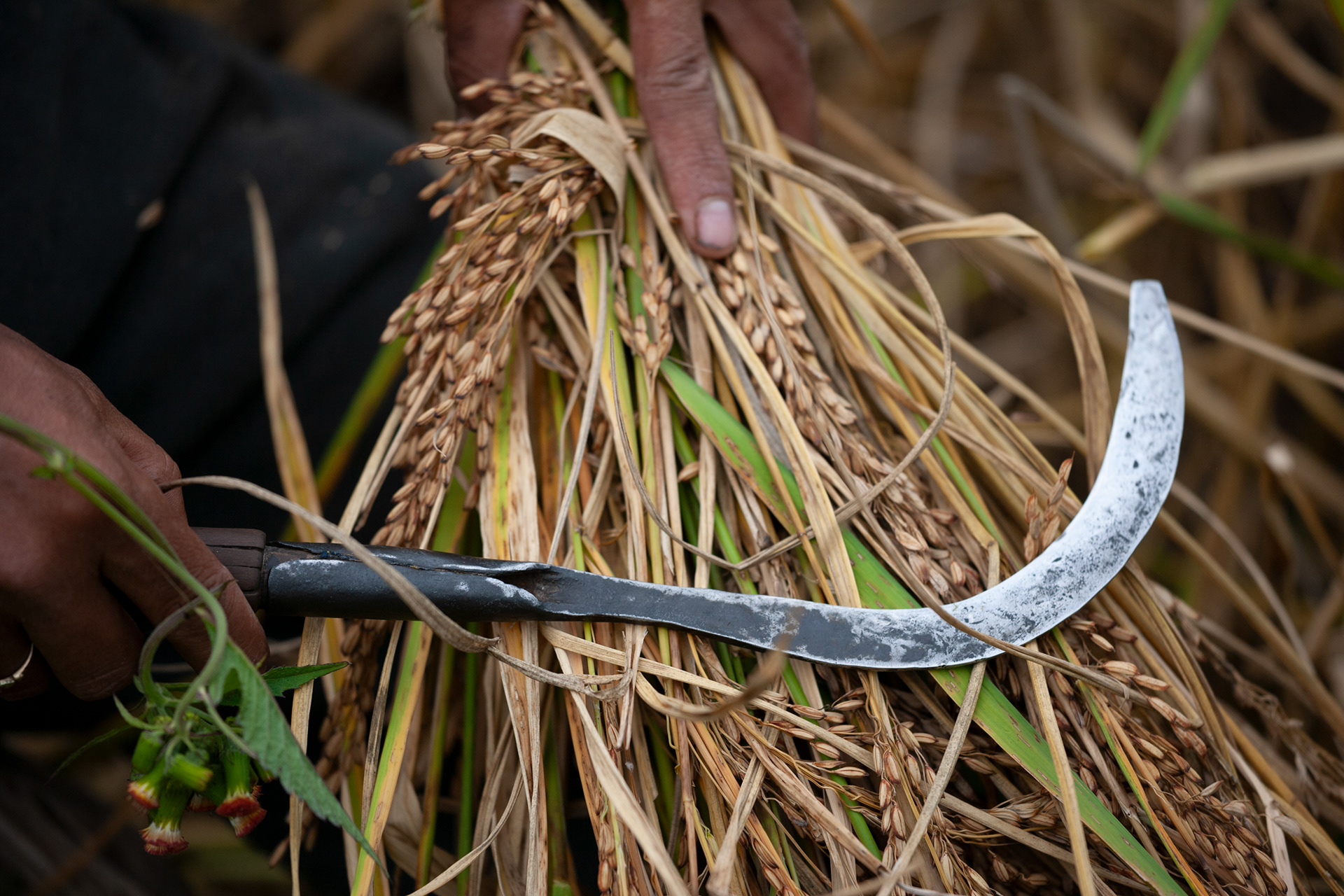
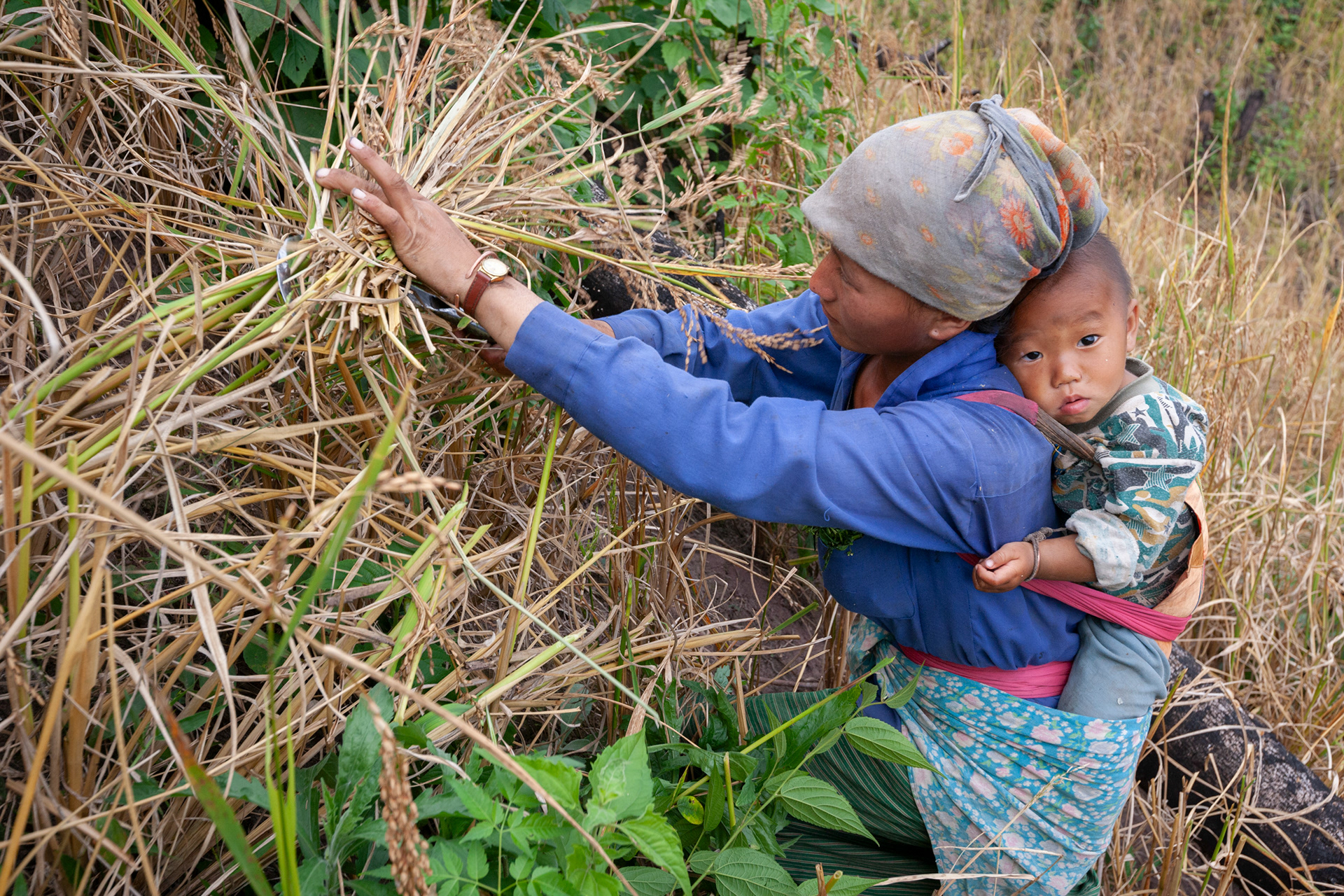
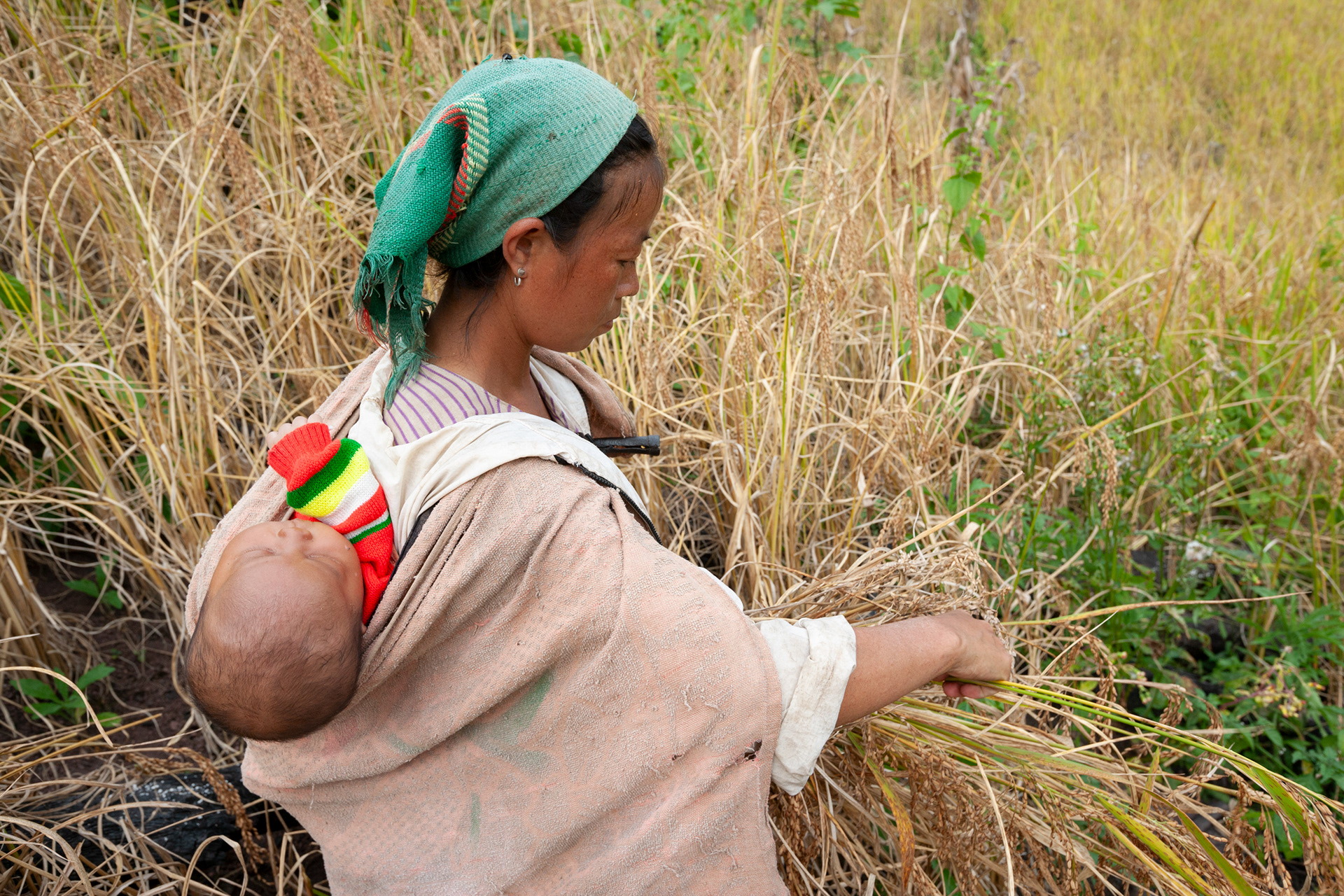
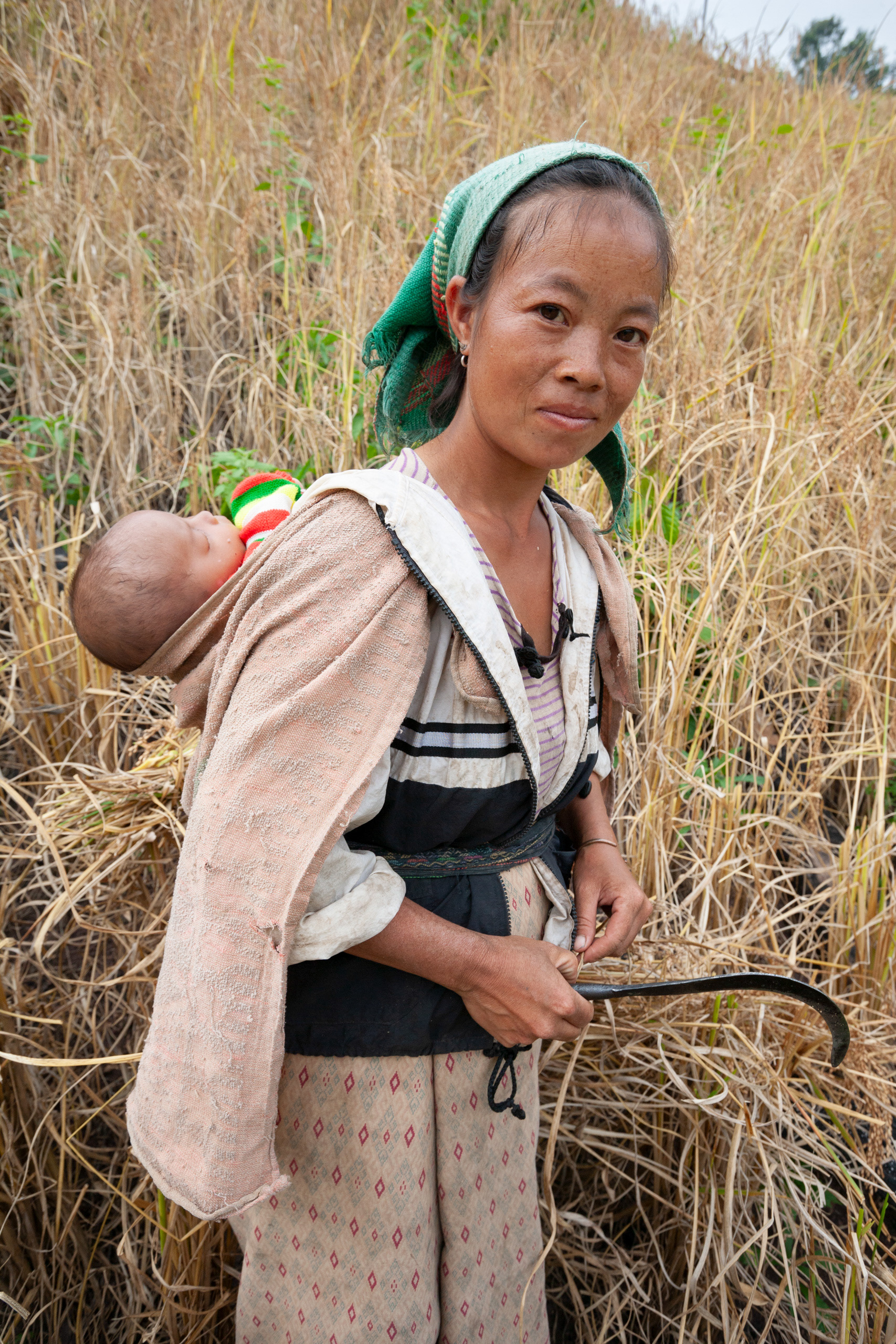
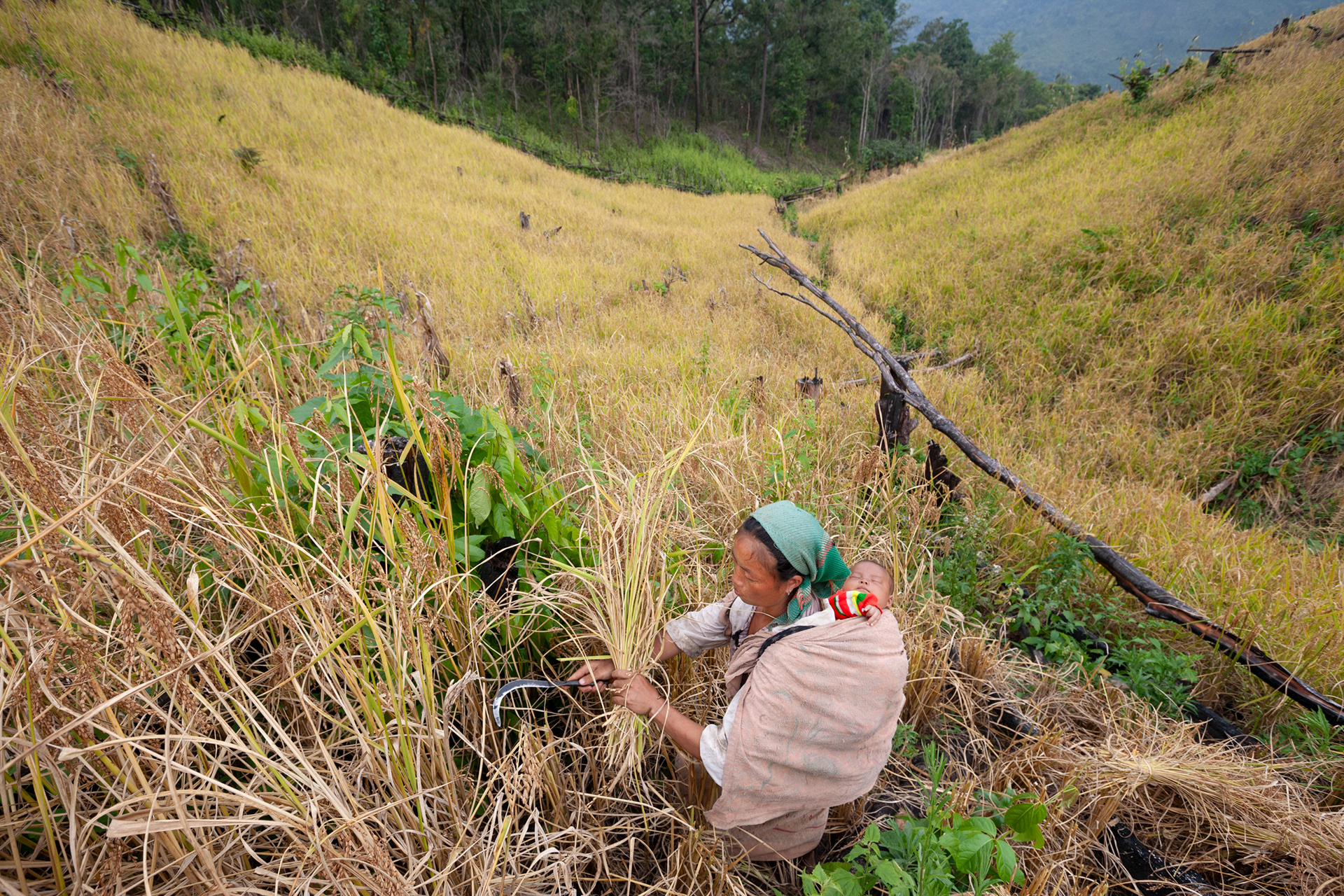
From the edge of the small plateau, I photograph the family cutting and bundling rice on a near-vertical wall of mountainside. They move slowly across the slope, balancing on precarious footholds as they cut the stalks with small hand scythes. Each bundle is tied with a single strand of rice cinched around its girth and then left to dry on the hillside. The work crew includes two brothers, their aging mother, and their two young wives, each carrying a baby on her back. While the others cut rice, one brother gathers up the tied bundles from the hillside, carries them back to the plateau, and arranges them on the growing dome.
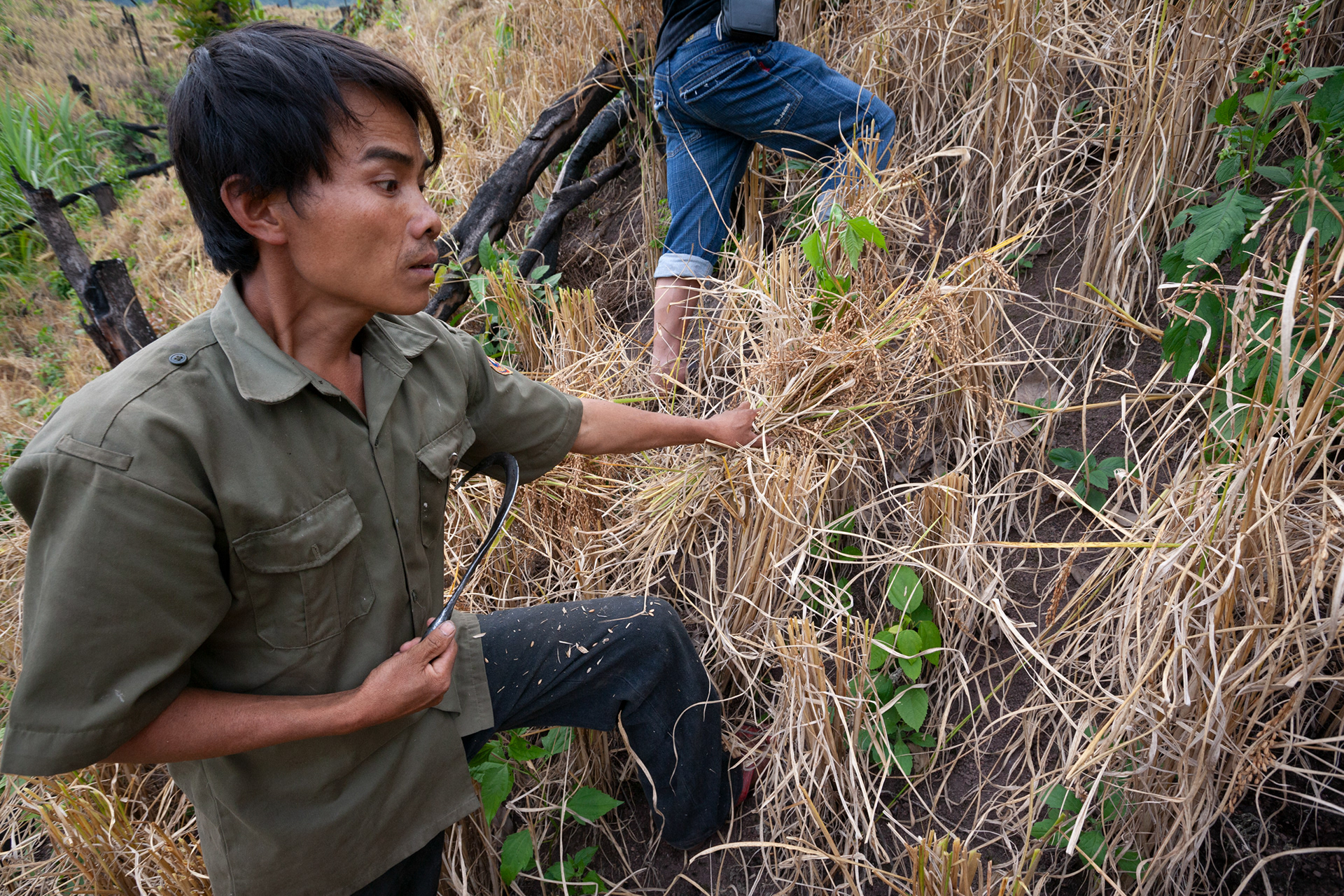
After getting some telephoto shots from the relative comfort of the plateau, I decide to brave the steep slope myself, in order to capture close-up images of the workers. I descend a steep ravine, using a charred tree trunk to get across to the wall of rice on the other side. Once there, I find it almost impossible to keep my balance with the heavy camera and lenses dangling from my neck. I slowly make my way toward the workers, grasping handfuls of rice stubble to keep from falling. These farmers move surprisingly fast considering the difficulty of the terrain; I can barely keep up with them. I try to anticipate their movements and then position myself a little bit ahead, photographing them as they approach, but it is easier said than done; my footholds often give out and I am soon covered with the black soot of the scorched hillside.
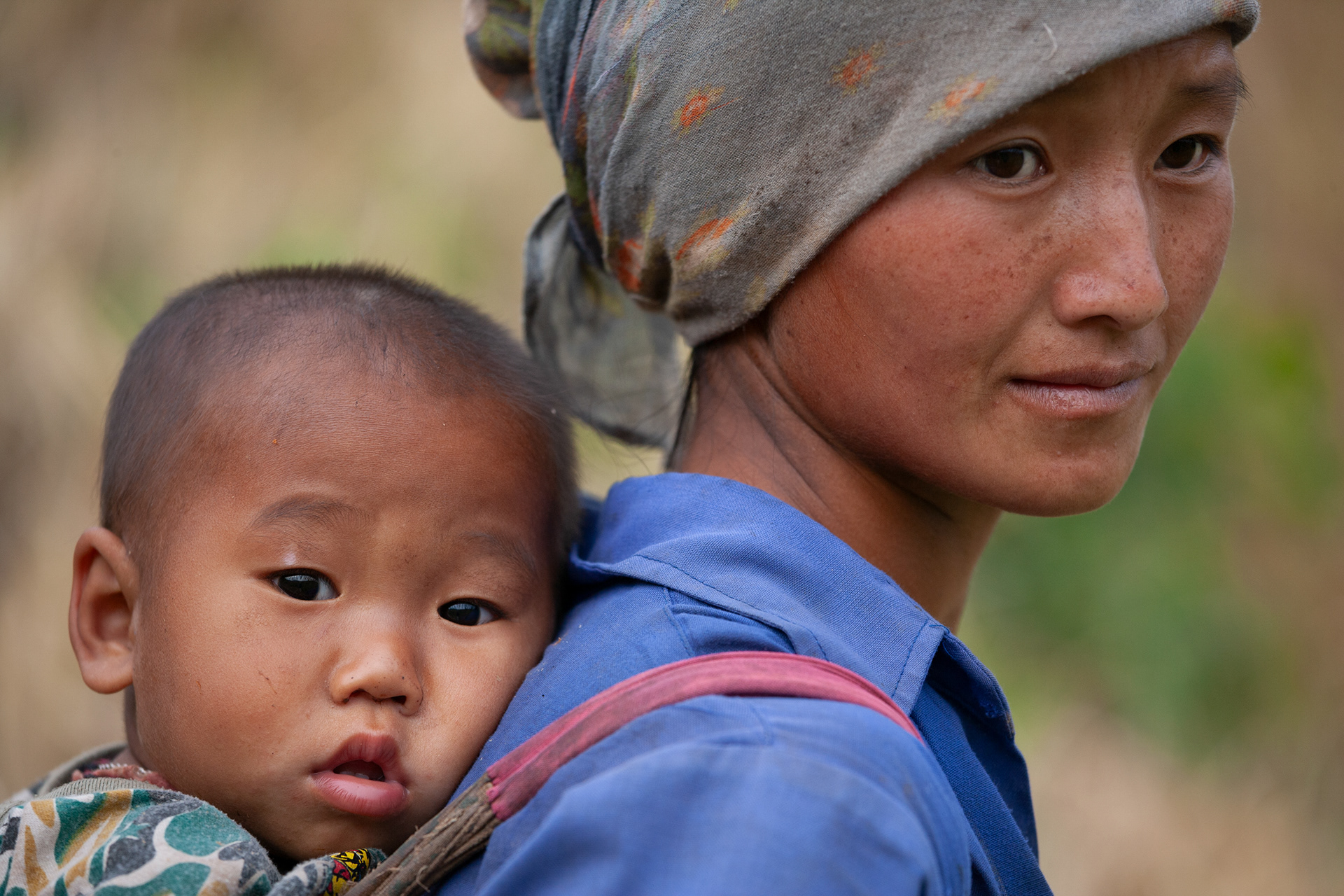
I photograph two young women, aged seventeen and eighteen, and marvel at their ability to work all day under these grueling conditions and still keep their balance while carrying babies on their backs. Suddenly the old woman working a few yards up the slope loses her footing, slides, and crashes into me; together we slide a dozen more yards down the dusty hillside as everyone else breaks into hysterical laughter. After an hour of this punishment, I decide that I have enough pictures and retreat to the plateau, exhausted. It is almost incomprehensible to me how hard these people work to produce just enough rice to subsist on for a year. The statistics Americans are always being fed about how much work we supposedly do in a year shrivel to insignificance after spending a day with these Hmong farmers.
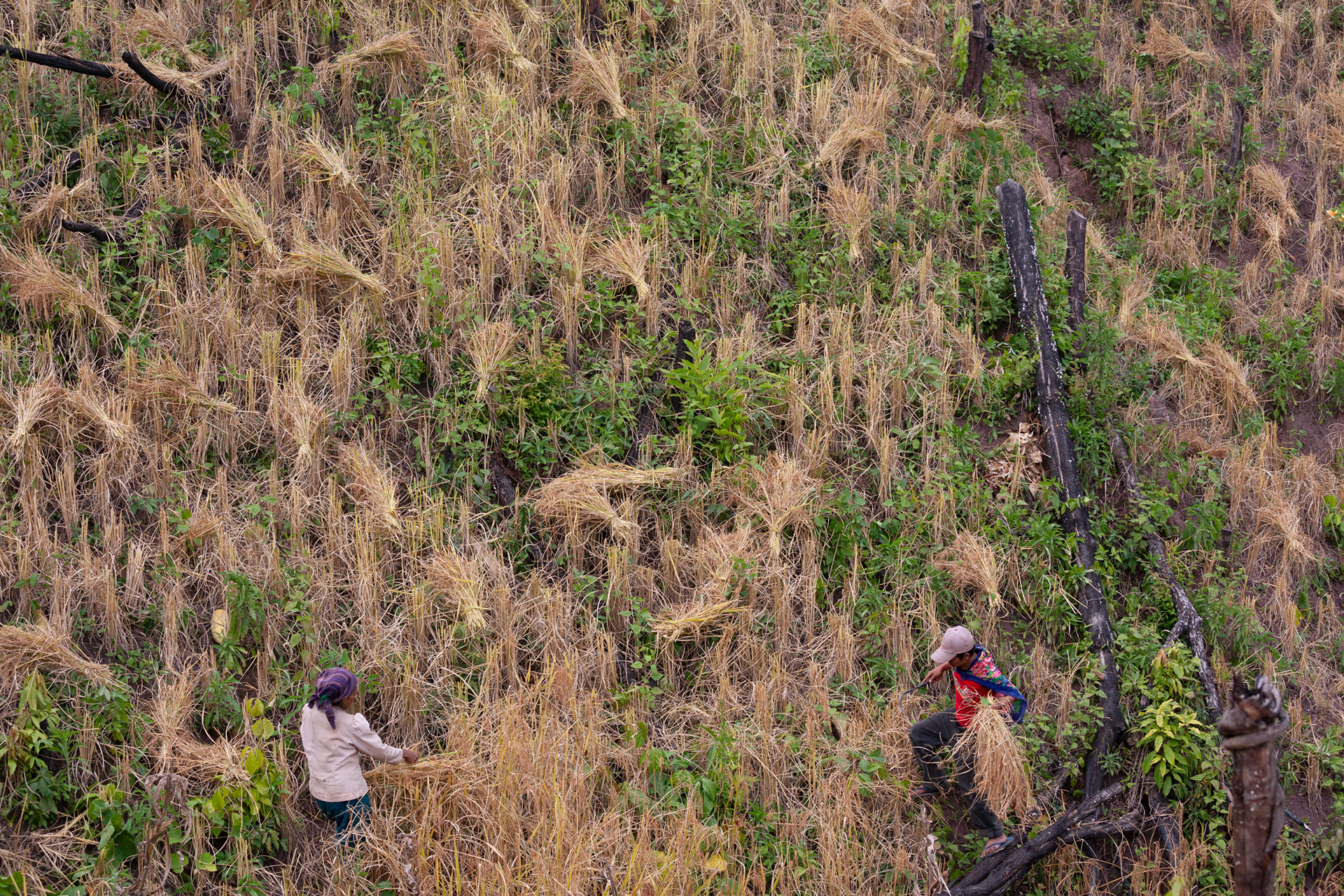
Hmong farmers harvest rice from a steep, hillside field.
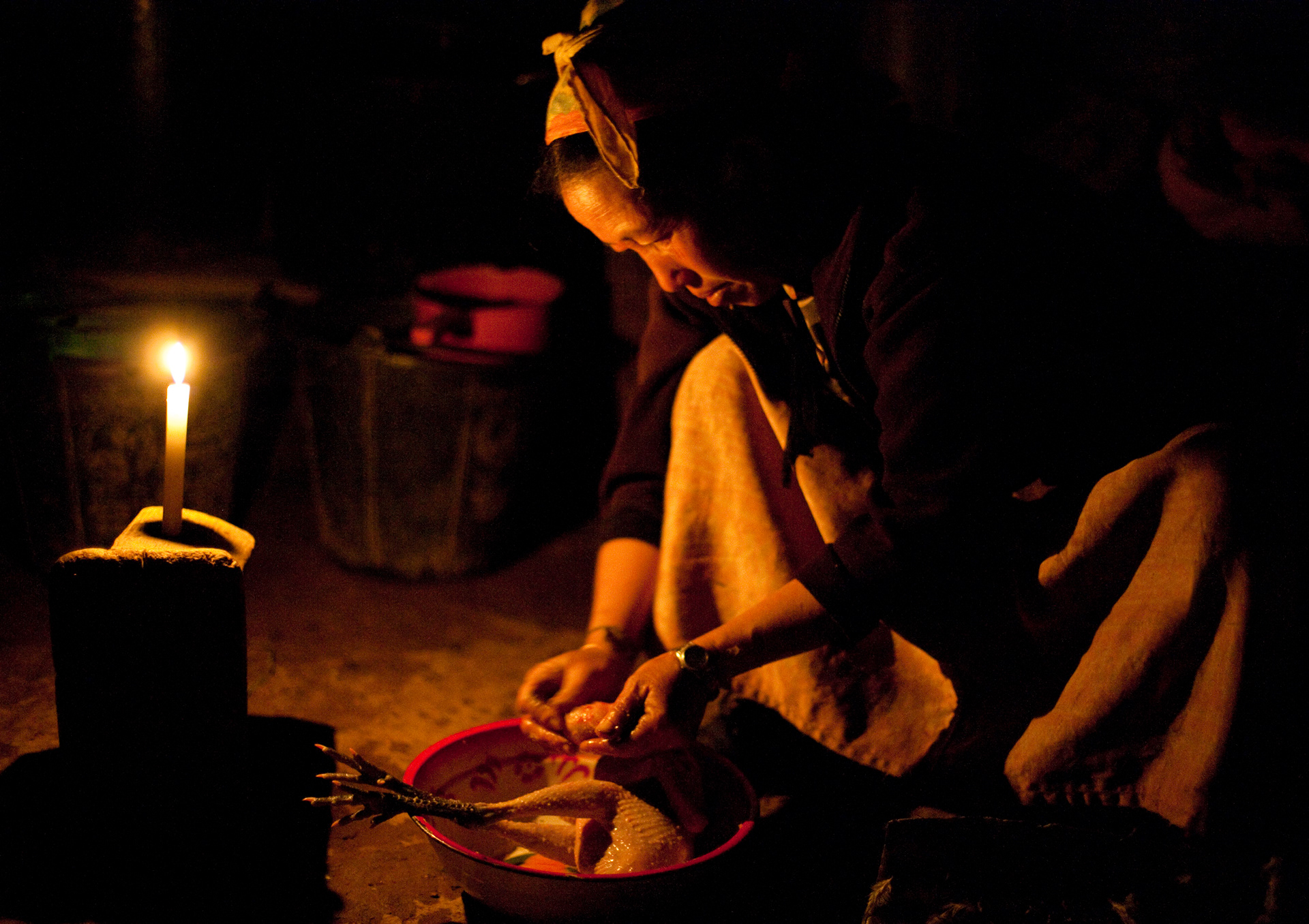
As the light in the sky grows dim, Long and I follow the family back to Ban Pha Keo. Along the way they gather large, heavy branches to cut up for firewood. It is dark by the time we get back to the village and the temperature is already dropping. Long and I relax in the home of the village chief as his wife kills a scrawny chicken and boils it for dinner. The chief’s house is relatively large and well built; the cooking fire keeps it toasty warm. Long, who grew up in a similar village at lower altitude, complains to me in English about the meal: “The problem with these villagers is always the food. They don’t know how to cook the way people in the city like to eat.” I chuckle to myself at his condescending tone, knowing that he was raised on food exactly like what we are now eating. Although the chicken is tough and scrawny, the freshly ground white pepper lends both the meat and broth a delicious flavor. After a long, hard day of hiking and photography, this simple, hearty fare provides welcome sustenance. Even Long has to admit that the sticky rice has an unusually sweet, pungent flavor that comes from being so freshly harvested.
A calm descends on the village as we finish eating and stare into the fire. The ambient sound bed of crickets, frogs, and cicadas lulls me into a soporific state. With no electric lighting, it is incredibly dark out; even the simplest errand is better postponed until morning. After a day so long and exhausting, I can think of nothing but sleep. But it is not to be. Just as I begin contemplating where I will lie down in the chief’s warm, spacious house, Long informs me that a family we saw harvesting rice has invited me to stay with them. It seems to me that there is plenty of room in the chief’s house for both Long and me, since all of his children have already grown up and moved to the city, but before I get a chance to plead my case, the young father from the other family arrives with a flashlight and leads me to his much smaller, more crowded house.
Divided into two rooms, the rickety dwelling sits on short legs above the bumpy terrain on which it is built. Some of the village’s homes are constructed in this nontraditional way, as the rocky, sloping mountain soil does not afford enough good sites to build standard, packed-earth Hmong houses. As a result, this stilted house is creaky, cold, and drafty.
The entire family sleeps in the back room so that I can have the single wooden palette in the front room to myself. By candlelight, I arrange my body diagonally on the short, bumpy pallet, using a foul-smelling blanket as a makeshift mattress and piling all of my extra clothes on top of me for warmth. I blow out the candle and am plunged into a total darkness to which I am unaccustomed. Within a few minutes, the formerly peaceful village comes alive with a loud cacophony of human and animal noises that will last most of the night. Eventually human conversations subside, but it hardly makes any difference in the overall chorus of squawking chickens, crowing roosters, grunting or squealing pigs, fighting dogs and cats, and the occasional bellow of a water buffalo. Add to this the close-range sounds of snoring family members, babies who wake up and cry at all hours, a dozen people crowded into a small wooden house, and a pallet built for someone five feet tall, and you have a foolproof recipe for falang insomnia.
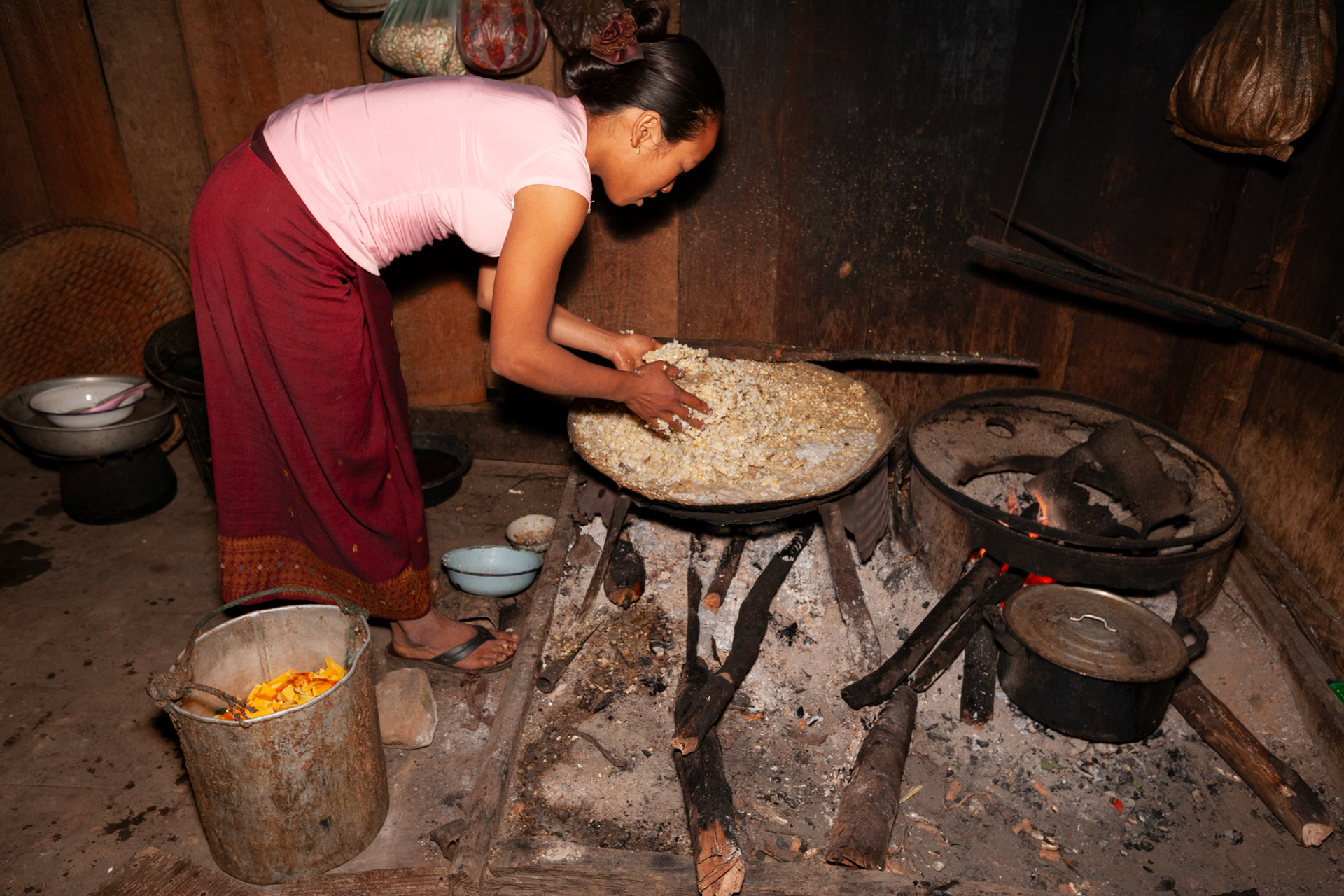
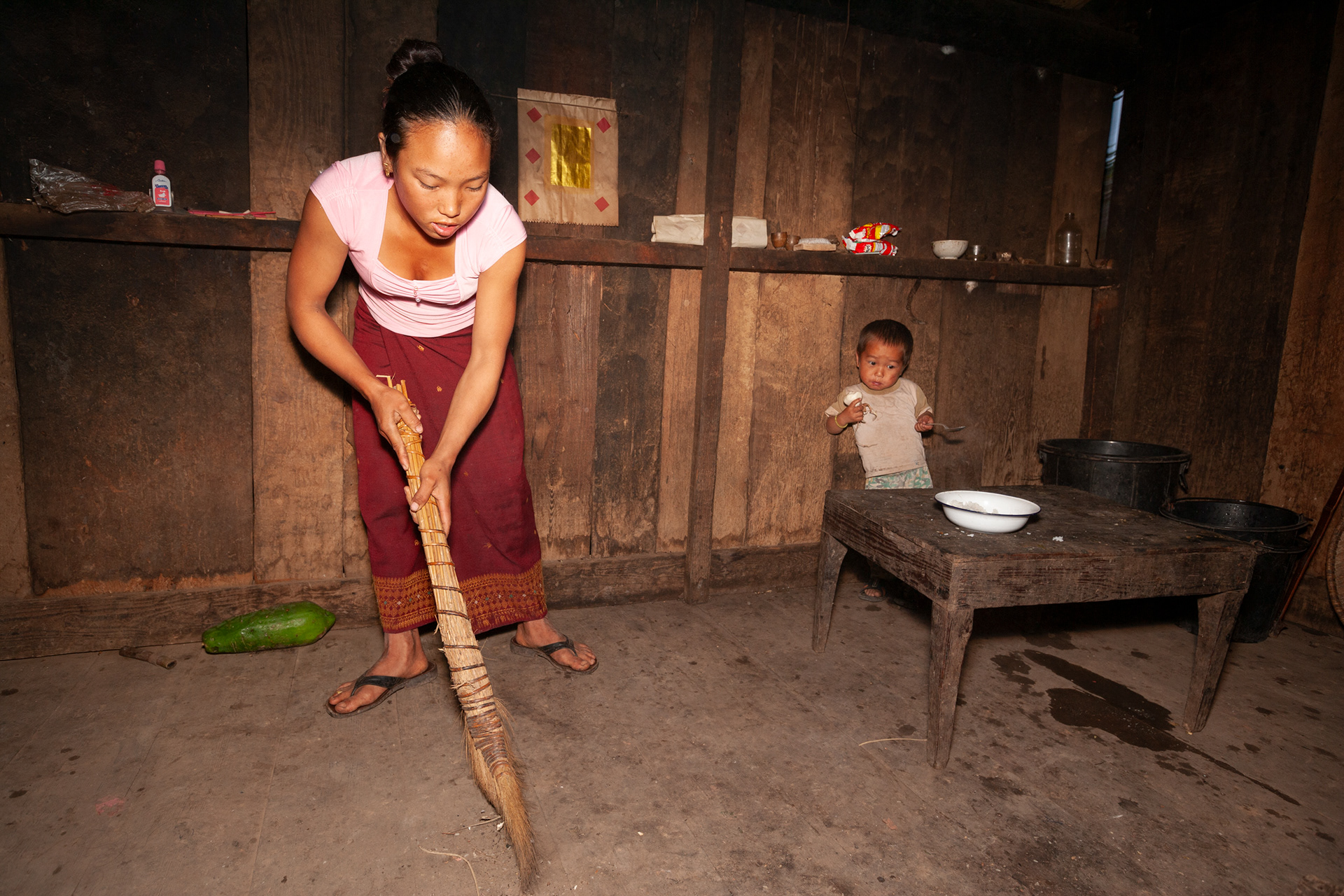
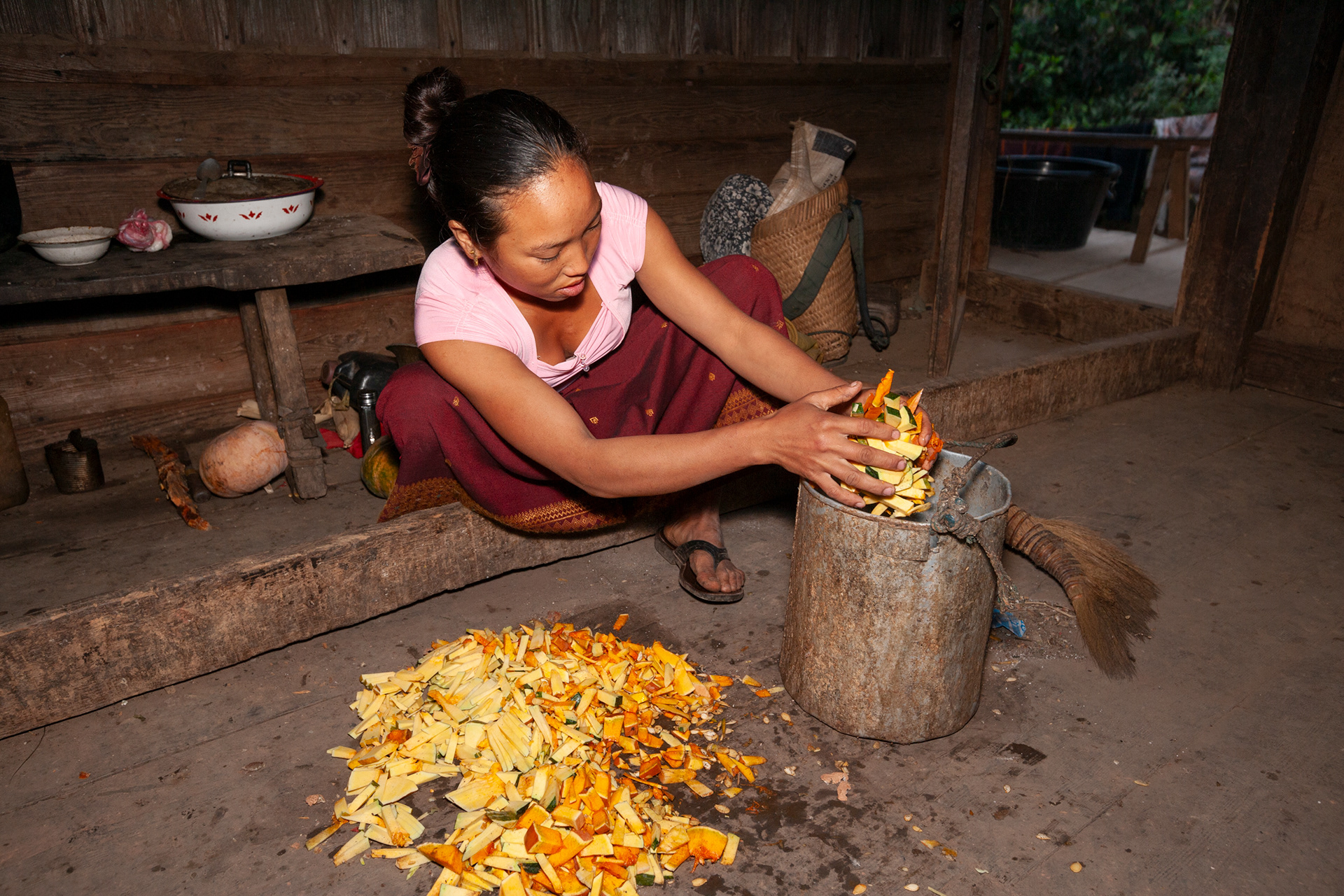
I toss and turn for what seems like an eternity, searching for a comfortable position that does not exist. Finally, I begin to discern a grid of dawn sky leaking through the gaps in the roof. The young mother is the first one to get up, building a cooking fire in the adjacent kitchen. I join her and warm myself by the fire as she begins her daily chores. She starts a big pot of rice, then peels and chops squash, all while keeping an eye on her youngest toddler. As soon as she has a spare moment, she sweeps the kitchen floor and outer porch with a short-handled broom. Most of her work is done in a stooping or squatting position. Soon she will return to the vertical rice fields to put in another full day of harvesting while carrying the baby on her back. This mature eighteen-year-old seems worlds apart from her mall-hopping, text-messaging counterpart in the United States.
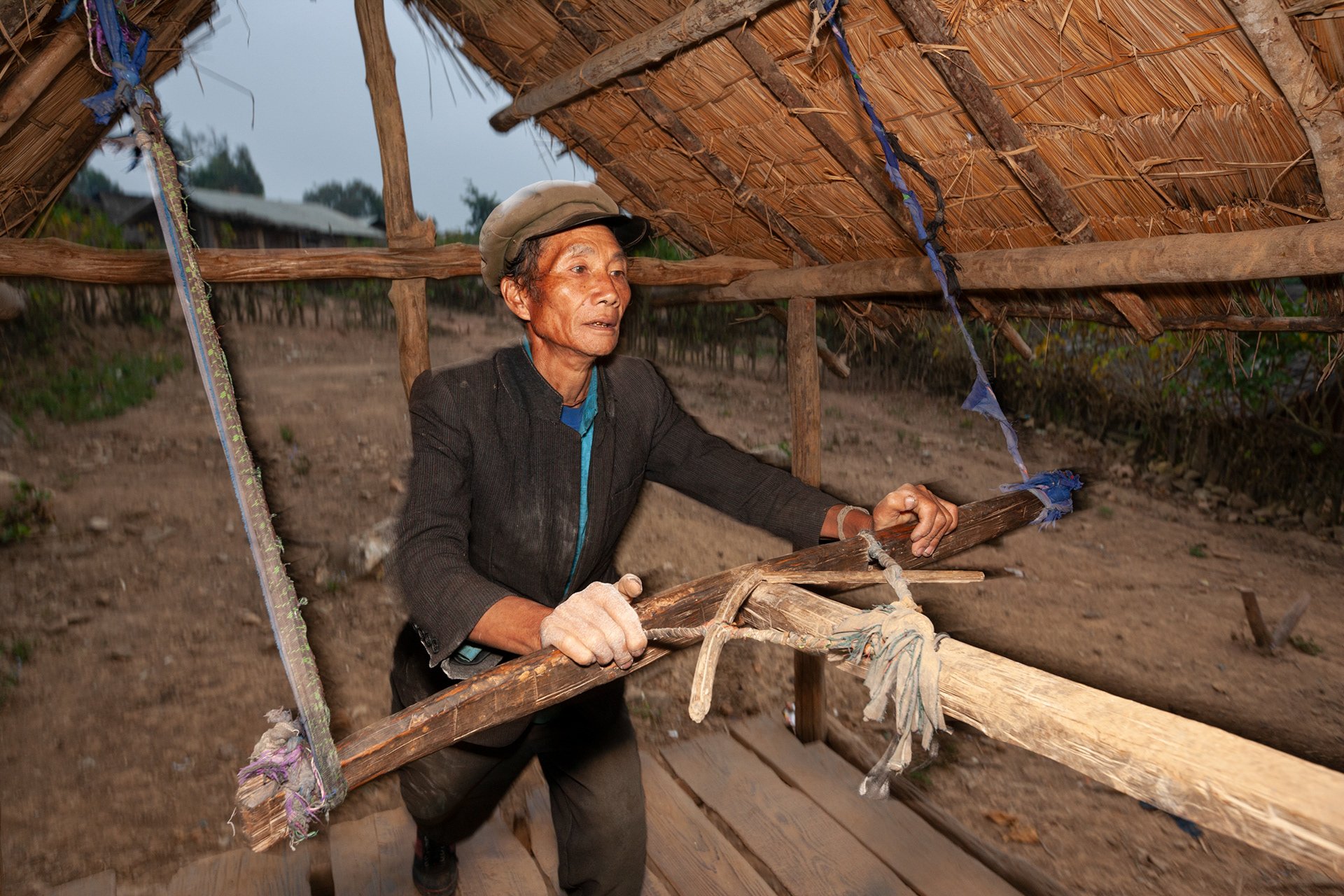
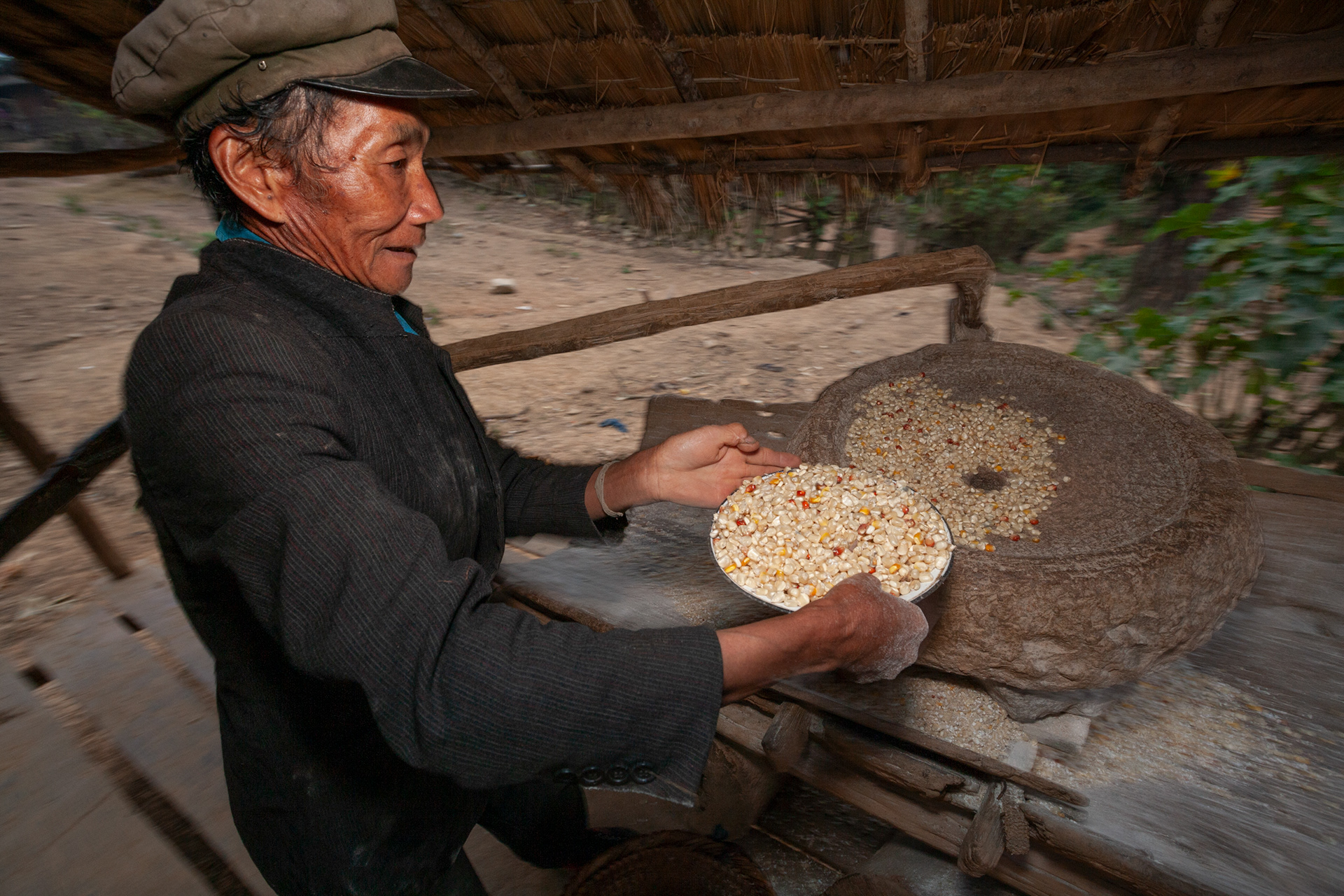
I prowl the village in the cold, bluish light of early dawn, hoping to capture images that might not be possible later in the day. An old man grinds corn using a wood and stone contraption that looks like it might have been designed by Rube Goldberg if he had lived two hundred years ago. Children slop hogs, feed cattle and chickens. Families breakfast on the same food they dined on the night before, fortifying themselves for another day of harvesting, threshing, or pounding their rice crops. In a few hours I will leave Ban Pha Keo, unlikely to ever return, but I will carry memories of this village and her people with me for the rest of my life. When I go home to the United States and visit my Hmong friends in their familiar houses and apartments, I will see them in an entirely new way.
Ban Pha Keo-01
Near the trailhead, a Hmong villager prepares to fish from a giant bomb crater that has been converted into a pond. After flooding the crater, it was stocked with Tilapia, November 12, 2007.
Ban Pha Keo-02
A rickety bamboo bridge for crossing a stream along the trail. I removed my boots and waded across, November 12, 2007.
Ban Pha Keo-04
Villagers from Ban Pha Keo descend the trail with surplus rice from the recent harvest, which they will sell along Route Seven, November 12, 2007.
Ban Pha Keo-05
Villagers from Ban Pha Keo stop to rest as they descend the trail with surplus rice from the recent harvest. They will sell their surplus along Route Seven for much-needed cash income November 12, 2007.
Ban Pha Keo-06
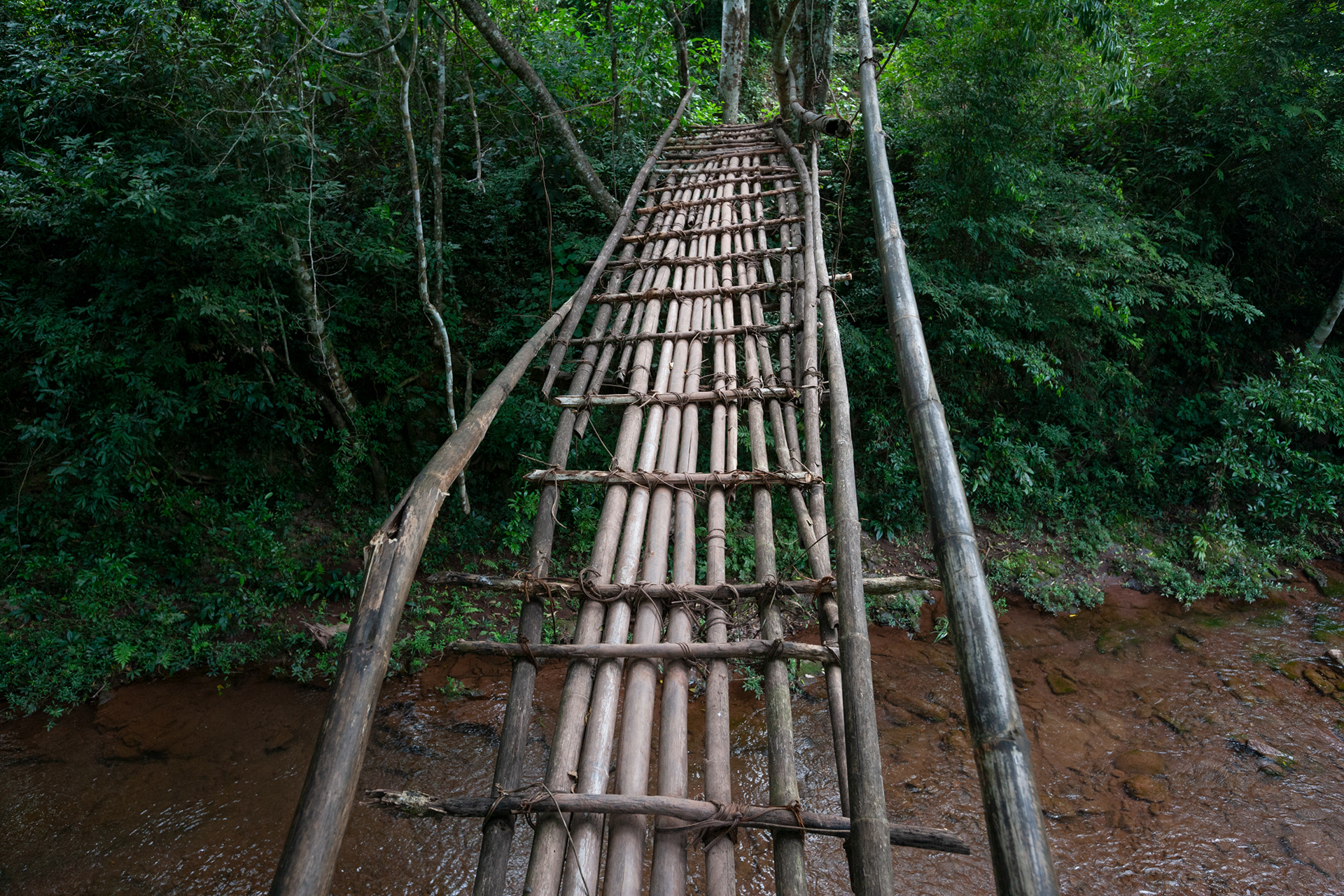
This aging suspension bridge made from bamboo and rusting cables is the best option for crossing a river gorge at the low altitude nadir of the trail. During rainy season, when the river is running higher and faster, it is the only option, November 12, 2007.
Ban Pha Keo-07
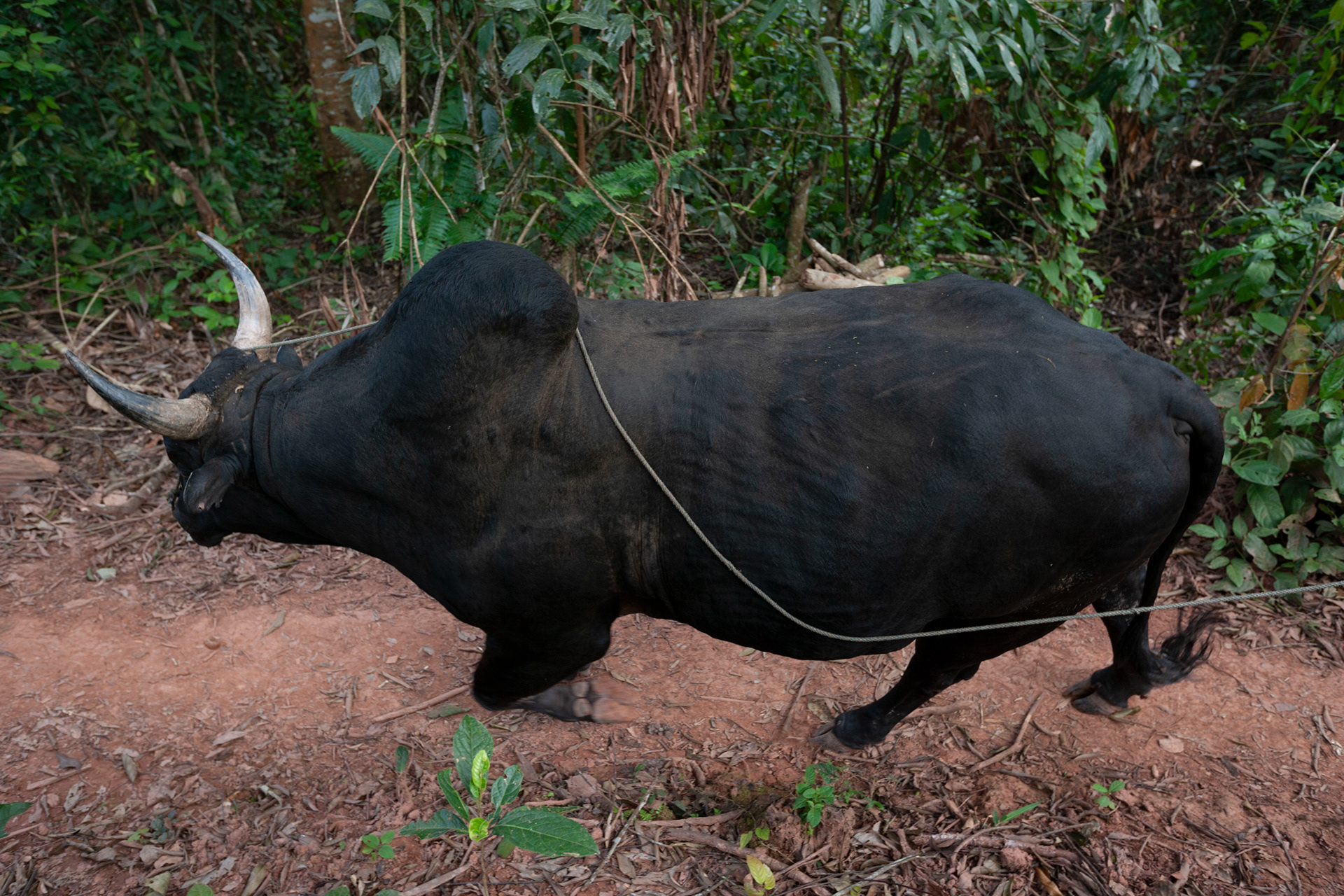
A Hmong fighting bull leads it’s owner down the trail, November 12, 2007.
Ban Pha Keo-08
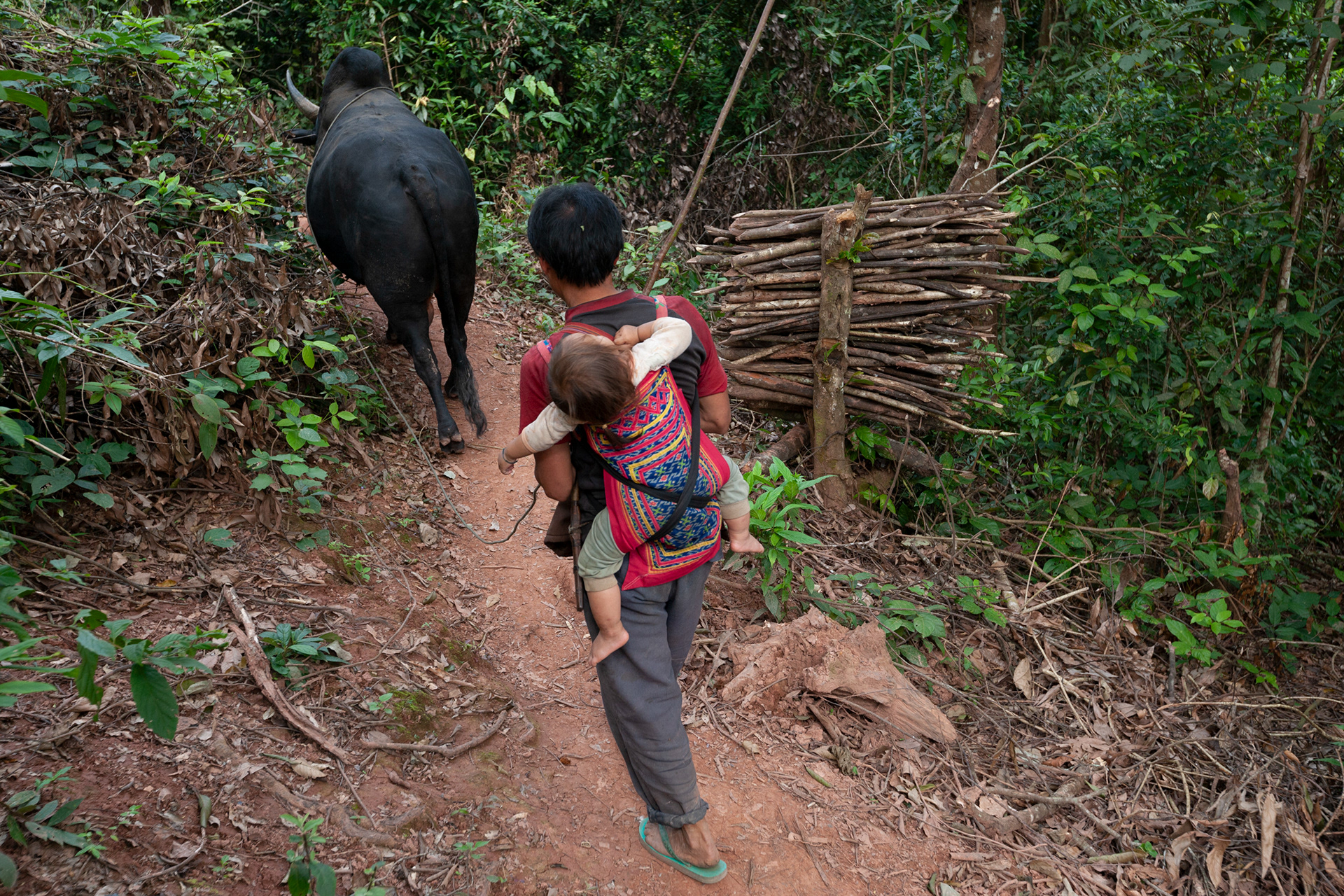
A villager from Ban Pha Keo follows his fighting bull down the trail to Ban Tha Chok, where he will either breed it for a fee or sell it, November 12, 2007.
Ban Pha Keo-09
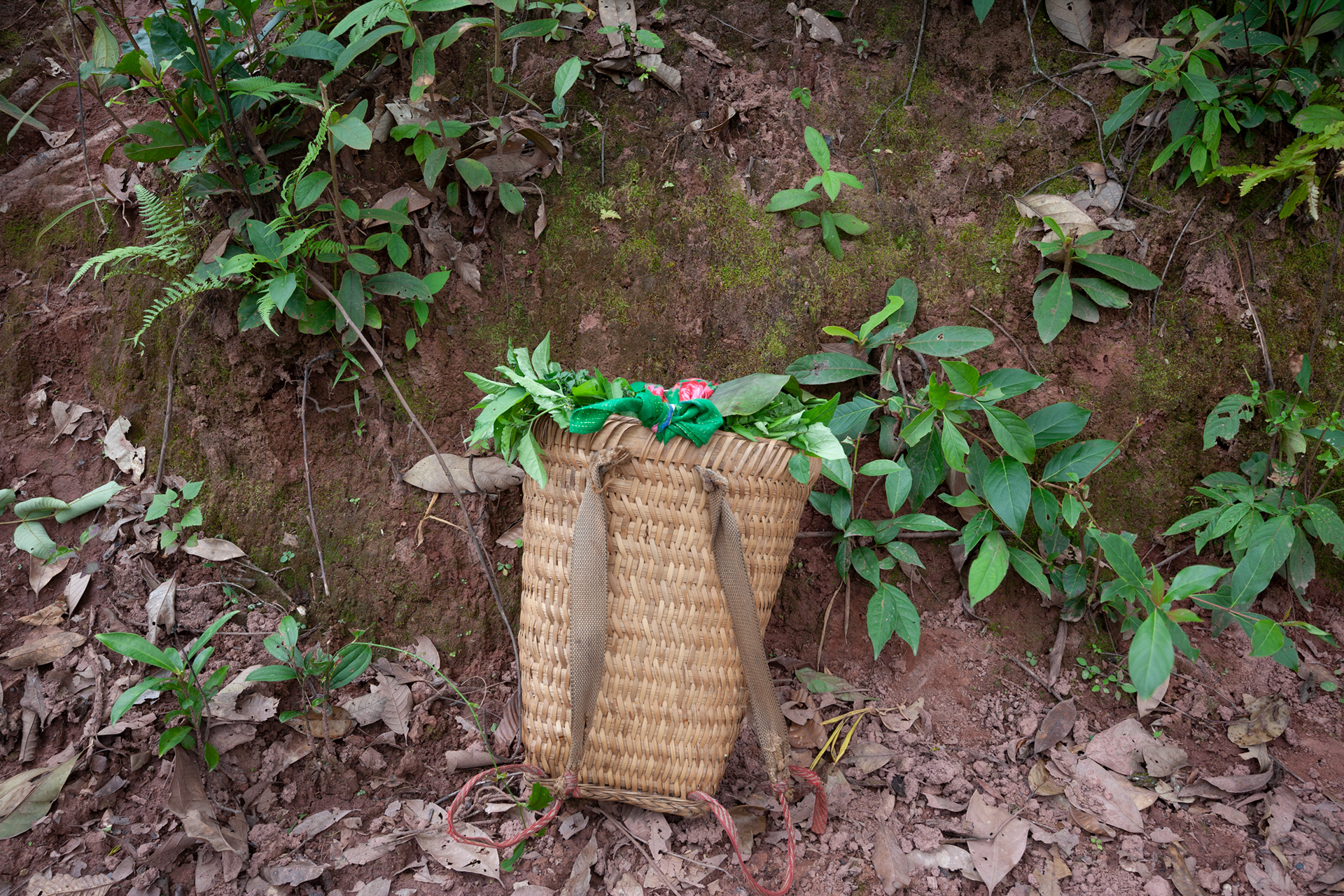
A Hmong basket rests beside the trail as its owner forages for edible or medicinal plants, November 12, 2007.
Ban Pha Keo-10
An ancient stone jar rests against a tree. The jars are estimated to be more than 2,000 years old. This group was discovered by western archeologists in 2007 but long known to Hmong villagers. Photo: November 12, 2007.
Ban Pha Keo-11
The hollow form of an ancient stone jar with an unusual flat top, November 12, 2007.
Ban Pha Keo-12
This ancient stone jar still retains most of its original form, November 12, 2007.
Ban Pha Keo-13
Ancient stone jars scattered among the trees. We were warned not to venture too far into this forest due to the prevalence of unexploded bombs from the Secret War November 12, 2007.
Ban Pha Keo-14
This hillside rice field is a textbook example of Hmong swidden farming. After burning the field, it is planted during the early rainy season. This field has just been harvested, leaving only the shortened stalks of the rice plants.
Next year, the family will have to burn and plant new field in a different location as swidden farming exhausts the soil so that it must be left fallow for several years, November 12, 2007.
Ban Pha Keo-15
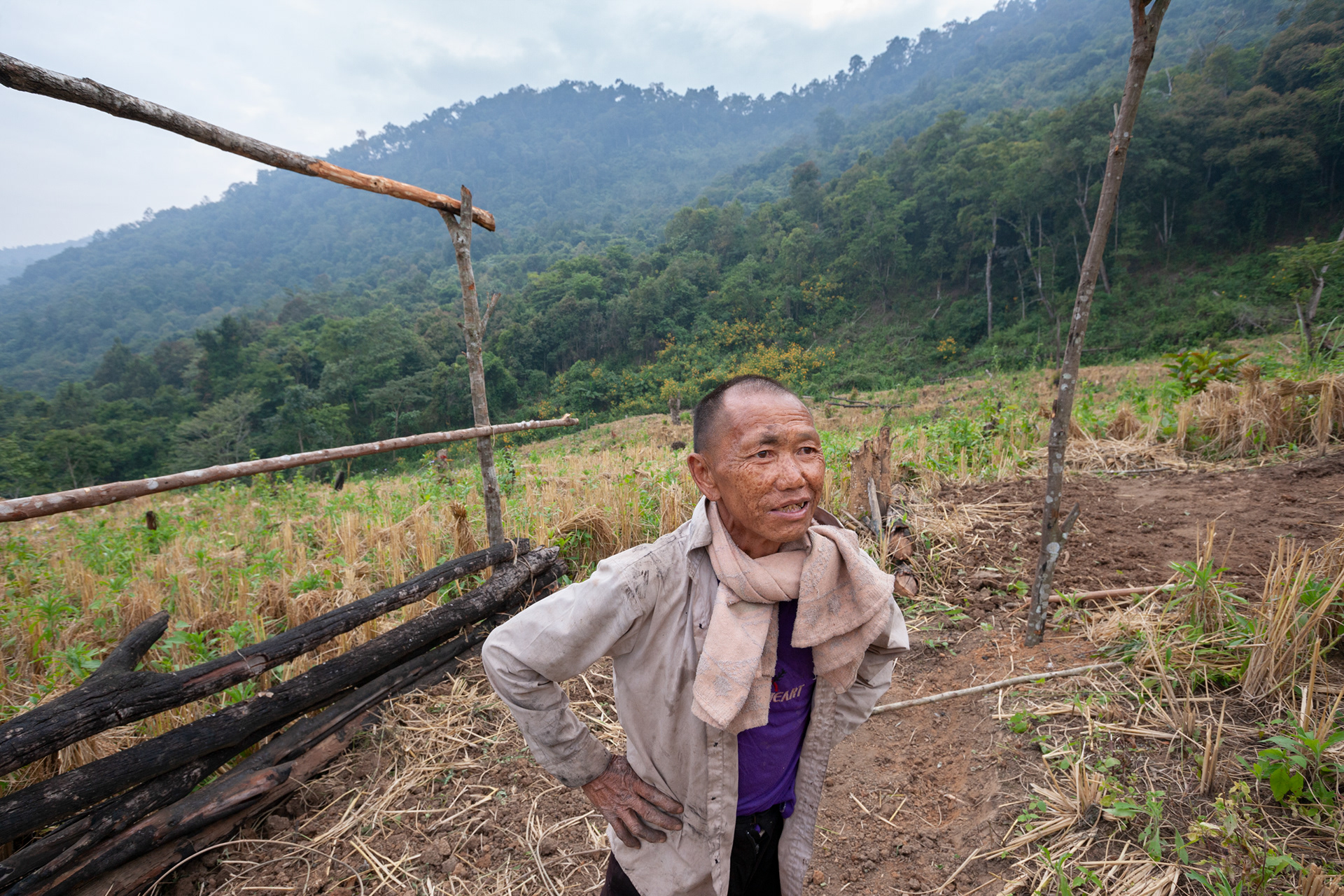
A Hmong farmer gives us directions to fields higher up in the mountains where families are still harvesting rice, November 12, 2007.
Ban Pha Keo-16
A Hmong family is building this wheel of freshly harvest rice so that it can dry. Eventually, the wheel will grow to become a tall sphere, resembling one of Monet’s haystacks, November 12, 2007.
Ban Pha Keo-17
Members of a farming family harvest rice on a steep hillside. They are cutting stalks and tying one strand around each bundle.
Another family member has the job of gathering the cut bundles and carrying them up to the hilltop wheel of rice, November 12, 2007.
Ban Pha Keo-18
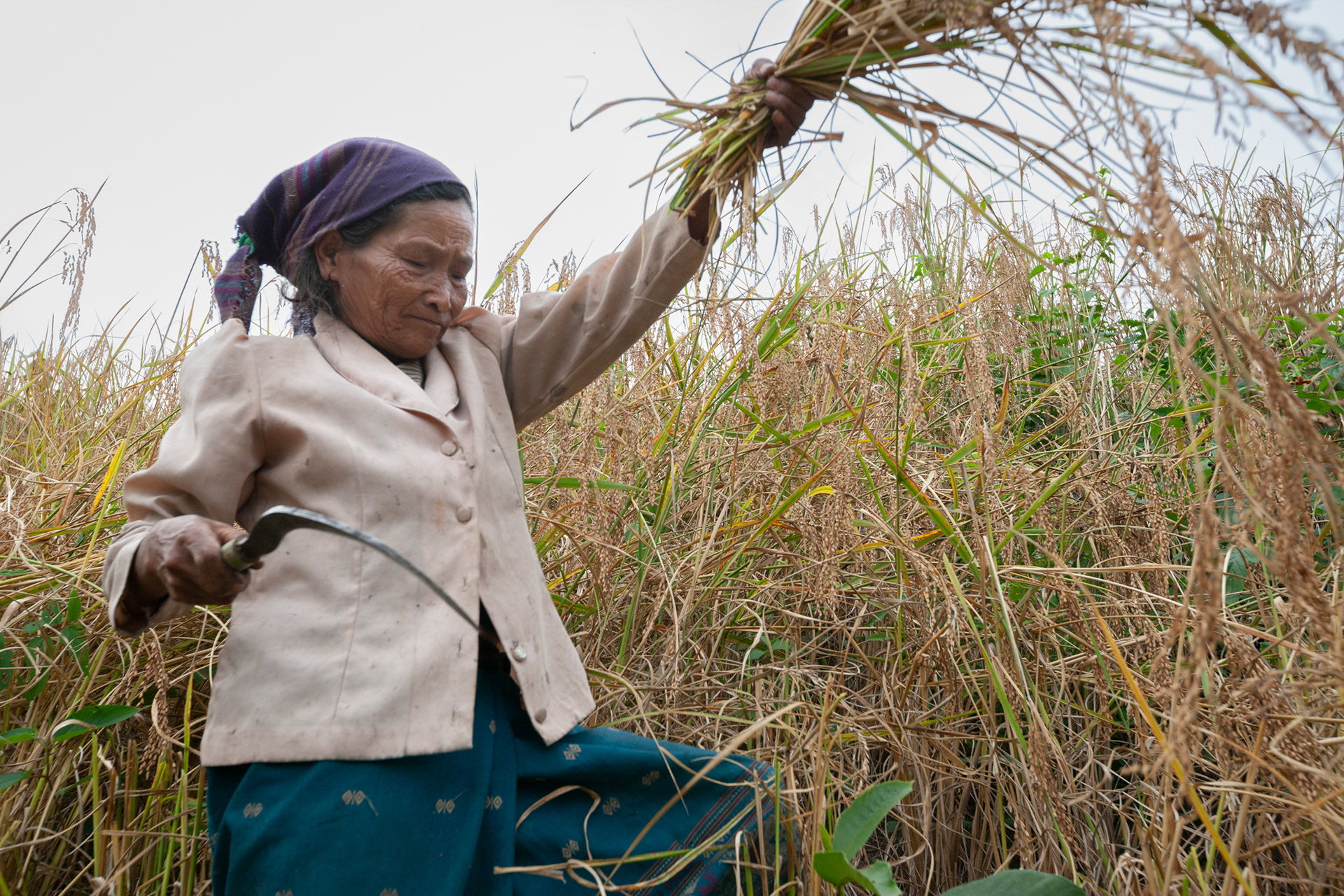
Hmong farmers in mountain regions harvest rice by hand, using homemade scythes. The hours are long and the work is strenuous, November 12, 2007.
Ban Pha Keo-19
Ban Pha Keo farmers pick their way carefully along the steep hillside strewn with burnt trees and other debris. This work is not easy. November 12, 2007.
Ban Pha Keo-20
A closeup detail of a handmade scythe and freshly-cut rice stalks, November 12, 2007.
Ban Pha Keo-21
A Hmong mother carries her youngest child as she harvests rice, November 12, 2007.
Ban Pha Keo-22
A Hmong mother carries her youngest child as she harvests rice. After returning to the village, she will likely prepare the evening meal for her family and do other chores before she sleeps, November 12, 2007.
Ban Pha Keo-24
Another young mother carries her sleeping infant as she harvests rice, November 12, 2007.
Ban Pha Keo-25
Despite long hours of rice harvesting while carrying a baby, these Hmong mothers are surprisingly friendly and gracious in welcoming visitors, November 12, 2007.
Ban Pha Keo-26
Photography seems a woefully inadequate medium to capture the dizzying steepness of this slope, where a Hmong mother harvests rice while carrying her infant child, November 12, 2007.
Ban Pha Keo-27
A farmer negotiates the steep hillside. My guide, Long Vang (upper right), pitches in to help, November 12, 2007.
Ban Pha Keo-28
A Hmong woman lifts a freshly-cut rice stalk high in the air to free it from the undergrowth, November 12, 2007.
Ban Pha Keo-29
A field of freshly-cut rice bundles waiting to be picked up and added to the growing wheel of rice at the top of the hill, November 12, 2007.
Ban Pha Keo-30
The same family’s upper hillside field of freshly-cut rice stalks waiting to be gathered, November 12, 2007.
Ban Pha Keo-31
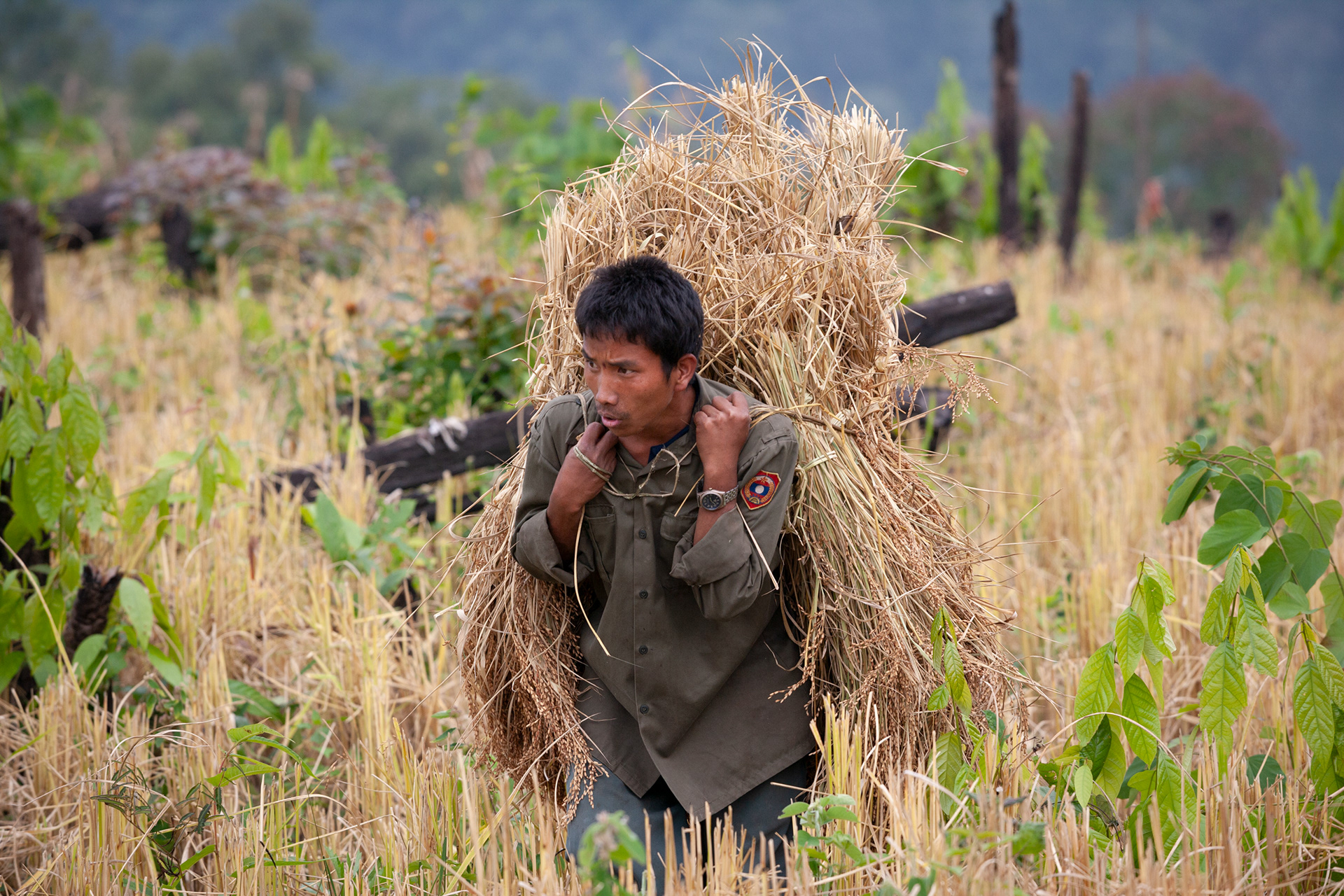
A farmer carries a heavy load of rice stalks up a steep hillside, November 12, 2007.
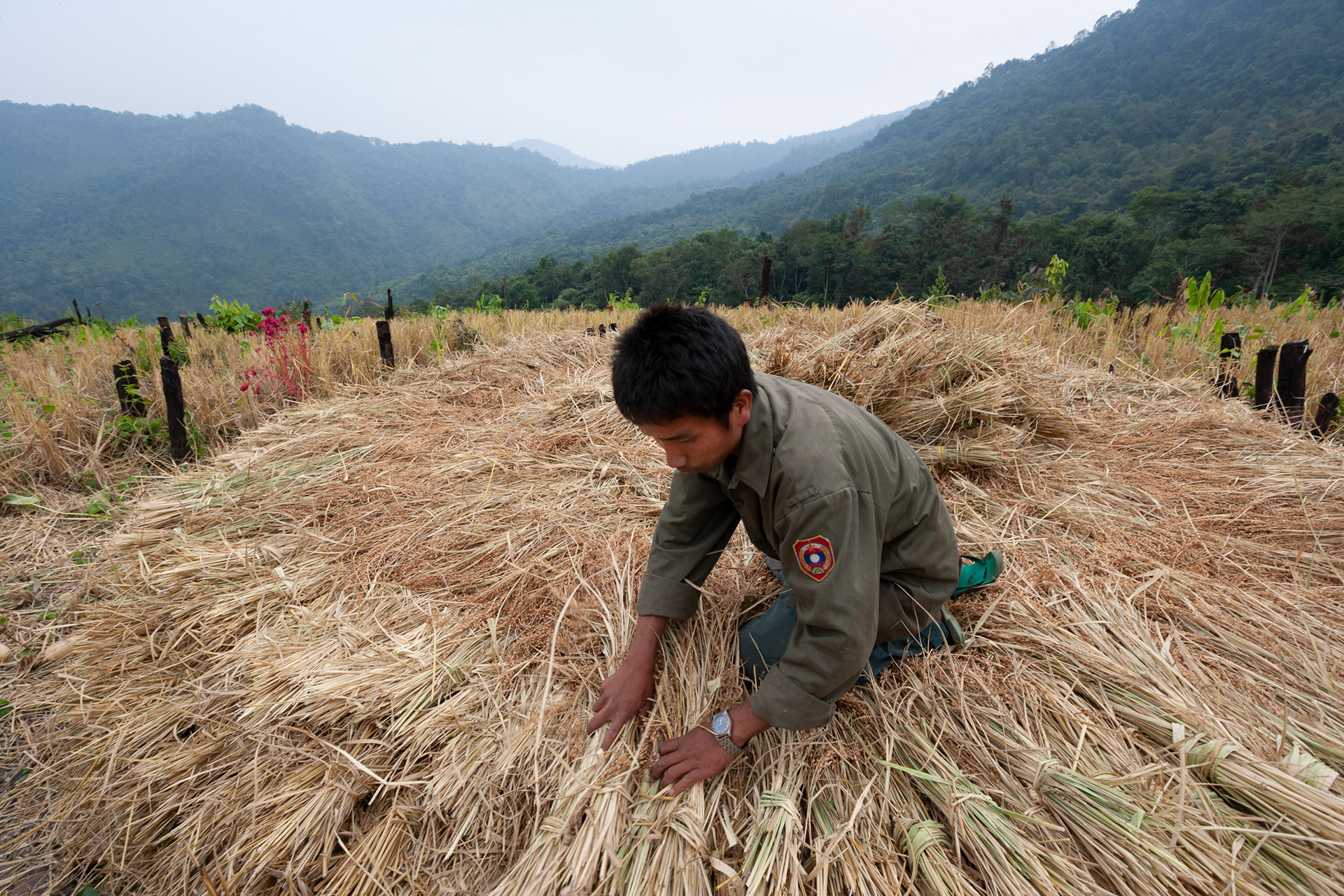
Ban Pha Keo-32
The farmer carefully arranges cut stalks of rice to build a growing wheel of rice at the top of the hill, where it will dry for 5-7 days before being threshed November 12, 2007.
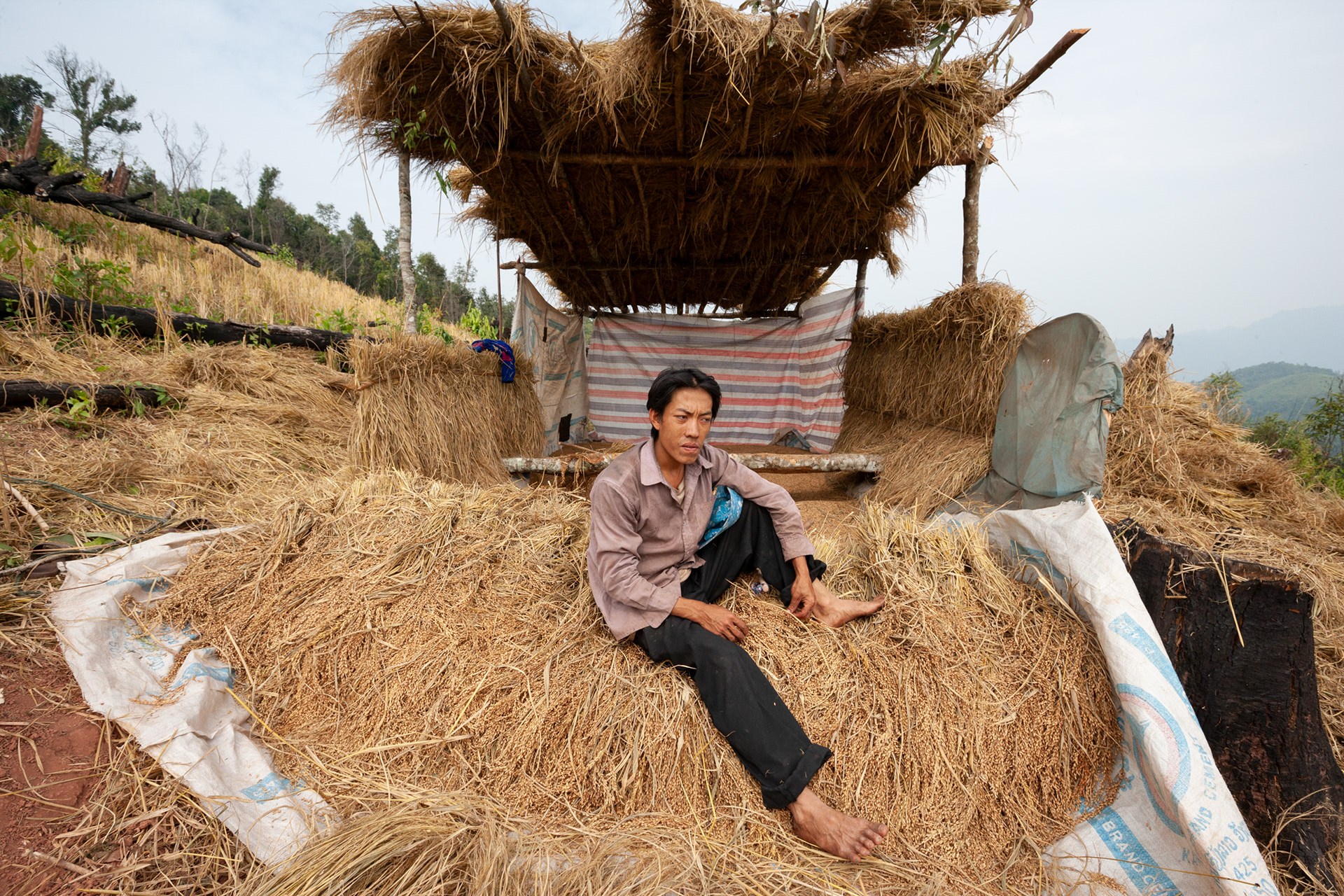
Ban Pha Keo-34
A farmer from another family is in the next stage of the rice cultivation process: his rice crop has already dried sufficiently and now he and his wife are threshing the stalks to remove the hulled kernels, November 12, 2007.
Ban Pha Keo-35
This mother is now threshing her family’s rice crop, November 12, 2007.
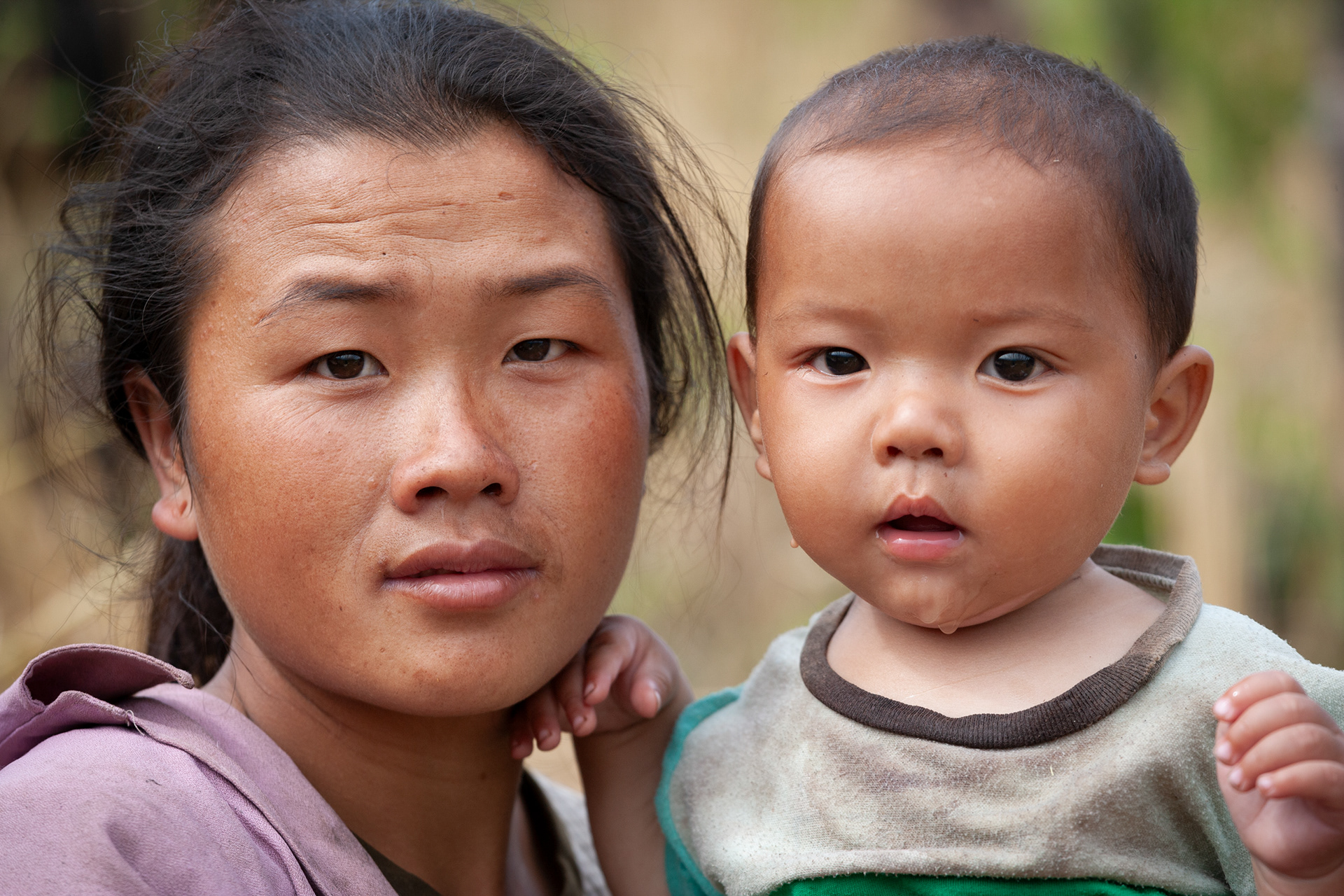
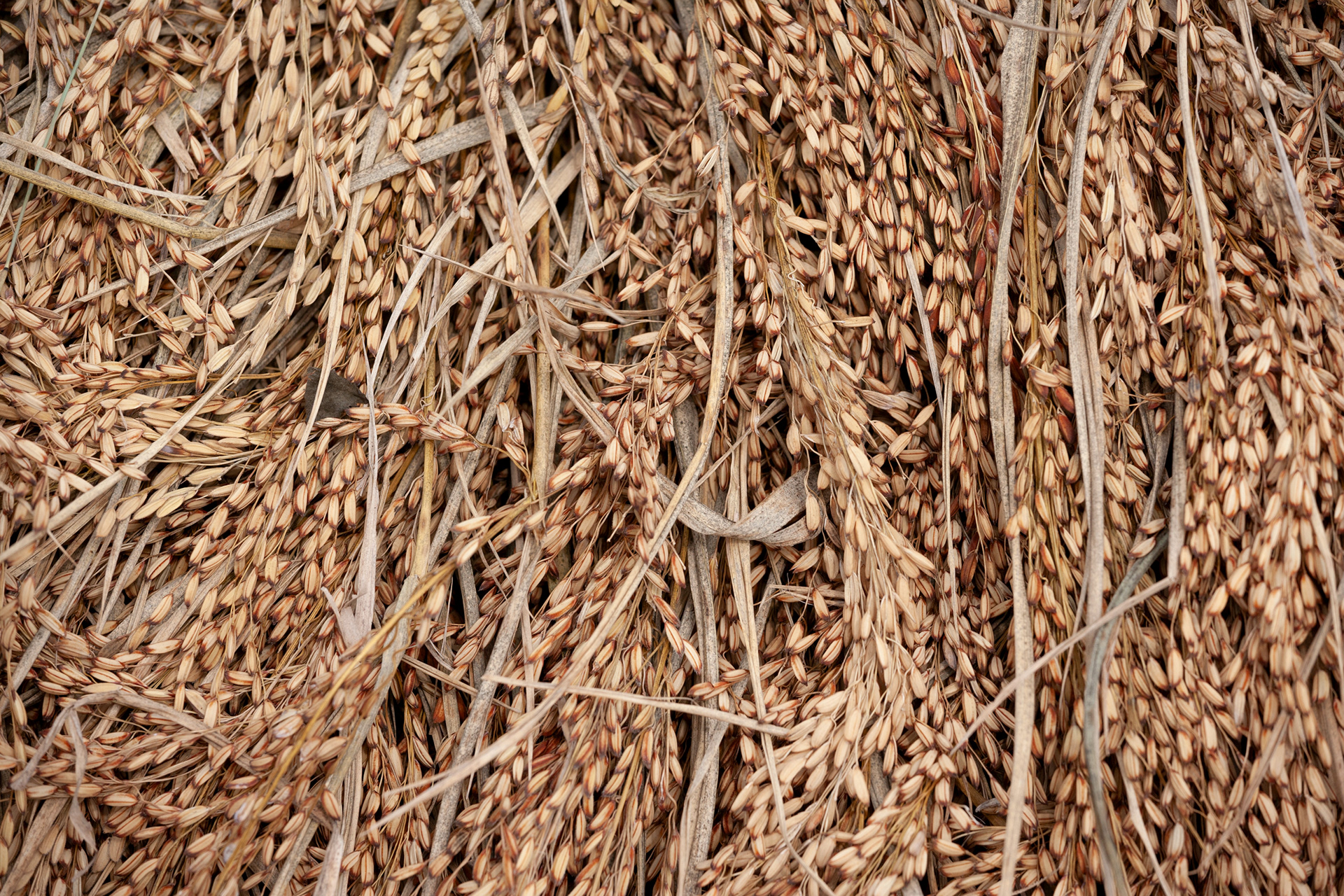
Ban Pha Keo-36
A closeup view of harvested rice that is dry enough to be threshed, November 12, 2007.
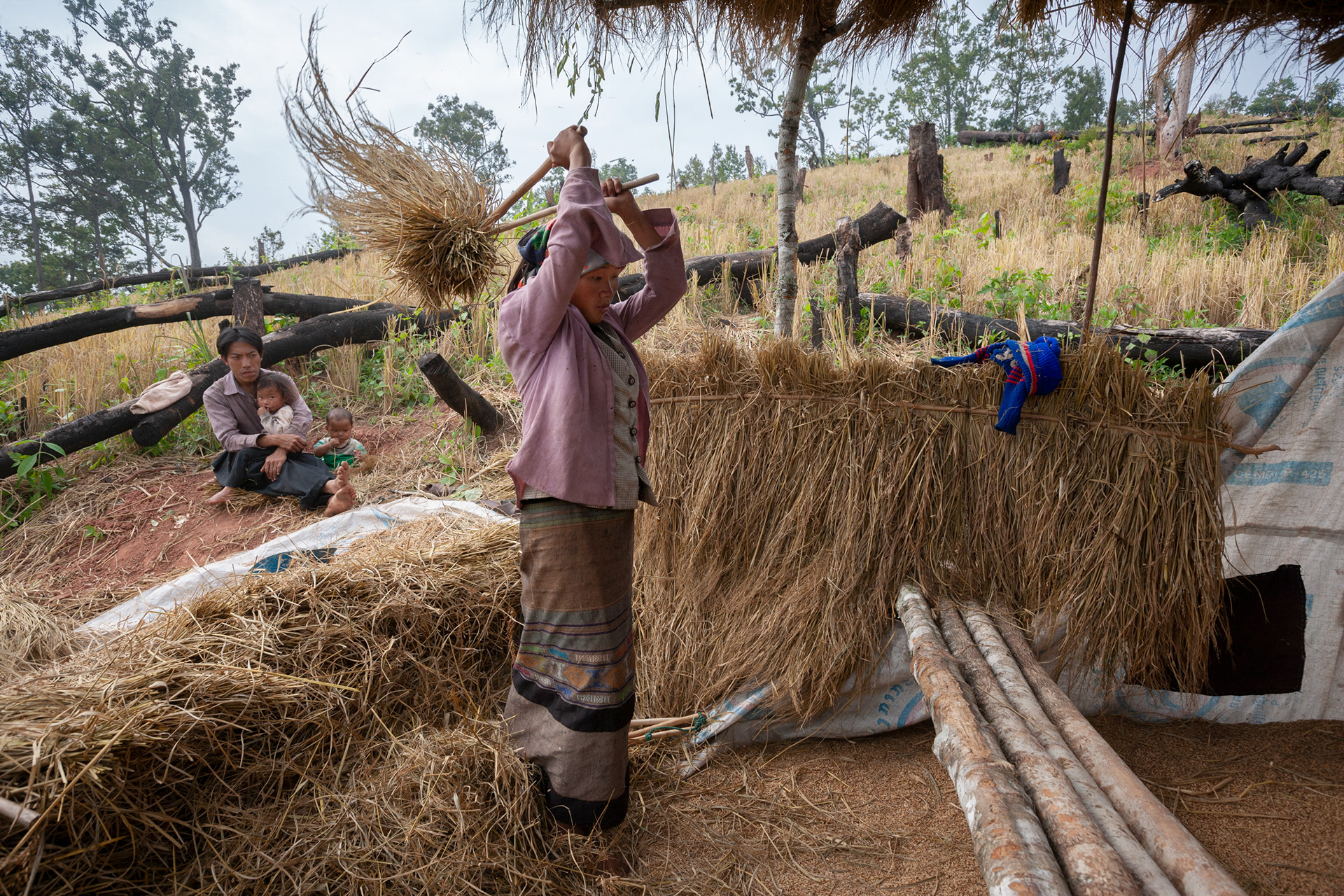
Ban Pha Keo-39
A Hmong woman threshes rice as her husband watches the children, November 12, 2007.
Ban Pha Keo-38
She brings the rice bundle down as hard as she can so that her sticks collide with a threshing rack made from five saplings, November 12, 2007.
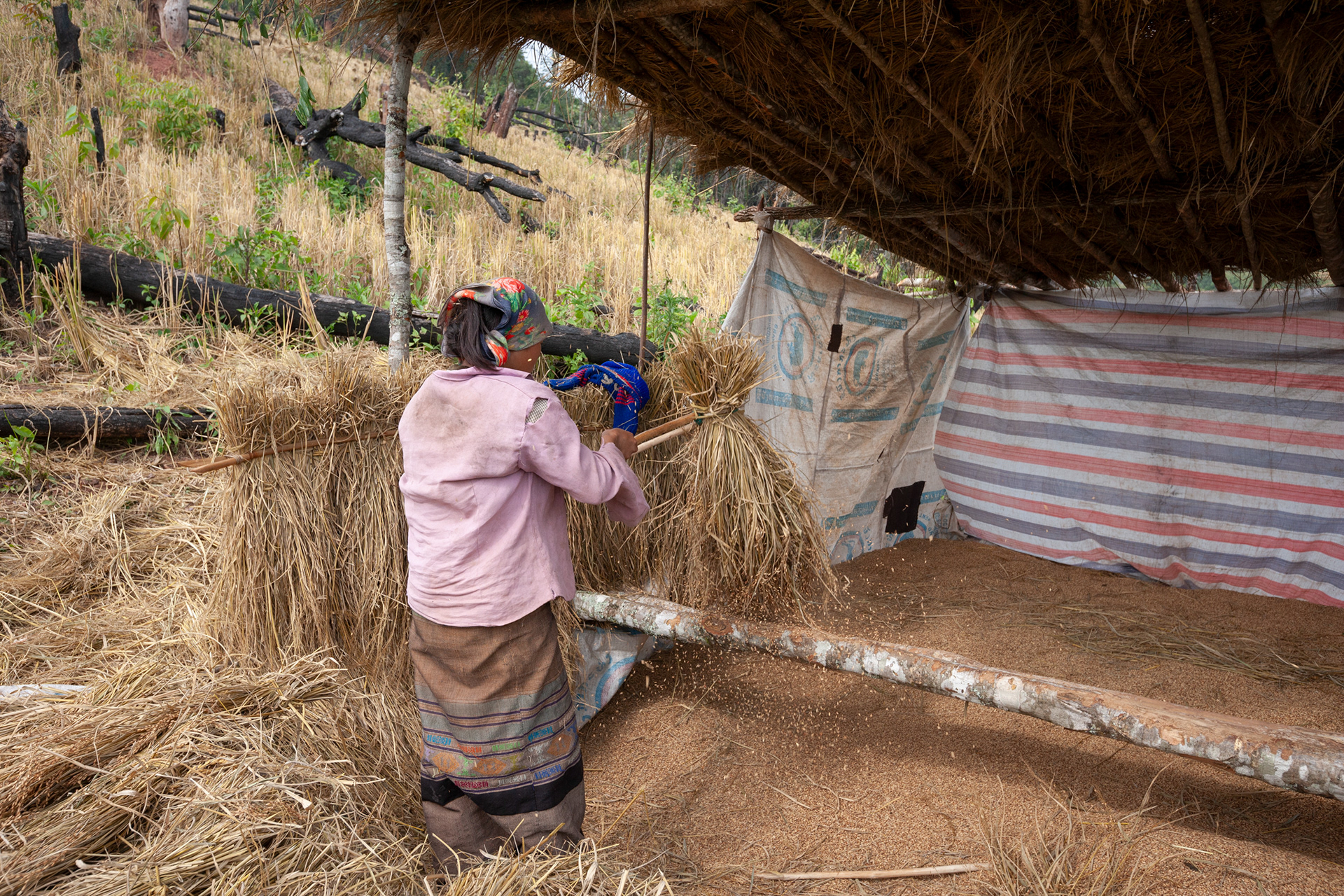
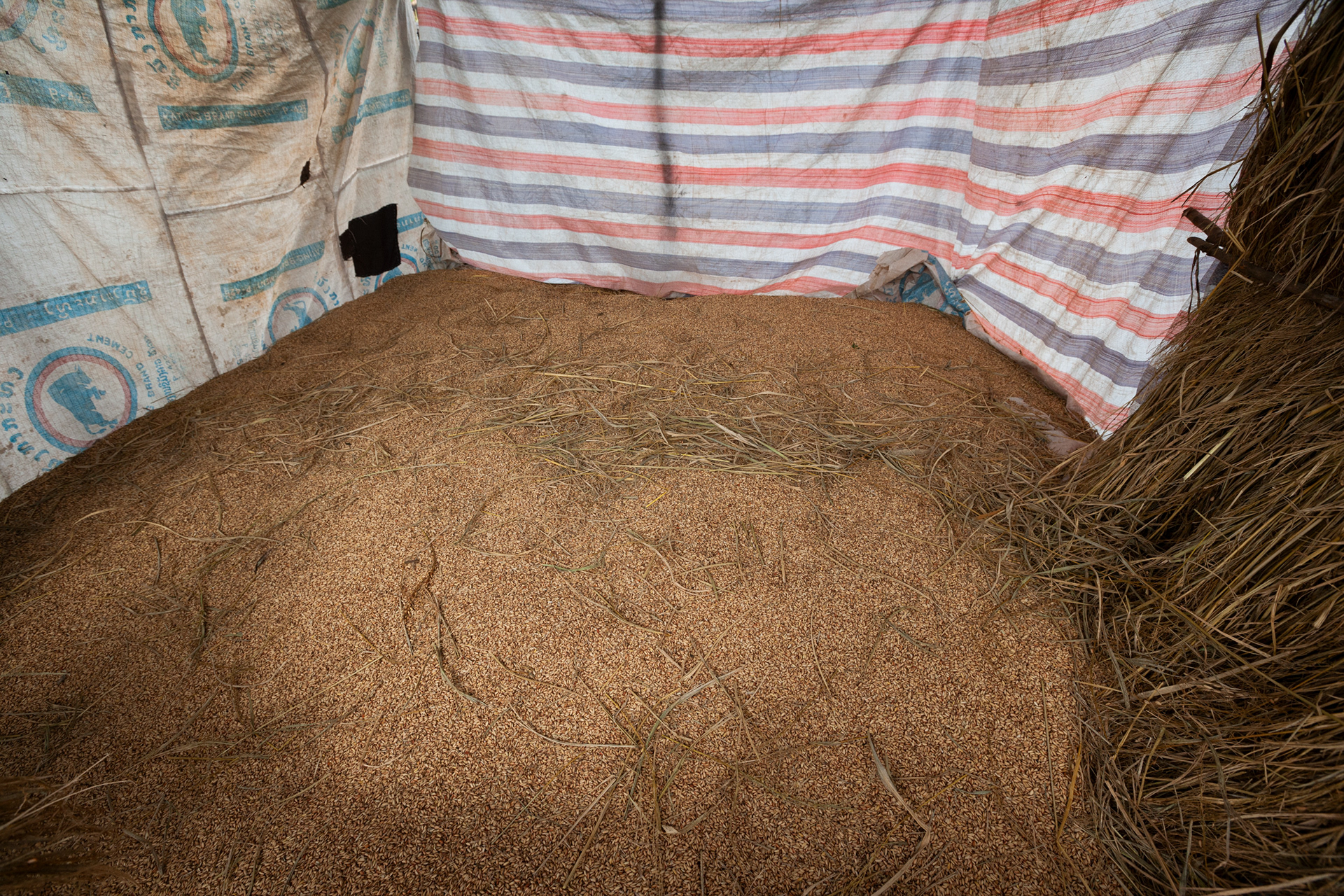
Ban Pha Keo-40
Millions of rice kernels, still in hulls, accumulate on the floor of the farmers’ makeshift threshing shed, November 12, 2007.
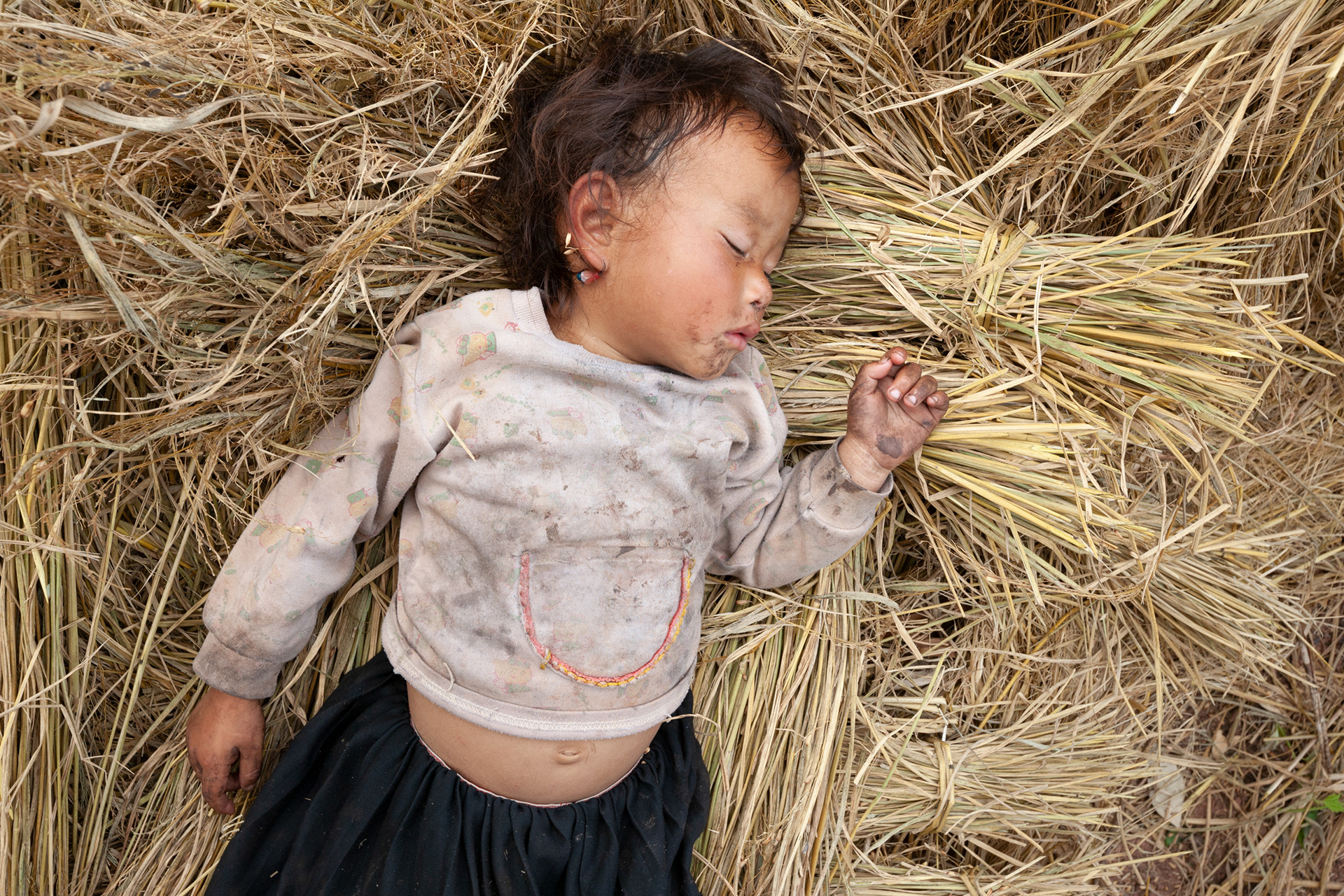
Ban Pha Keo-42
The family’s older child has fallen asleep on a pile of bundled rice stalks, November 12, 2007.
Ban Pha Keo-43
As the child sleeps, the father begins preparing more stalks for threshing, November 12, 2007.
Ban Pha Keo-44
Later that evening in Ban Pha Keo, the chief’s wife prepares a chicken for dinner, November 12, 2007.
Ban Pha Keo-45
The next morning, the young woman whose family is hosting me makes corn meal porridge for breakfast, November 13, 2007.
Ban Pha Keo-46
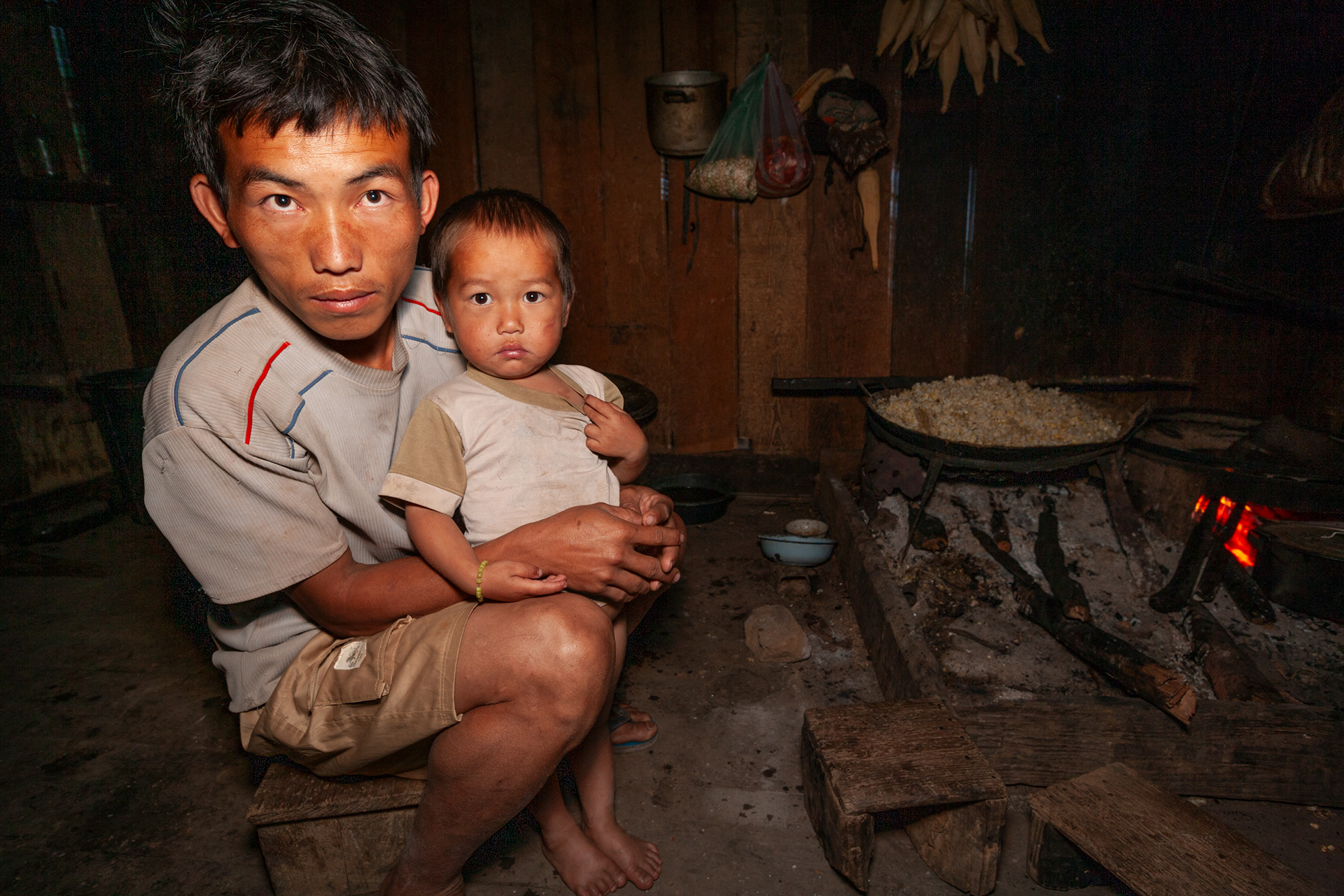
My host’s husband and one of their children await breakfast, November 13, 2007.
Ban Pha Keo-47
The young woman pauses to sweep the kitchen floor, November 13, 2007.
Ban Pha Keo-48
My host chops pumpkin squash, which will be served in a soup for breakfast, November 13, 2007.
Ban Pha Keo-49
A villager grinds corn in the early dawn hours, November 13, 2007.
Ban Pha Keo-50
The villager adds more dried corn to his grinding stone, November 13, 2007.
Ban Pha Keo-51
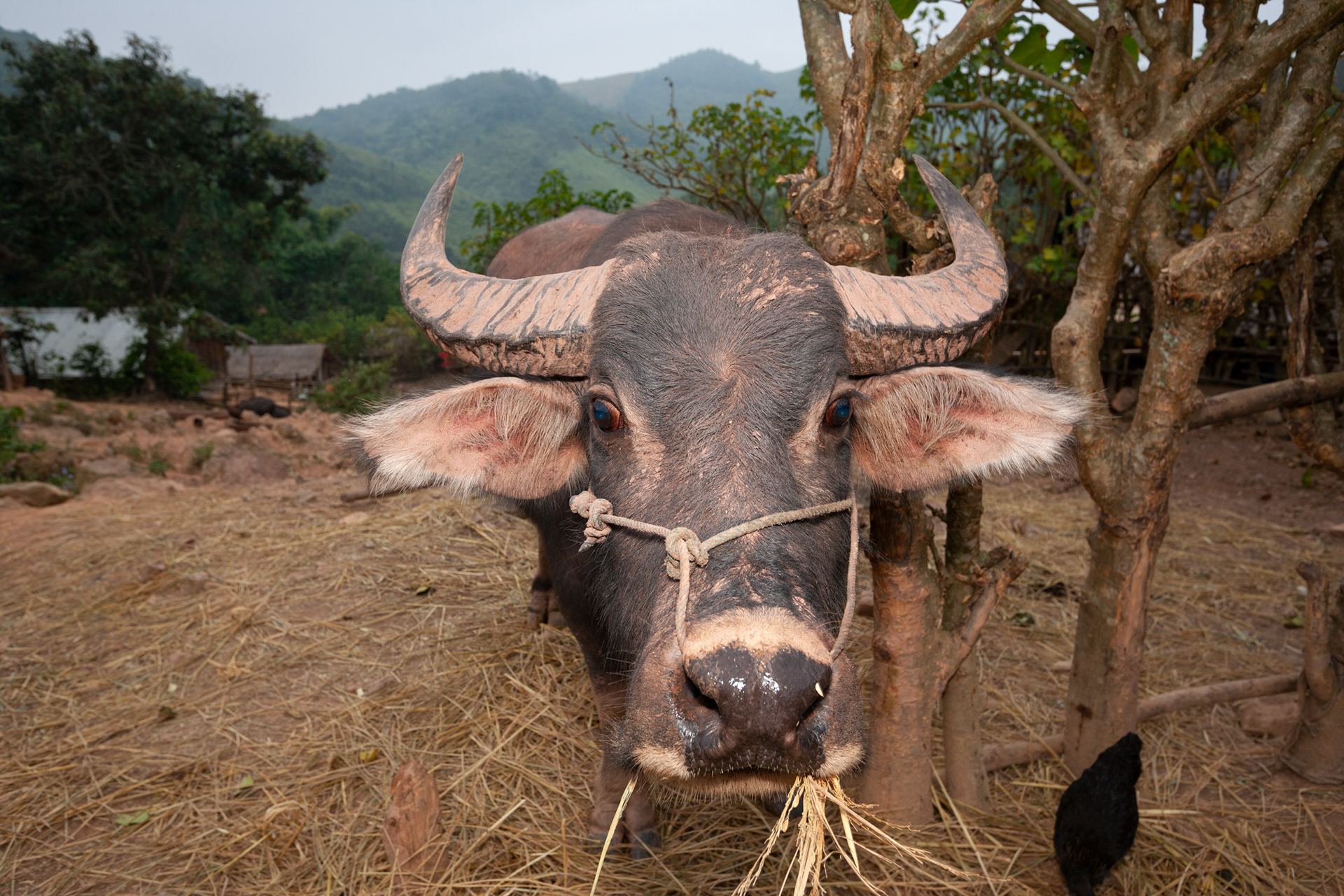
A tethered buffalo feeds on rice stalks that have already been threshed, November 13, 2007.
Ban Pha Keo-52
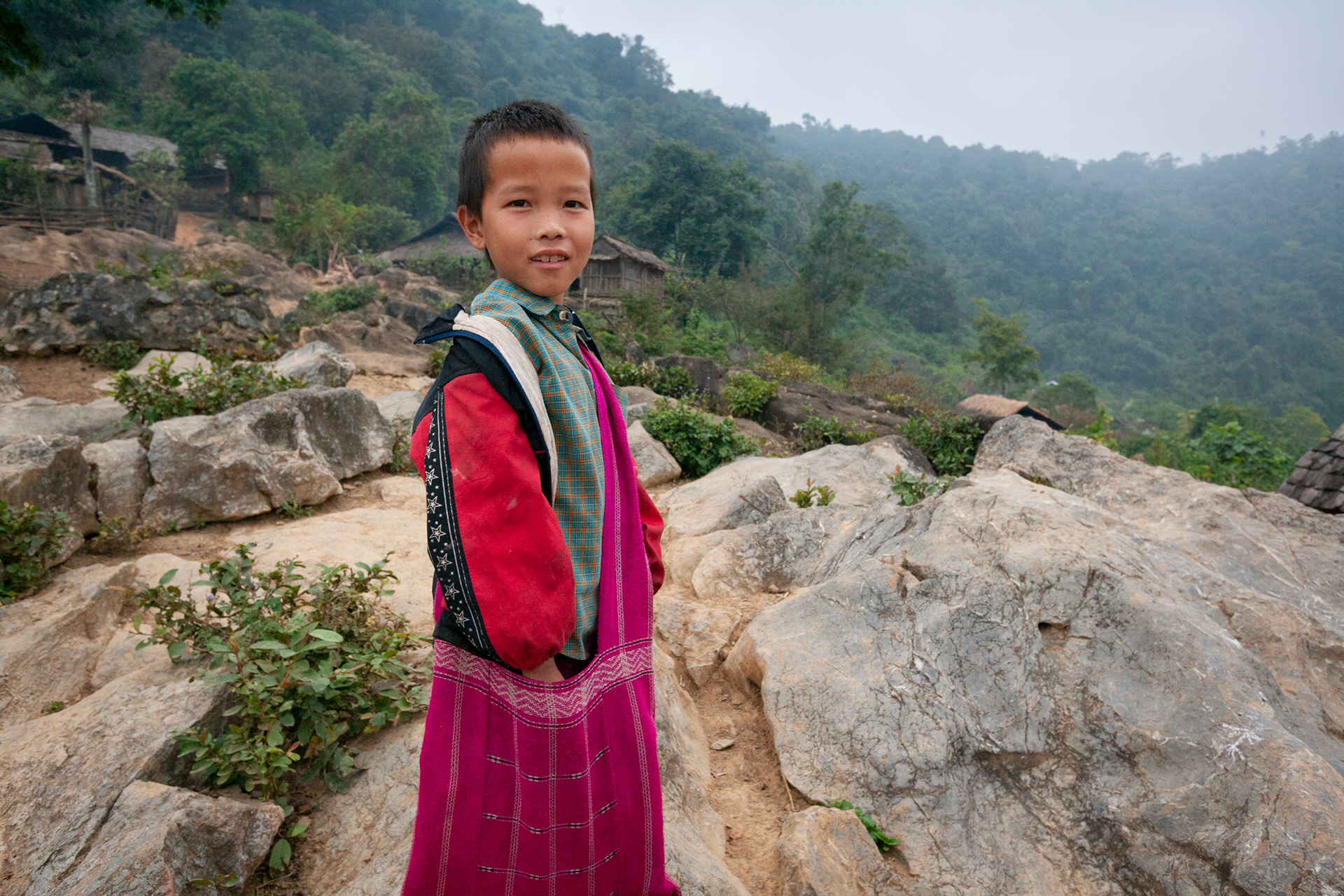
A village boy with a large shoulder bag on his way to school, November 13, 2007.
Ban Pha Keo-53
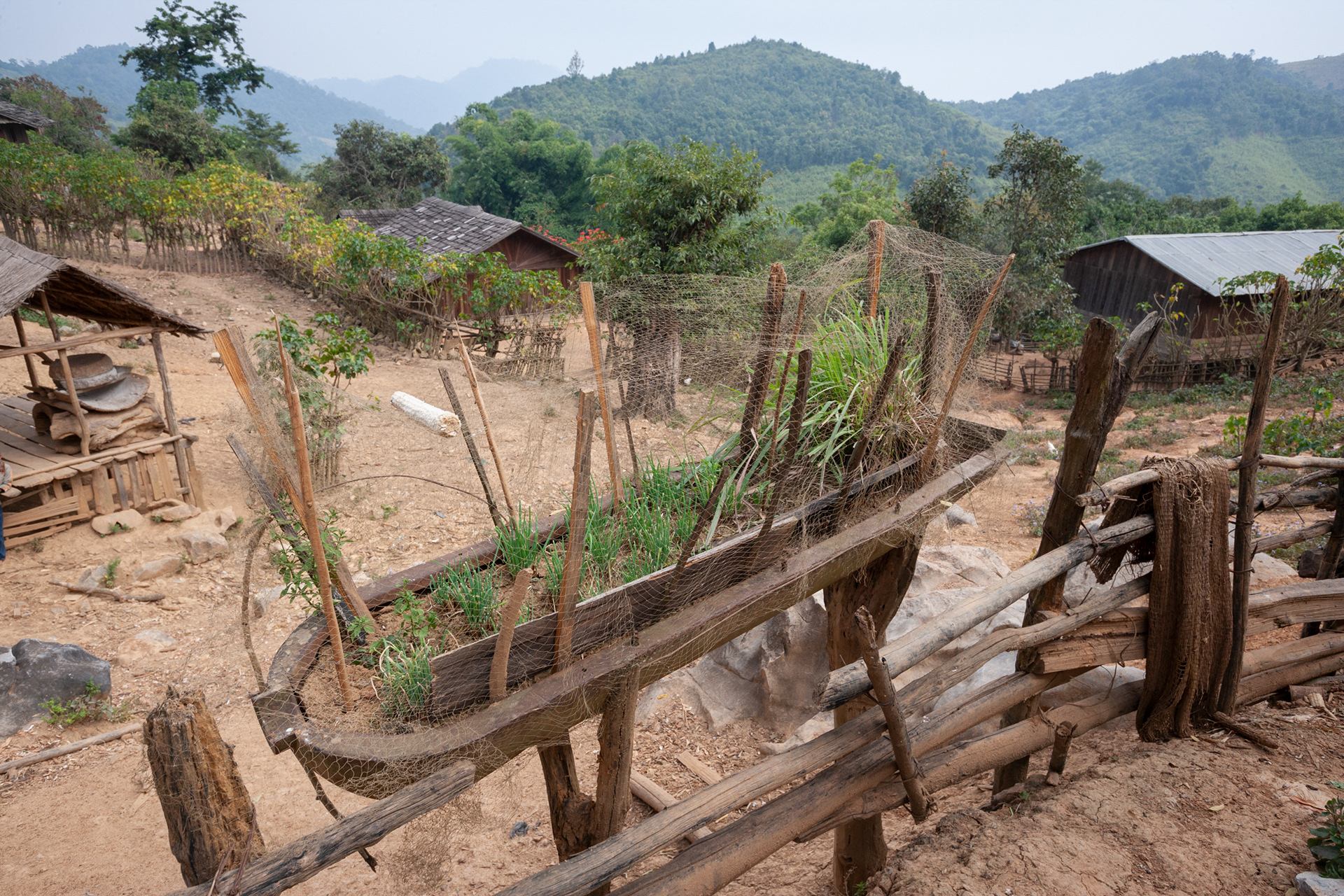
A bombshell casing on two forked tree stumps serves as an herb and onion planter, November 13, 2007.
Ban Pha Keo-54
Pigs have just cleaned out a slop trough made from a half bombshell, November 13, 2007.
Ban Pha Keo-55
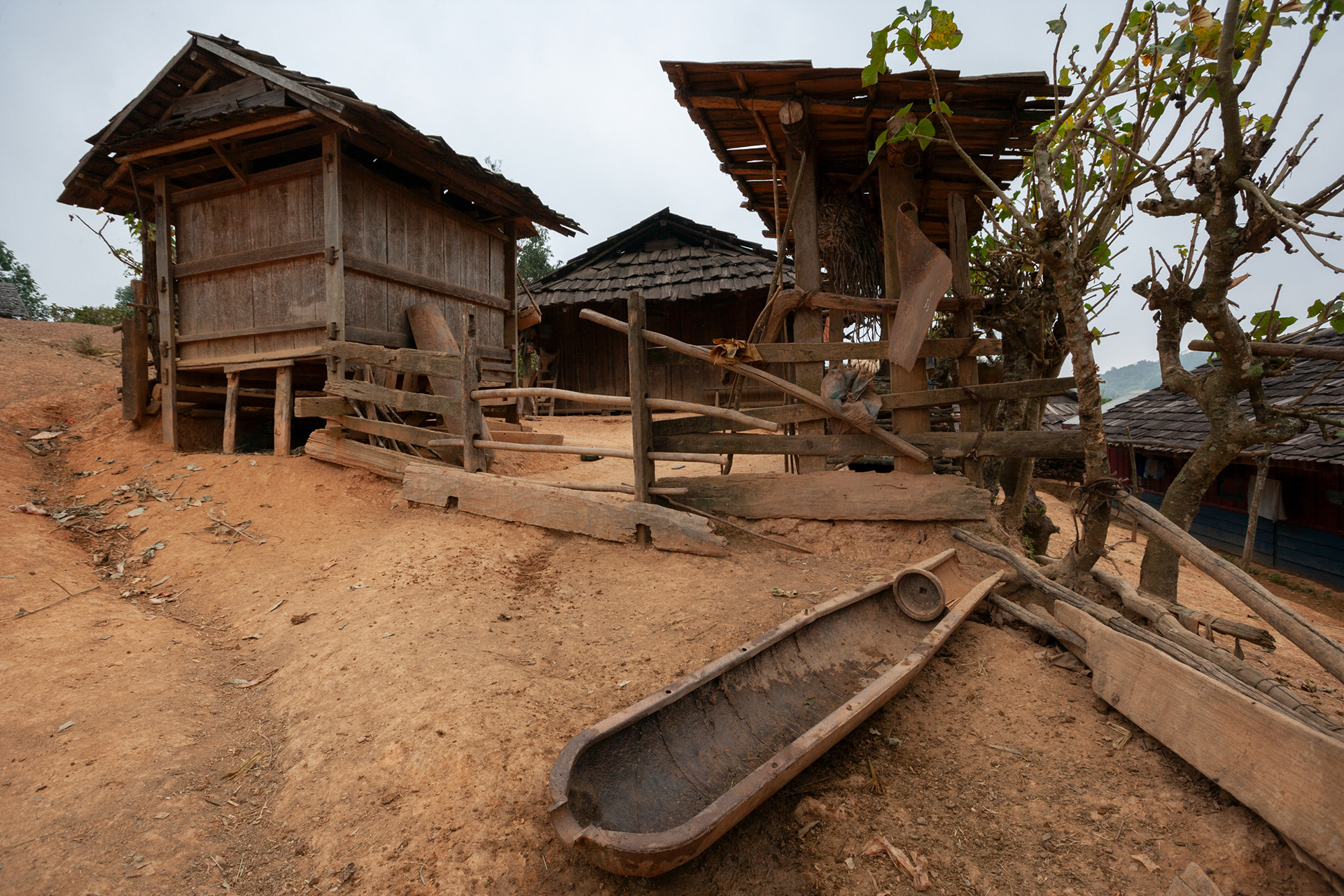
The village school sits atop it’s highest hill, November 13, 2007.
Ban Pha Keo-56
Children enter the doorway to start their school day, November 13, 2007.
Ban Pha Keo-57
The teacher sits at the back of the one room school, guiding the students in their language study, November 13, 2007.
Ban Pha Keo-58
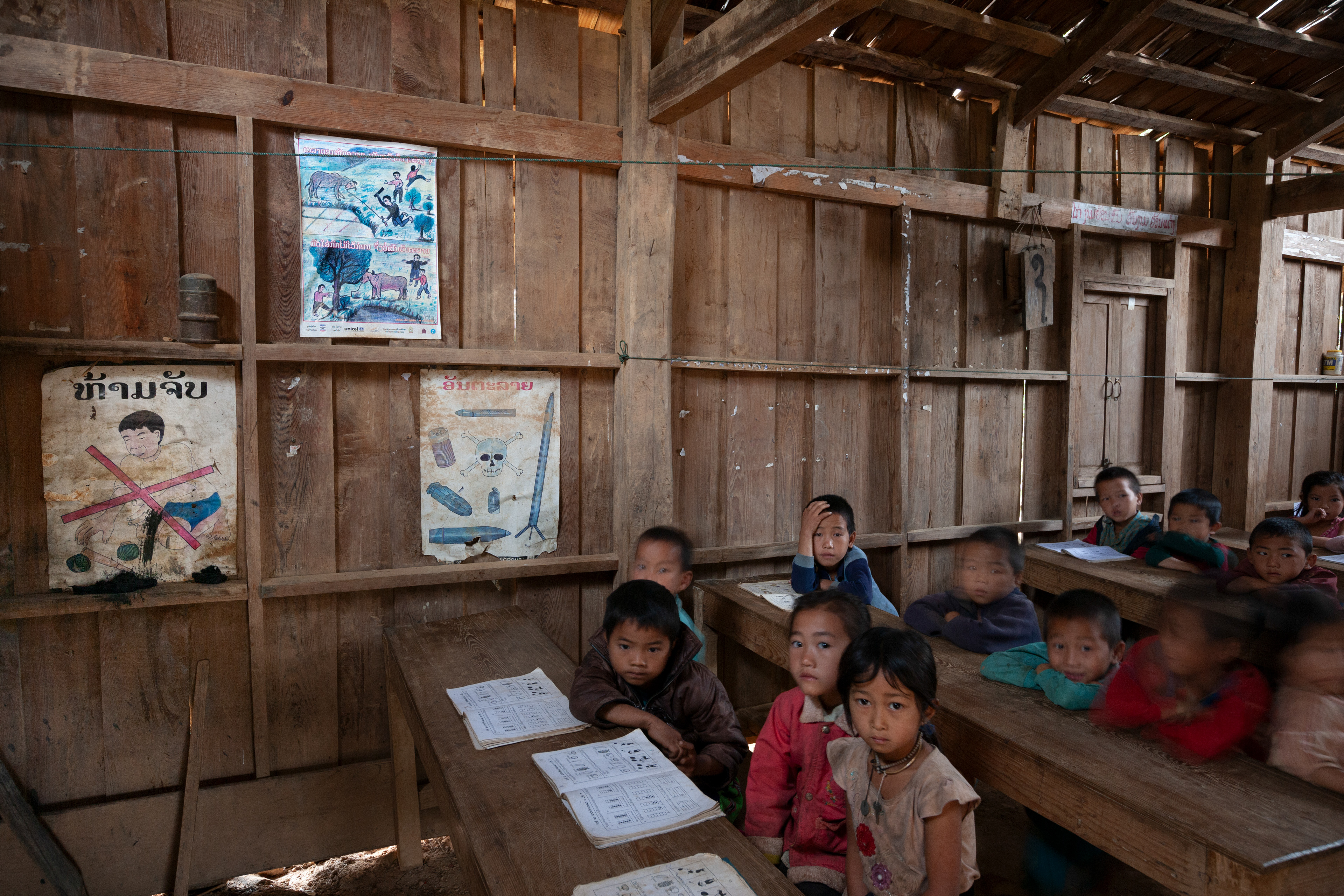
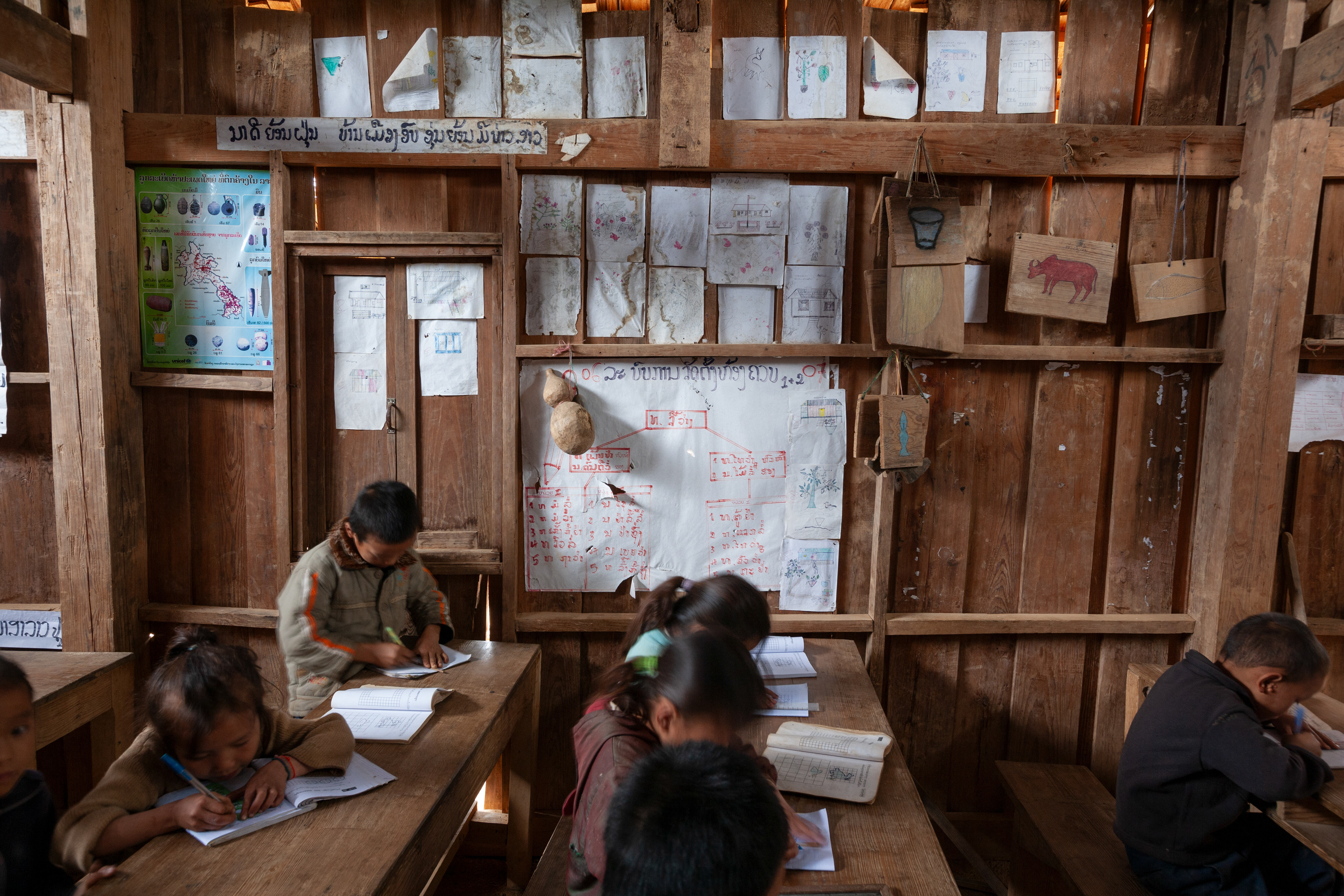
School posters in Lao language promote humane treatment of farm animals and warn of the dangers of American UXO, unexploded ordinance leftover from the Secret War.
The poster at the far left admonishes children not to pick up cluster bombs, known as “bombies,” which have killed and maimed thousands of villagers since the war ended in 1975, photo: November 13, 2007.
Ban Pha Keo-59
The large poster in the center shows class rankings for grades one and two, November 13, 2007.
Ban Pha Keo-60
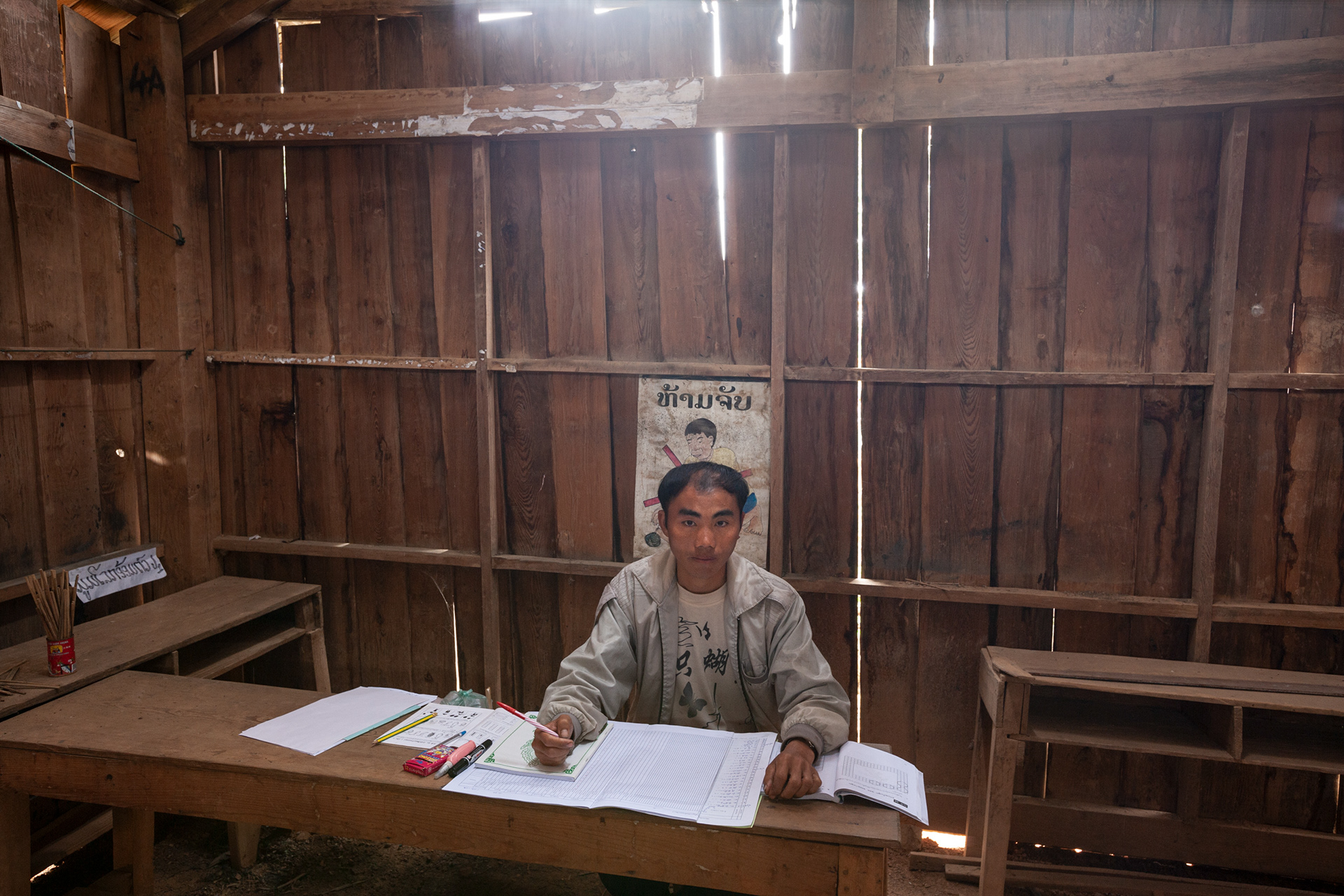
The life a teacher assigned to a remote village like Ban Pha Keo is often a lonely one, requiring the teacher to spend a great deal of time away from his own family for very low pay, November 13, 2007.
Ban Pha Keo-61
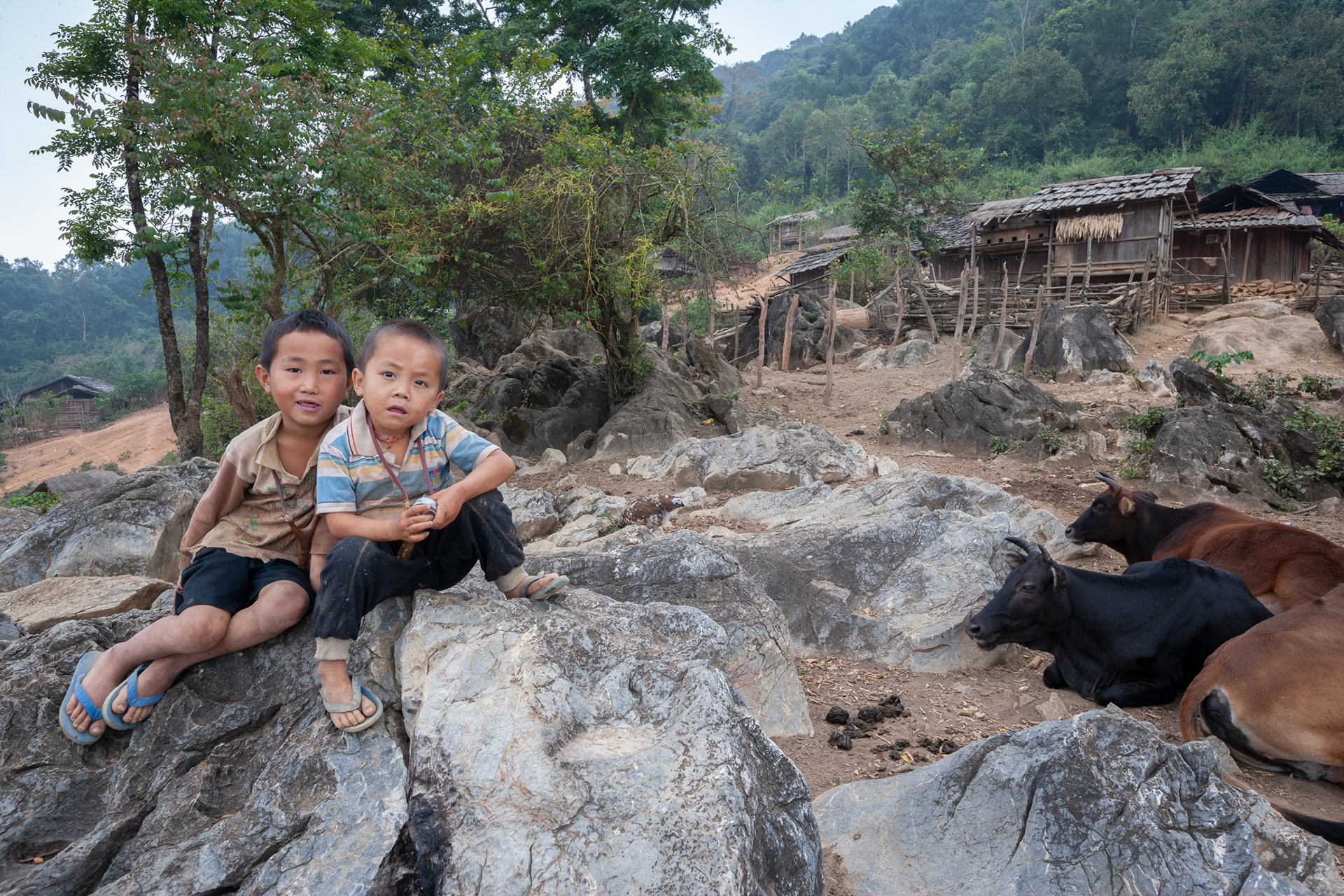
Two boys who aren’t in school play on rocks near a small cow herd. In Laos, public schools are not free and some families cannot even afford the relatively low monthly tuition, November 13, 2007.
Ban Pha Keo-62
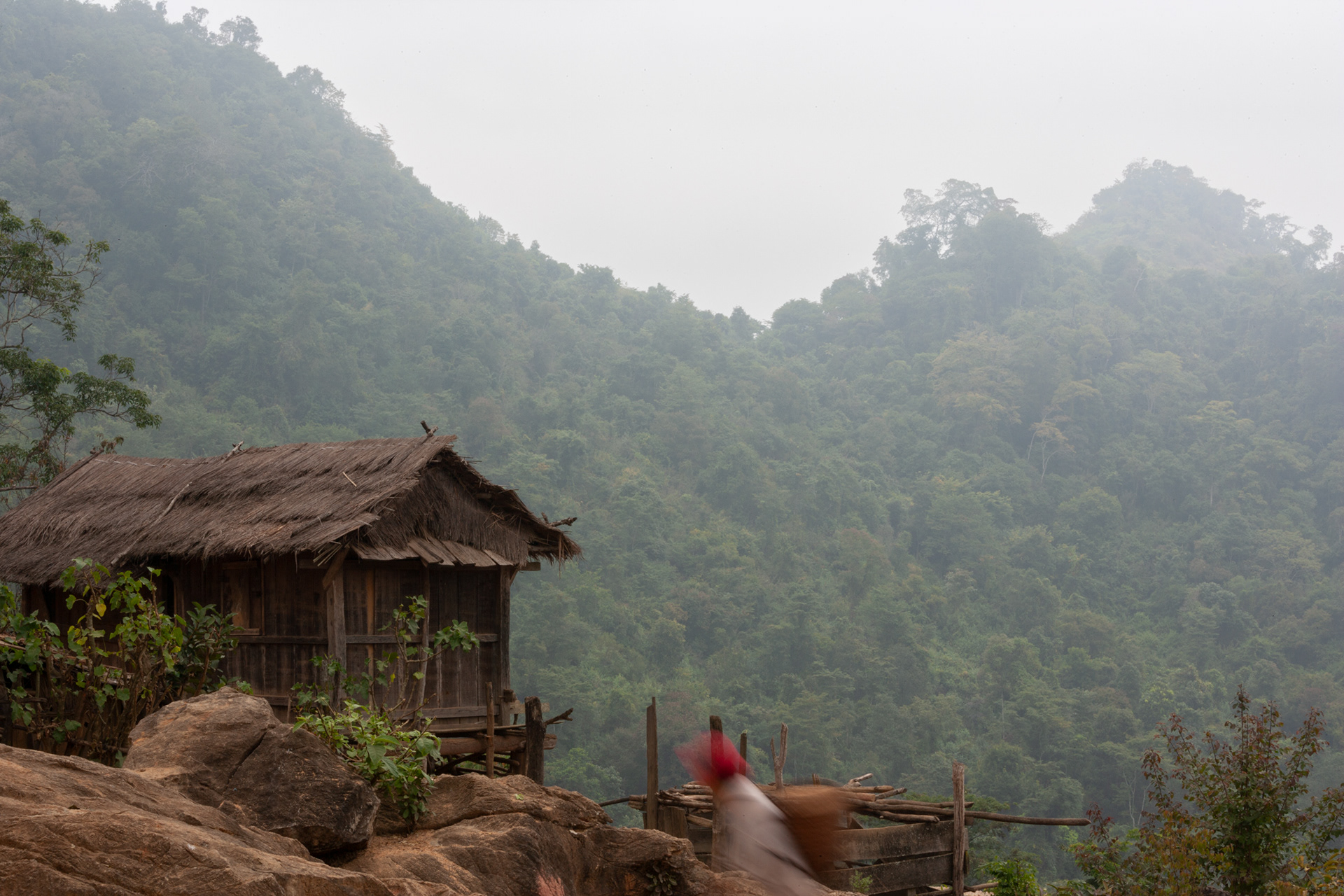
A woman climbs one of the village’s steep, rocky hills in morning fog, November 13, 2007.
Ban Pha Keo-63
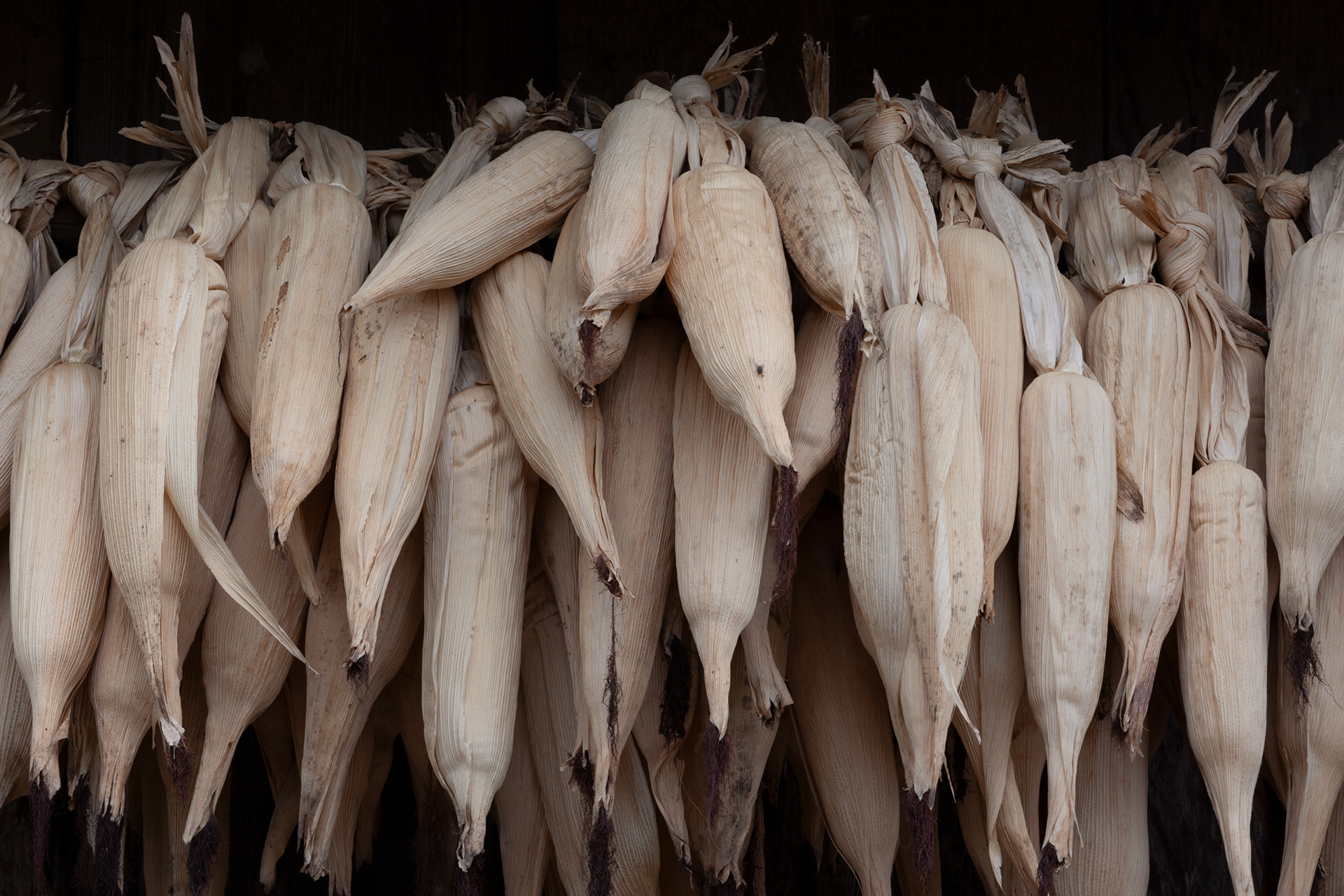
Corn dries in the rafters of a house. Most corn grown by Hmong villagers is dried and ground into meal, rather than cooking it fresh, November 13, 2007.
Ban Pha Keo-64
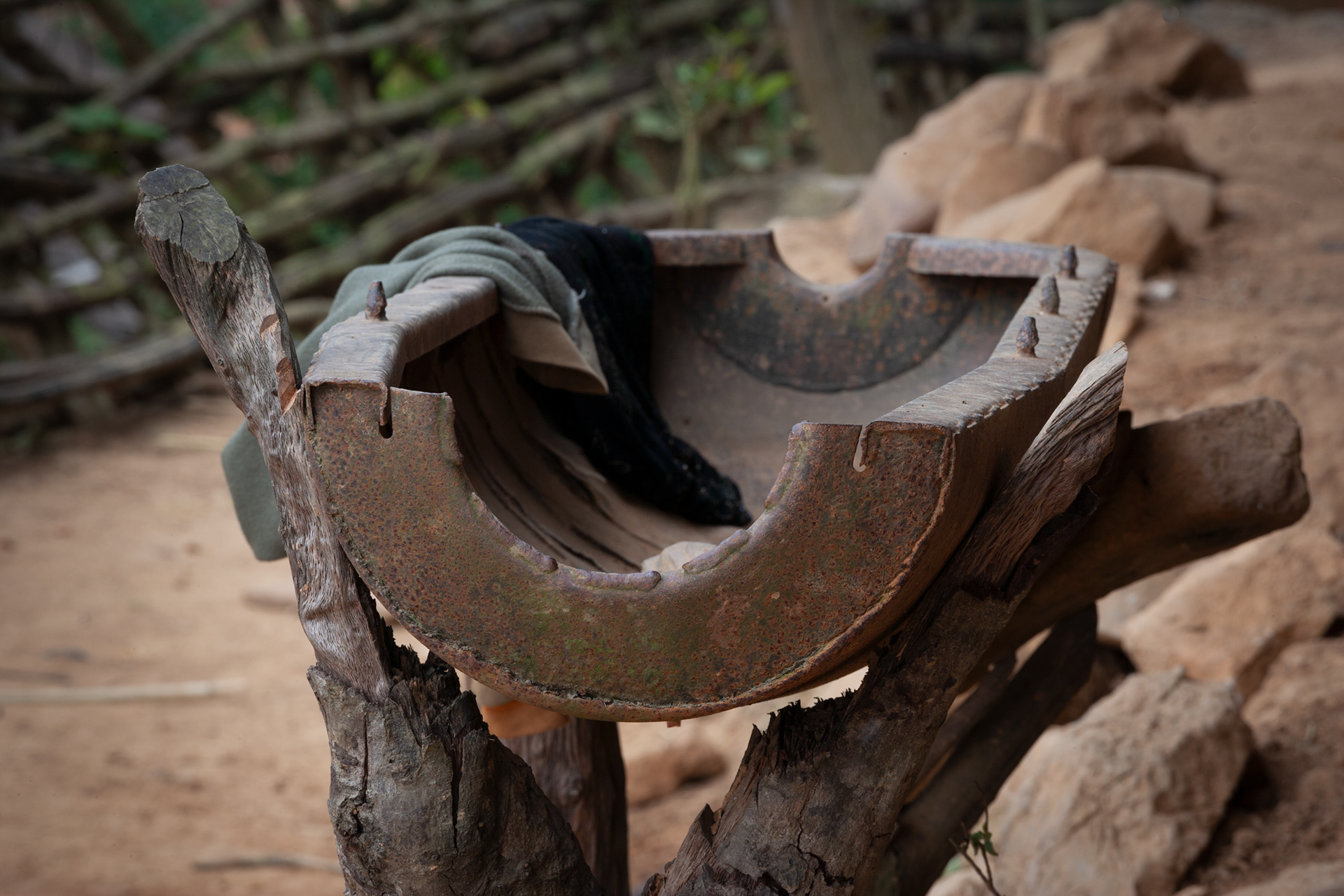
A clothes washing tub fashioned from a bombshell casing, November 13, 2007.
Ban Pha Keo-65
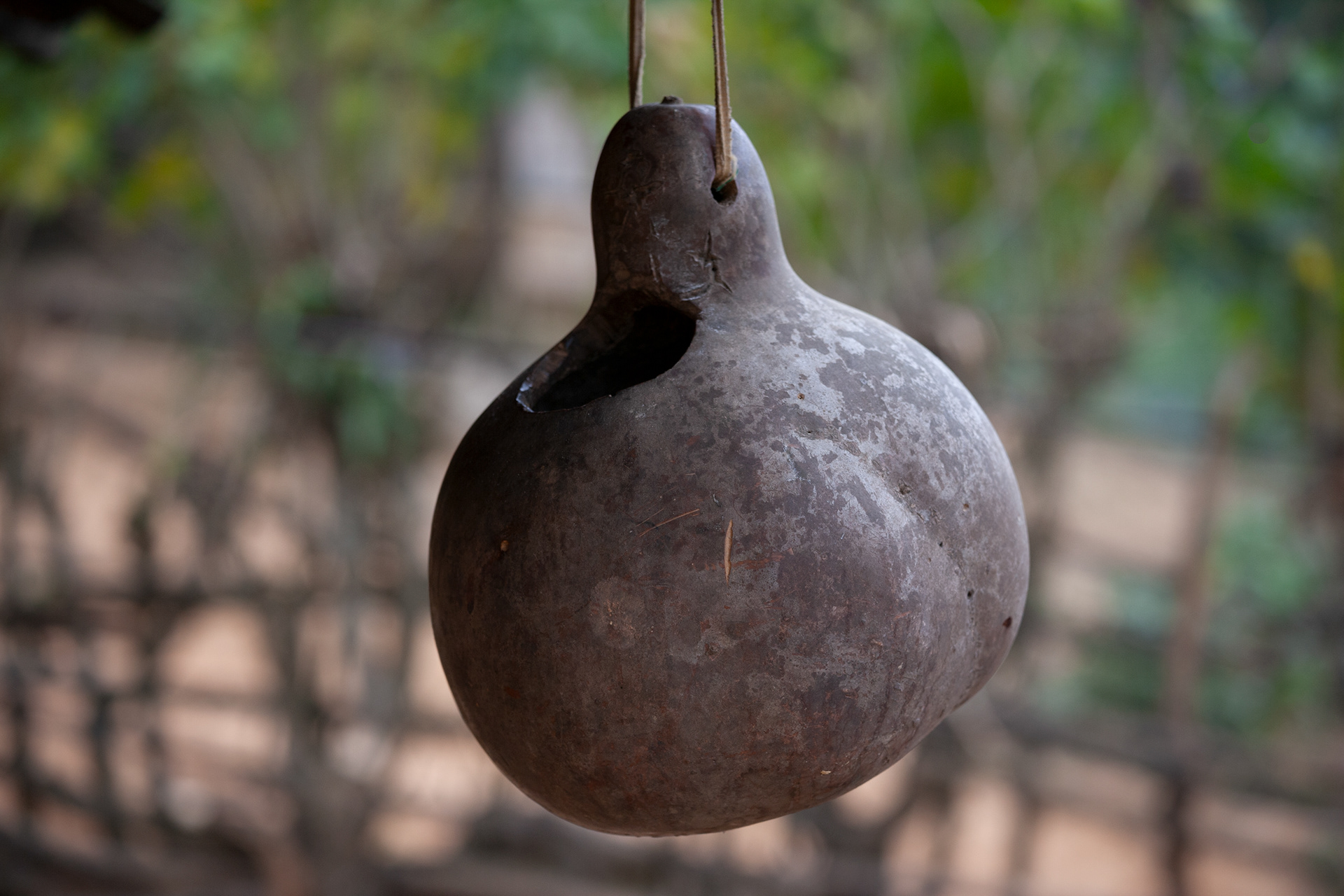
A gourd used for seed storage hangs from the porch of a house, November 13, 2007.
Ban Pha Keo-66
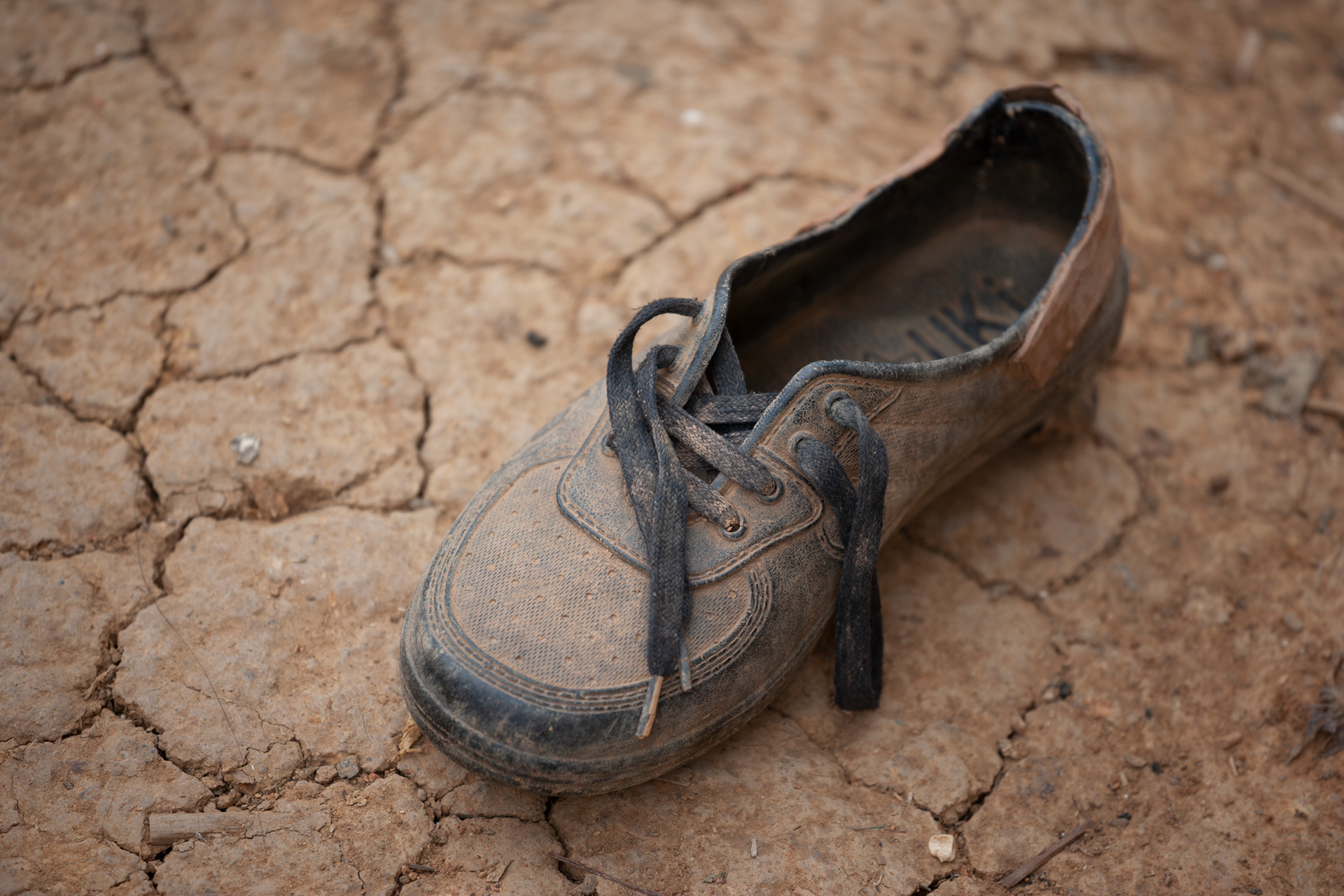
A missing or discarded shoe caked with dried mud, November 13, 2007.
Ban Pha Keo-67
A woman prepares to make white pepper, a cash commodity, November 12, 2007.
Ban Pha Keo-68
The woman pours fresh ground pepper pulp that has been soaked overnight on to a drying screen, November 12, 2007.
Ban Pha Keo-69
The pepper maker spreads her pulp as evenly as she can over the drying screen, November 12, 2007.
Ban Pha Keo-70
Now she must wait for her product to dry before grinding and selling it, November 12, 2007.
Ban Pha Keo-71
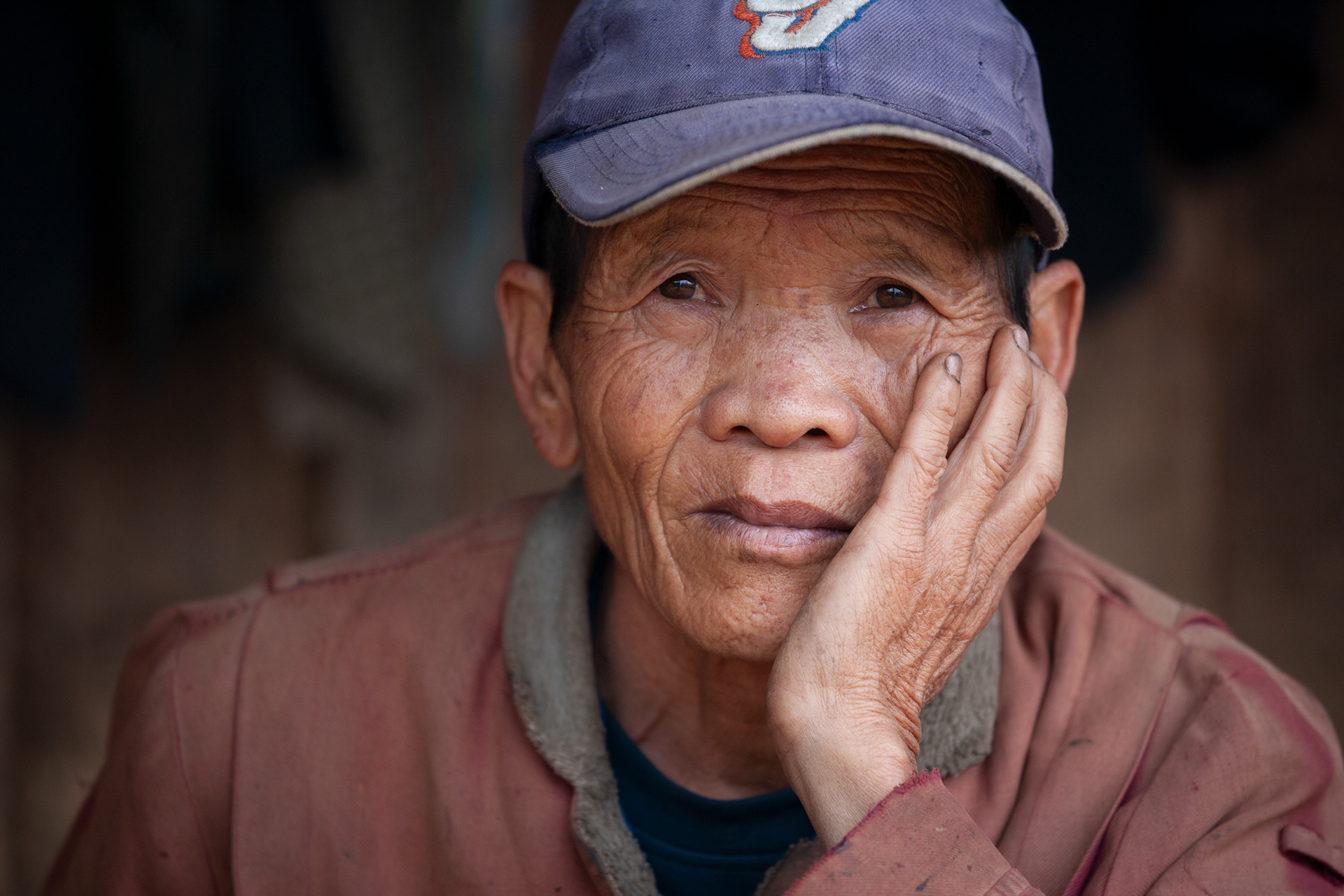
Portrait of a Ban Pha Keo villager, November 13, 2007.
Ban Pha Keo-72
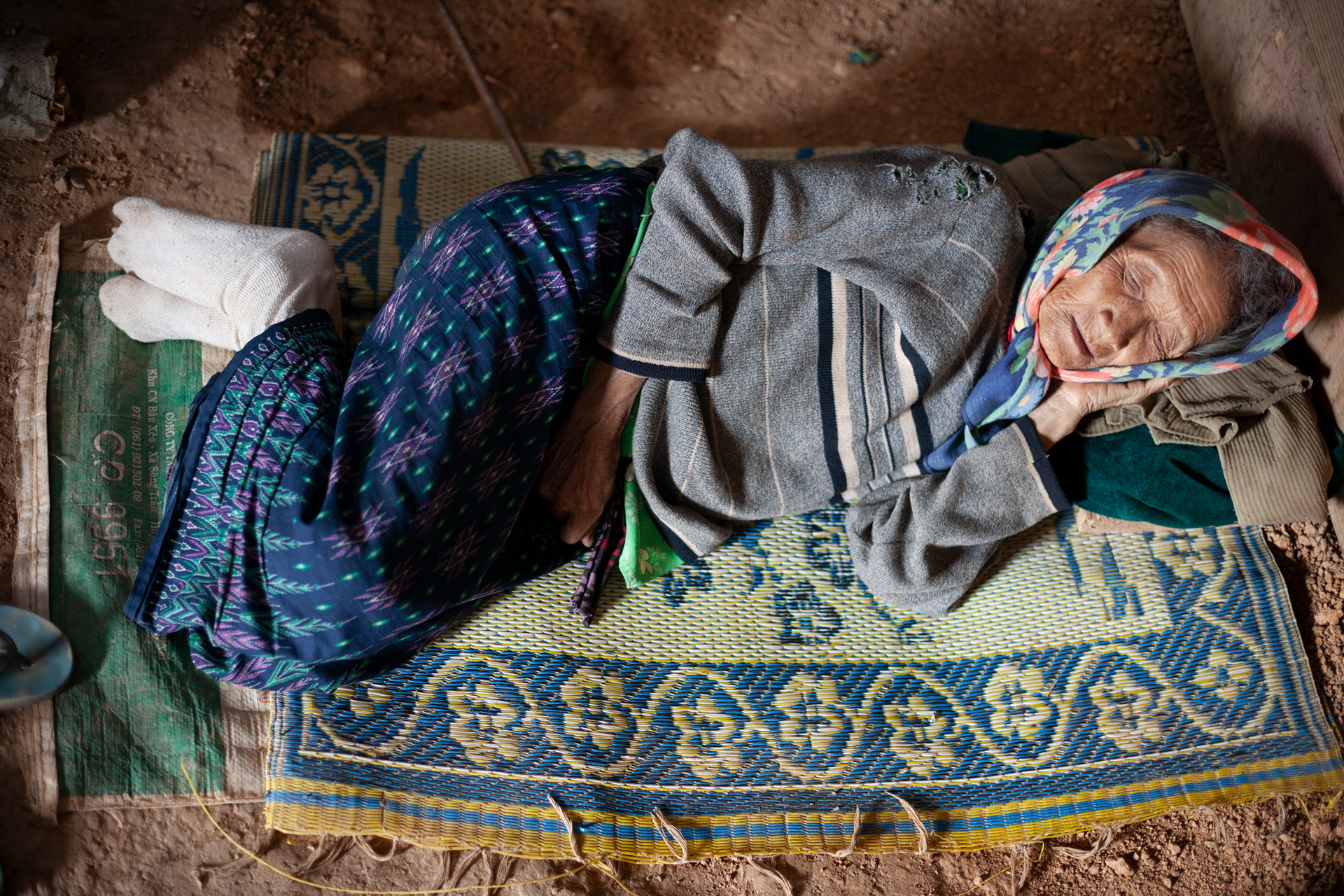
The pepper maker’s mother naps during the warm part of the day, November 12, 2007.
Ban Pha Keo-73
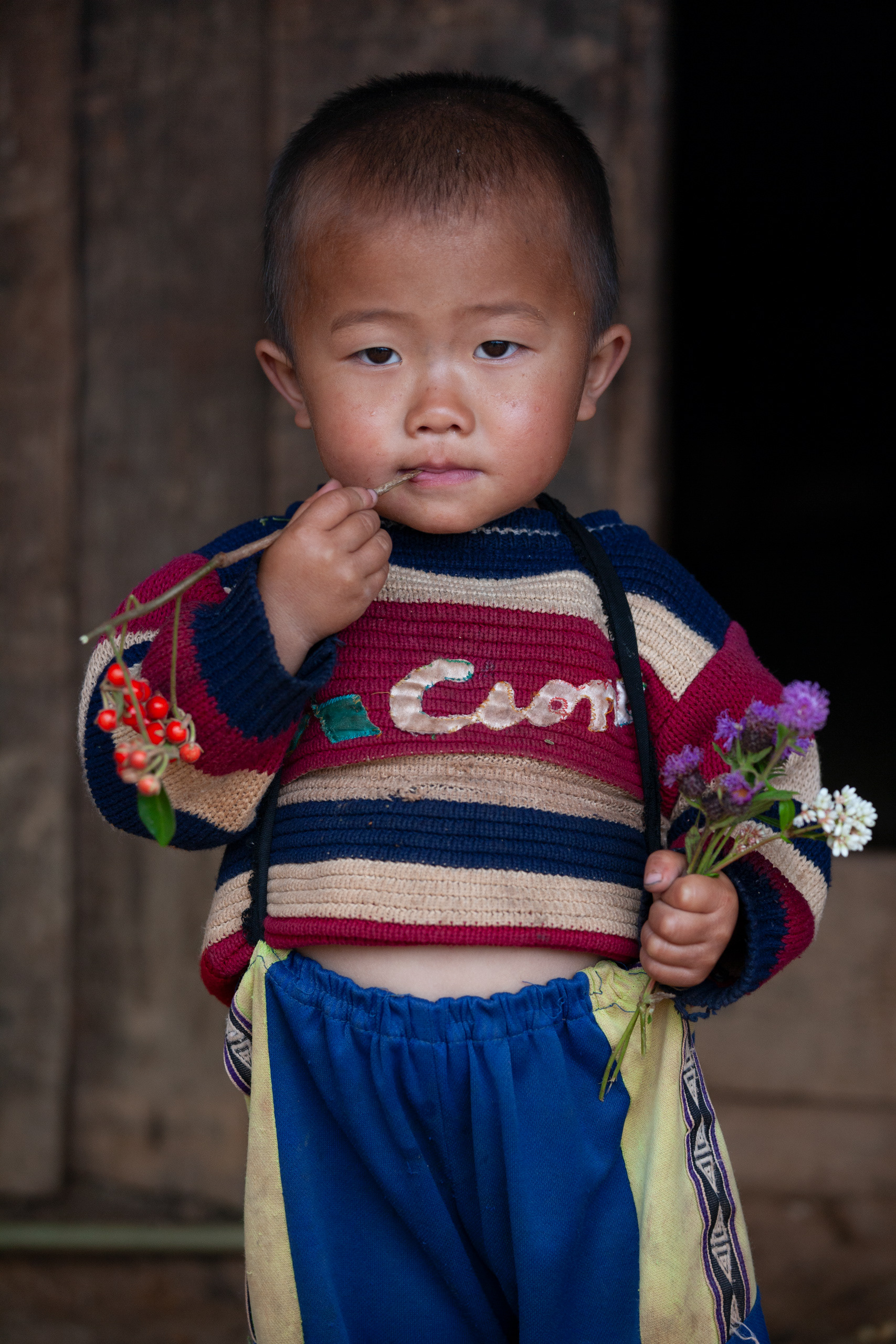
This Hmong boy has been gathering flowers and edible plants, November 13, 2007.
Ban Pha Keo-74
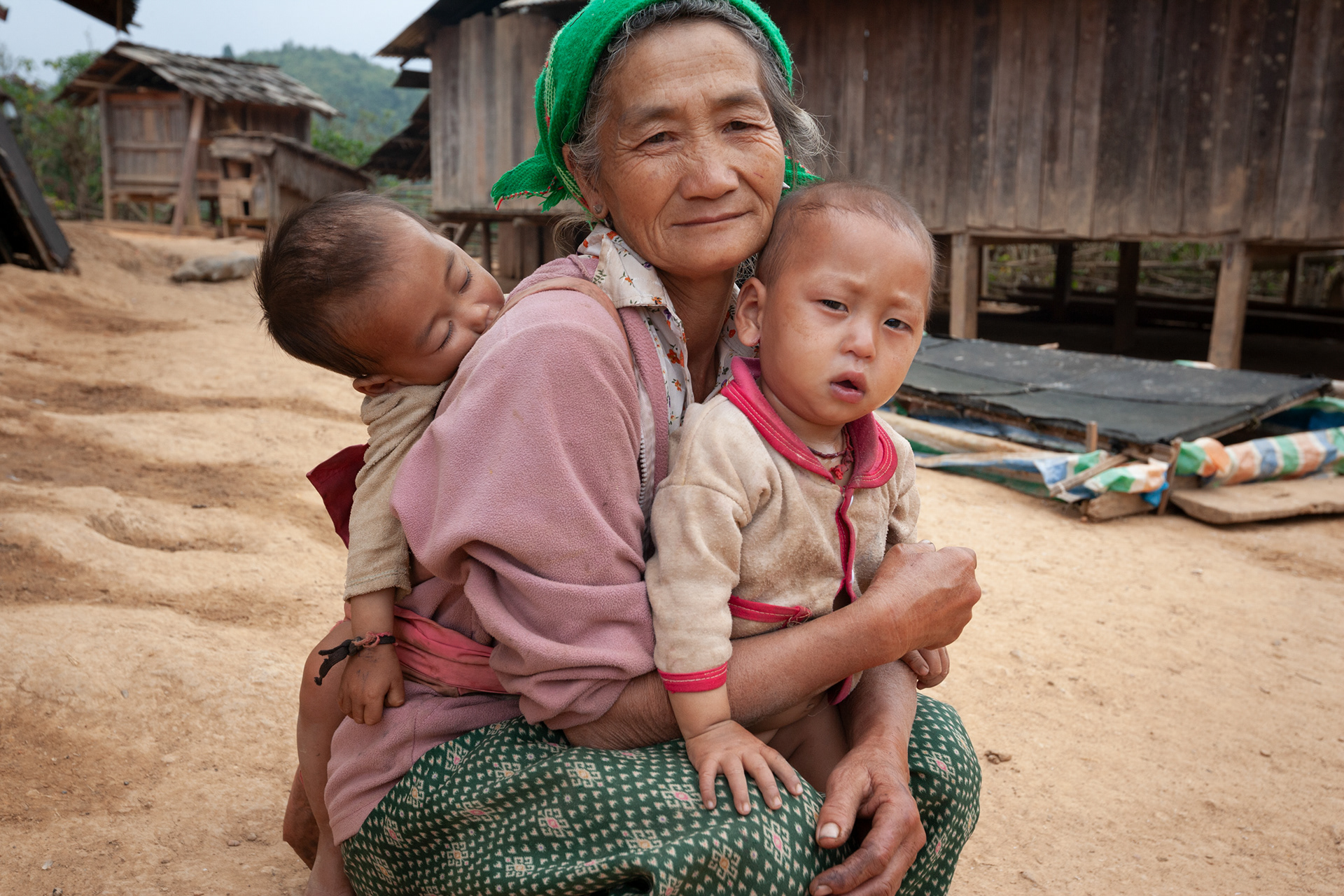
The pepper maker takes a break to babysit her grandchildren, November 13, 2007.
Ban Pha Keo-75
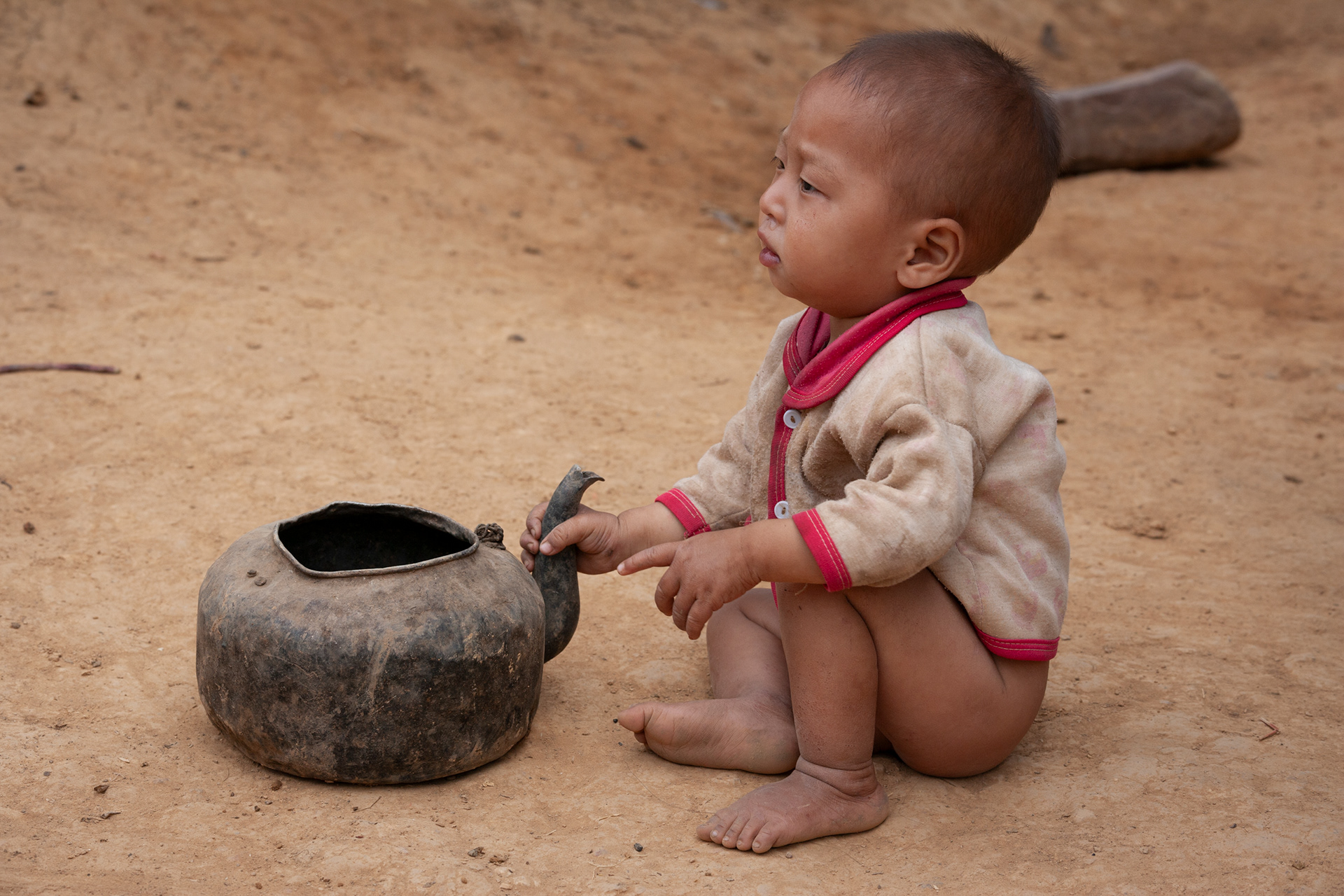
Hmong child playing with a very old metal teapot, November 13, 2007.
Ban Pha Keo-76
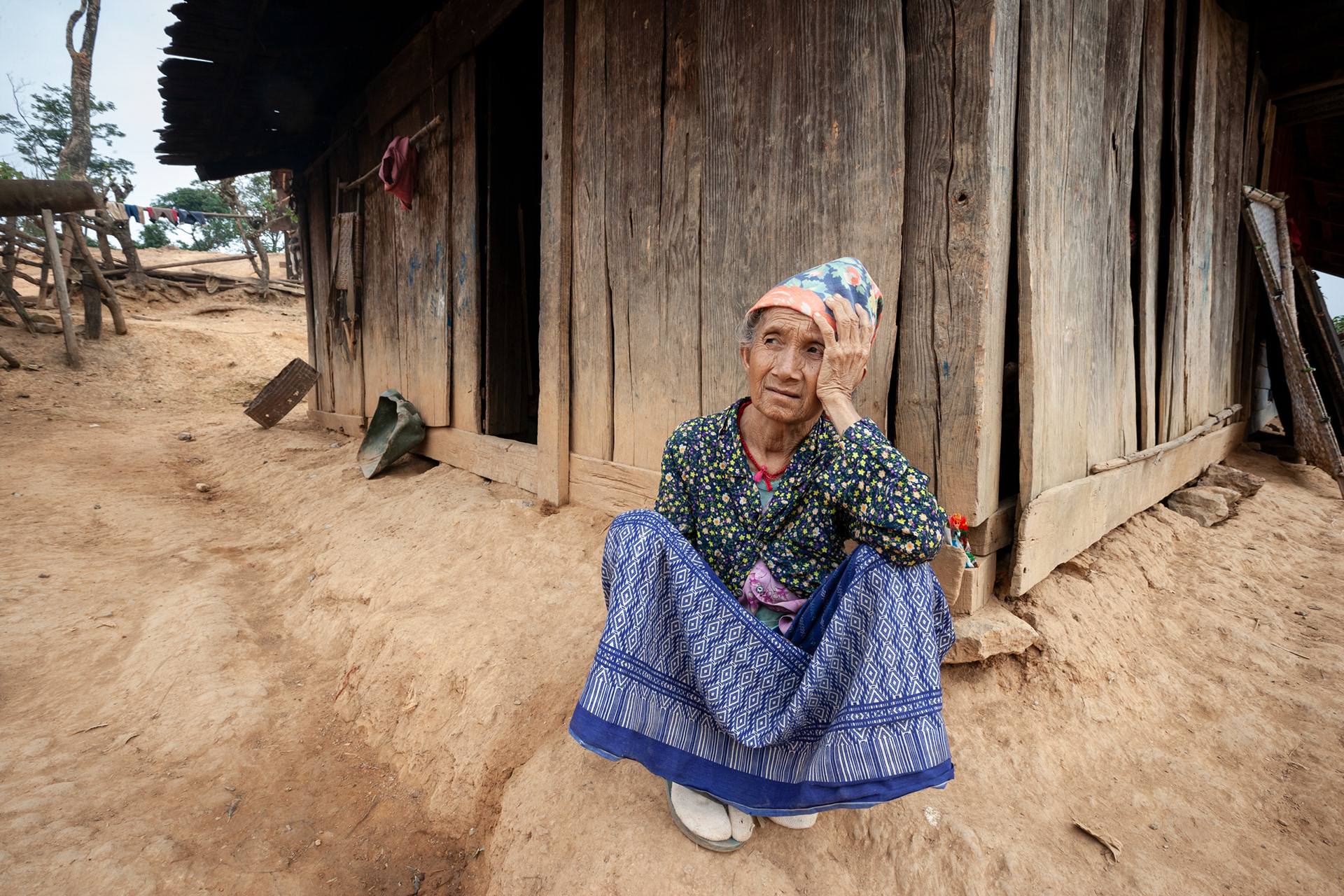
This village elder, the pepper maker’s mother looks old enough to have childhood memories of the Japanese occupation of Laos during WWII, November 13, 2007.
Ban Pha Keo-77
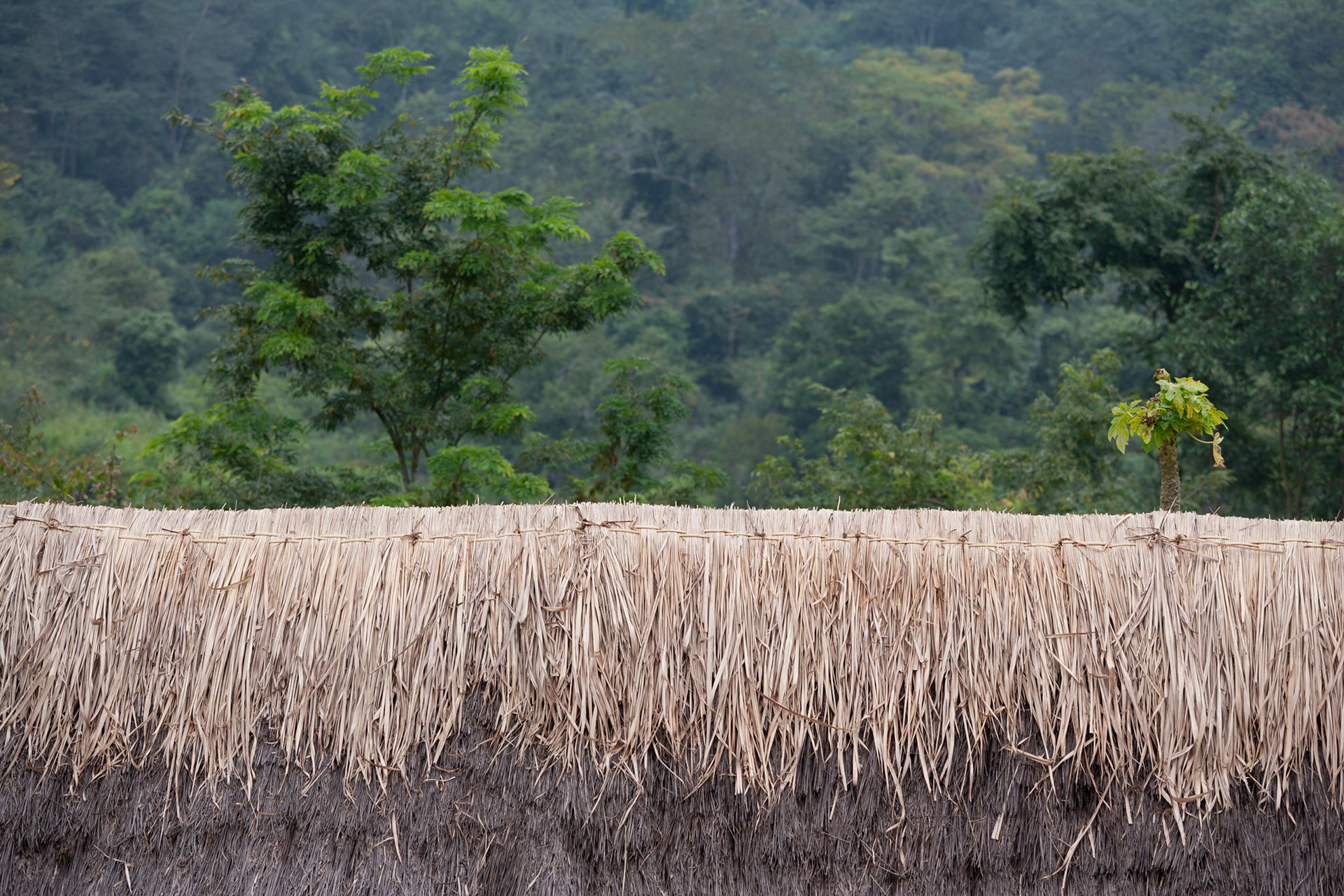
Closeup detail of Imperata grass, or “Alang Alang,” being used to patch a leaking thatch roof, November 13, 2007.
Ban Pha Keo-78
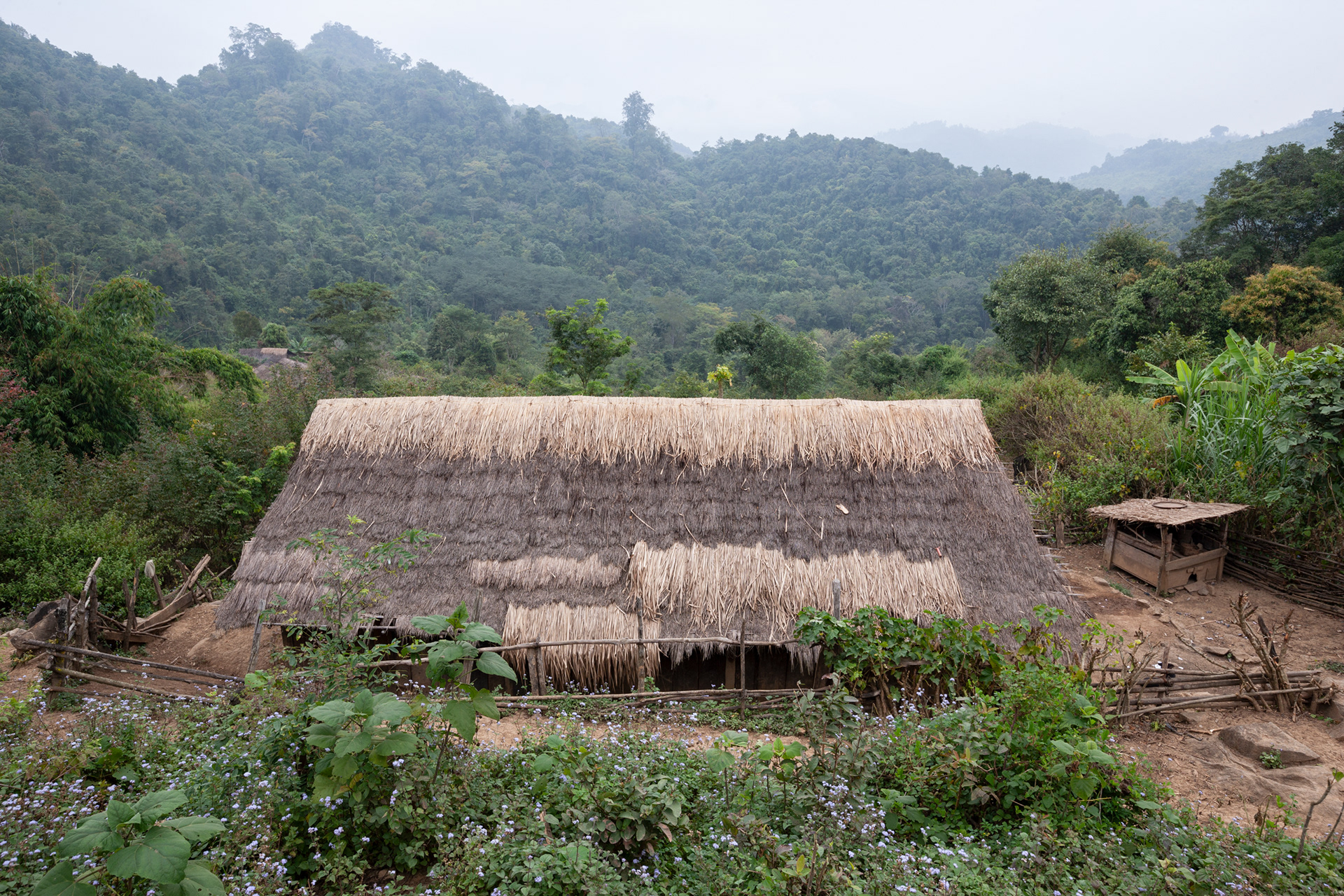
Wide view of Imperata grass, or “Alang Alang,” being used to patch a leaking thatch roof. A 2026 satelite view of Ban Pha Keo reveals that all of the traditional grass roofs in the village have been replaced with corrugated metal or wood. Photo: November 13, 2007.